eISSN: 2093-8462 http://jesk.or.kr
Open Access, Peer-reviewed

eISSN: 2093-8462 http://jesk.or.kr
Open Access, Peer-reviewed
Jong Hyun Kim
, Chang Gi Lee
, Eun Kyoung Woo
10.5143/JESK.2026.45.5.613 Epub 2026 November 08
Abstract
Objective: This study aims to develop and validate a facial image capture guideline for homogeneous facial image acquisition across application domains such as skin analysis, remote photoplethysmography (rPPG), and emotion analysis for care farming, by quantitatively examining whether captured images meet the guideline's face angle, illuminance, and image-resolution targets.
Background: Facial images are increasingly used for skin-condition analysis, rPPG-based physiological monitoring, and emotion inference in therapeutic interventions such as care farming, but these analyses are highly sensitive to capture conditions (angle, illuminance, resolution). Booth-type systems (e.g., VISIA) provide controlled capture but are costly and not widely accessible, whereas smartphone-based capture generally lacks standardized guidelines. The authors previously developed a facial image capture guideline and evaluated its illuminance and resolution criteria in a first-phase validation with 20 participants, but its face-angle criterion had not yet been examined.
Method: In the first-phase validation, illuminance was evaluated for 20 participants using an EXIF-based smartphone illuminance estimation method. In the second-phase validation, 99 front, right, and left facial images were captured from 33 participants (31 women, 2 men) recruited at cosmetics retail sites in Indonesia, using the front camera of a single smartphone model (Xiaomi Redmi Note 12) according to the developed guideline (target angles 0°/-30°/+30°). The yaw angle of each image was estimated using facial landmark detection (MediaPipe Face Landmarker) combined with a Perspective-n-Point (PnP) algorithm and a standard six-point 3D face model, and the mean estimated yaw for each pose was compared with its target angle using a one-sample t-test; image resolution was evaluated in the 33 front-view images.
Results: Mean estimated illuminance was 15.4 lux against a 15-lux target. For all three poses, no statistically significant difference from the guideline's target angle was observed, and the mean estimated yaw was close to the target (front: 0.34° vs. 0°, p=.650; right: -31.51° vs. -30°, p=.458; left: 32.40° vs. 30°, p=.286), although between-participant variability was larger for the side views (SD 11.6~12.7°) than for the front view (SD 4.2°). Image resolution met the guideline's minimum criterion (720×1,280 pixels) in 23 of the 33 participants (70%).
Conclusion: On average, the estimated illuminance and face angle were close to the guideline's targets, with no statistically significant difference from the target angles, suggesting that the guideline is applicable as a domain-agnostic facial image capture standard. However, individual variability in the achieved angle and a substantial minority of under-resolution captures indicate a need for tighter real-time capture tolerances in the mobile application.
Application: These findings can inform the refinement of mobile facial image capture applications, and the guideline is planned for use in a follow-up study that will acquire homogeneous facial images before and after care farming programs for rPPG-based assessment of their emotional healing effects.
Keywords
Facial image capture guideline Face angle estimation Remote photoplethysmography (rPPG) Care farming Smartphone
With recent improvements in smartphone camera performance and advances in computer vision and artificial intelligence, facial images have come to serve as core data across a range of fields beyond any single industry. In the beauty industry, services that analyze skin conditions such as skin tone, pore size, erythema, and wrinkles from facial images have become increasingly widespread (Amini et al., 2018; Arani et al., 2023; Burrow et al., 2024; Hashimoto and Kaneda, 2024). In healthcare, remote photoplethysmography (rPPG), which measures heart rate without contact from subtle color changes in facial skin (Poh et al., 2010), has been actively investigated, and its extension to heart-rate-variability analysis enables the monitoring of stress and emotional instability. Facial images have also been used to infer emotional state more directly, for example through thermal imaging, which captures emotion-related changes in facial skin temperature independently of ambient lighting conditions (Eom and Sohn, 2012). By contrast, the more widely accessible visible-light smartphone cameras used for rPPG and skin-condition analysis are directly susceptible to variations in illuminance and capture angle, underscoring the need for standardized capture conditions in these more common applications. Facial-image-based biosignal and emotion analysis can further be applied to quantitatively evaluate the emotional effects of nature- and agriculture-mediated therapeutic interventions such as care farming and forest therapy. Horticultural therapy programs, for instance, have been reported to reduce physiological stress indicators such as salivary cortisol (Han et al., 2018). Given that care farming and forest therapy are similarly nature-based interventions expected to yield comparable emotional and physiological benefits, facial-image-based contactless biosignal measurement may likewise offer a convenient means of quantifying such intervention effects.
However, these facial-image-based capture and analysis techniques, despite serving different purposes, share a common sensitivity to capture conditions and environmental variables. Because rPPG relies on extremely subtle temporal variations in the light reflected from the skin surface as its signal, signal quality is heavily influenced by changes in illuminance and capture angle; skin-condition and facial-expression-based emotion analyses are likewise affected by capture angle and image resolution, both of which influence the accuracy of feature-point extraction. In practice, many of the facial images used in such analyses are captured with users' own smartphones, without standardized capture guidance, under varying lighting, distance, and angle conditions. In other words, regardless of the intended application, a standardized capture methodology that yields homogeneous facial images irrespective of environmental variation is a prerequisite for ensuring the accuracy and reproducibility of analyses across these fields.
To date, the most representative attempts at capture standardization have been the booth-type skin measurement devices used in the beauty and dermatology fields. Products such as VISIA (Canfield Scientific, Inc.) and Zemits VeraFace (Zemits, Inc.) capture the subject's face from the front and from the left and right sides to collect data on pores, erythema, blemishes, wrinkles, acne, and other skin features. The correlation among measurements taken from the three capture perspectives (front, left, and right) has been reported to be high (Henseler, 2022), and because these products themselves provide a constrained, controlled capture environment, they offer the advantage of reliable evaluation results. However, in the absence of an absolute evaluation scale for the results, analysis by a trained evaluator is required, making self-diagnosis difficult for untrained users, and the size and cost of these devices limit their accessibility for widespread use. To overcome these drawbacks, research on facial image capture and analysis using smartphones has been actively pursued; however, compared with booth-type devices, such approaches lack standardized capture criteria, so that even similar services can yield results of low reliability owing to differing capture environments and criteria. Ensuring the reliability of mobile capture therefore requires providing standardized criteria, in the form of a guideline, for the conditions and environment that should be observed during capture, so that more accurate results can be obtained.
Accordingly, the present study aims to develop a general-purpose facial image capture guideline that is not limited to any specific application, and to verify whether its illuminance, resolution, and capture-angle criteria are achieved. Specifically, the objectives of this study are to (1) present a reproducible computational method for back-calculating the actual capture angle from a captured facial image, (2) apply this method to verify whether the capture angle and image resolution intended by the guideline are actually achieved, and (3) discuss the overall validity of the guideline by synthesizing these findings with the illuminance results obtained in the first-phase validation. In particular, the capture guideline examined in this study is planned for use as the underlying capture infrastructure for a follow-up study that will acquire homogeneous facial images of participants before and after their participation in care farming programs and apply rPPG-based heart-rate-variability analysis to quantitatively evaluate the emotional healing effects of care farming.
2.1 Literature review of capture guideline factors
Prior to developing the guideline, the literature and specifications of existing products involving whole-face capture by camera or measurement instrument were reviewed to examine precedents for standardizing facial image capture. Although most of the studies and products reviewed had been developed for skin-condition analysis, they were used as precedents informing the design of a general-purpose facial image capture guideline not limited to a specific analytical purpose, given that they represent attempts to standardize capture angle, illuminance, and resolution. The results of this review, focusing on lighting, capture angle, and image specifications, are summarized in Tables 1 and 2.
|
Author |
Research purpose |
Face angle |
Light source |
Image resolution, |
|
Hamer et al. |
Validation of image analysis
techniques |
Front, |
Indoor space without natural light |
2,452×2,056 pixels |
|
Jdid et al. |
Validation of digital photographic |
Front, side |
Two fixed 45° flashes (direct light, to avoid shadows) |
Max. 4,992×3,328 pixels,
Canon EOS-1 |
|
Zhang et al. |
Automated skin grading system for
men |
Front |
Outdoor daylight / indoor daylight
/ |
High-resolution |
|
Flament |
Automatic detection system for
severity |
Front |
Indoor artificial |
Smartphone |
|
Flament |
Accuracy of an automated algorithm- |
Front |
Example selfie images |
Smartphone |
|
Cho et al. |
Algorithm-based erythema diagnosis |
Front, side |
5,700K daylight-color light |
Max. 5,184×3,456 |
|
Bernhard |
Automated acne-severity model trained |
Front, side |
Ring light |
3,024×4,032 pixels |
|
Huynh et al. |
AcneDet: automatic acne-lesion |
Front, side |
~20cm distance; |
720×1,280 pixels |
|
Khavkin and |
Standardization of photographic |
Front (90°), |
Consistent artificial |
- |
|
Miyamoto |
Digital imaging system for quantitative |
Front, |
65° light angle, |
640×582 pixels, |
|
Product |
Face angle |
Image resolution, camera |
|
VISIA-CR |
Front, 37° (right/left) |
- |
|
VISIA 7th generation |
Front, 33° (right/left) |
- |
|
Colorface |
Front, 45° (right/left) |
- |
|
Janus Pro |
Front,
45° and 90° (right/left) |
Canon EOS 200D II / EOS
R-100, |
|
F-Ray |
Front, 60°/45°/30° (right/left) |
Canon EF, 22.1MP (5,760×3,840) |
|
Innovative facial skin analyzer
LineVu |
Front, 37° (right/left) |
Canon DSLR 100D, 18.0MP |
Among the six commercial products reviewed in Table 2, the lateral capture angle ranged from a minimum of 30° (F-Ray) to a maximum of 90° (Janus Pro); however, five of the six products (VISIA-CR, 37°; VISIA 7th generation, 33°; Colorface, 45°; Janus Pro's primary angle, 45°; LineVu, 37°) set their capture angle within the 33~45° range, indicating that this range is the most commonly adopted among commercial products. Some products supported multiple capture angles, with F-Ray offering three angles (30°/45°/60°) and Janus Pro offering two (45° and 90°).
As shown above, whereas relatively clear criteria were provided for face capture angle, along with guidance on capture equipment and image resolution, no clear criterion was provided for lighting conditions; most sources simply specified capture under general indoor lighting. However, because illuminance conditions can vary even under general indoor lighting depending on the environment, Korean and international indoor illuminance standards were reviewed and summarized in Table 3.
|
Standard |
Place |
Min. |
Recommended |
Max. |
|
|
Korea (KS A 3011) |
Residential |
General |
15 |
20 |
30 |
|
Entrance
shoe cabinet, display |
150 |
200 |
300 |
||
|
Entrance, general |
60 |
100 |
150 |
||
|
Office |
Lobby, reception, lounge |
60 |
100 |
150 |
|
|
Meeting room |
150 |
200 |
300 |
||
|
Japan (JIS Z 9110) |
Residential |
Reading, cooking |
- |
150 |
- |
|
Other |
- |
70 |
- |
||
|
Design, accounting |
- |
700 |
- |
||
|
Office |
Meeting room |
- |
500 |
- |
|
|
General administration |
- |
300 |
- |
||
|
ISO 8995 |
Common |
Entrance hall |
- |
100 |
- |
|
Lounge |
- |
100 |
- |
||
|
Dining/meeting |
Reception, desk |
- |
300 |
- |
|
|
Meeting room |
- |
300 |
- |
||
|
EU (EN 12464-1) |
Office |
Conference and meeting rooms |
- |
500 |
- |
|
Writing,
typing, reading, |
- |
500 |
- |
||
As indicated by these standards, residential spaces are generally recommended to have illuminance of at least 15 lux, ranging up to 300 lux depending on the specific space, while office spaces are recommended to have illuminance ranging from a minimum of 60 lux to a maximum of 300 lux, with general ambient lighting typically specified at up to 150 lux. Spaces requiring detailed work, such as document handling, are recommended to have a minimum of 300 lux and an average of 500 lux, whereas everyday spaces are recommended to have lower illuminance levels.
2.2 Guideline target criteria based on the literature review
Target criteria for each element of the facial image capture guideline were derived by synthesizing the literature reviewed above.
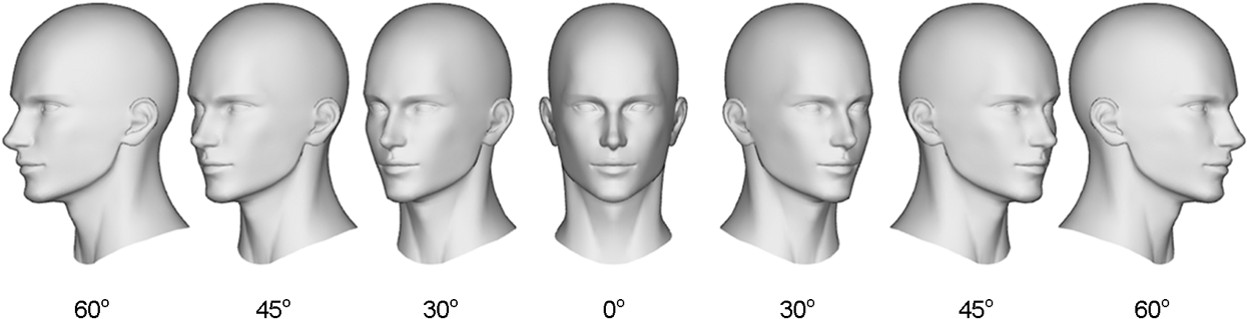
Face angle: Most of the reviewed studies captured and analyzed the subject's frontal face together with the left and right sides of the face, and some restricted the capture angle to 45°. Among the six products reviewed, lateral capture angles ranging from 30° to 90° were used; however, excluding Janus Pro's near-full-profile angle of 90°, capture angles were predominantly concentrated within the 33~45° range. Although capture is generally performed at approximately 45°, providing the guideline as a range with minimum and maximum values rather than strictly constraining it to a single angle was judged to be more advantageous for user convenience; the target criterion for lateral face capture angle was accordingly set at 30~45° (Figure 1).
Lighting environment and light source: Most of the reviewed studies used a controlled indoor environment with artificial lighting, because direct natural light could affect measurement results. Korean standards recommend 15~30 lux for general residential lighting, whereas Japanese and international standards recommend illuminance of 100 lux or below for general and common areas, with levels above 100 lux generally recommended only for document handling and other detailed work. Reflecting the common practice among the reviewed studies of controlling lighting to avoid facial shadows, the target criterion was set as general indoor lighting of 15~100 lux that does not cast high-contrast shadows on the face. This illuminance criterion directly affects the reliability of analysis techniques such as rPPG, which rely on subtle changes in skin-reflected light as their signal, making it an important criterion not only for skin-condition analysis but also for multipurpose facial image applications in general.
Image resolution: The reviewed studies used high-resolution cameras such as smartphones or DSLRs as their capture devices, and many required a minimum smartphone specification of 5 MP. Because 5 MP represents the minimum performance level of early-2010s smartphones, and most smartphones currently on the market exceed this specification, the criterion was defined by the resolution of the captured image rather than by camera specifications. The minimum image resolution was set at 720×1,280 pixels, taking into account both the mobile capture environment and the time elapsed since Miyamoto et al. (2002), which used the lowest resolution among the reviewed studies (640×582 pixels). Because facial image analysis results can vary with capture distance, a capture-distance instruction was also included in the guideline.
The target criteria of the facial image capture guideline, synthesized from the literature review above, are presented in Table 4.
|
|
Face angle |
Level of illuminance |
Image resolution |
|
Target |
Front (0°), 30~45° right/left |
General lighting source
(15~100 lx) |
Minimum 720×1,280 pixels |
2.3 Guideline-applied capture service development
Reflecting the derived target criteria, a mobile facial image capture-and-analysis service was developed (Woo et al., 2024). Although this service was initially designed for skin-condition analysis in the beauty industry, measuring eight skin-symptom elements (wrinkles, acne, pigmentation, dark circles, hydration, sebum, pores, and skin texture), the capture procedure itself (the angle, illuminance, and resolution criteria) was designed as general-purpose infrastructure independent of any specific analytical purpose, and can equally be applied to other facial-image-based applications such as rPPG-based biosignal measurement and emotion analysis. Face capture angle was divided into three views: front, right, and left. Two guideline display formats were compared: a contour-type format displaying the facial outline and a mesh-type format dividing the facial surface into two to five sub-regions. The mesh-type guideline was adopted because it proved more advantageous for region-specific analysis.
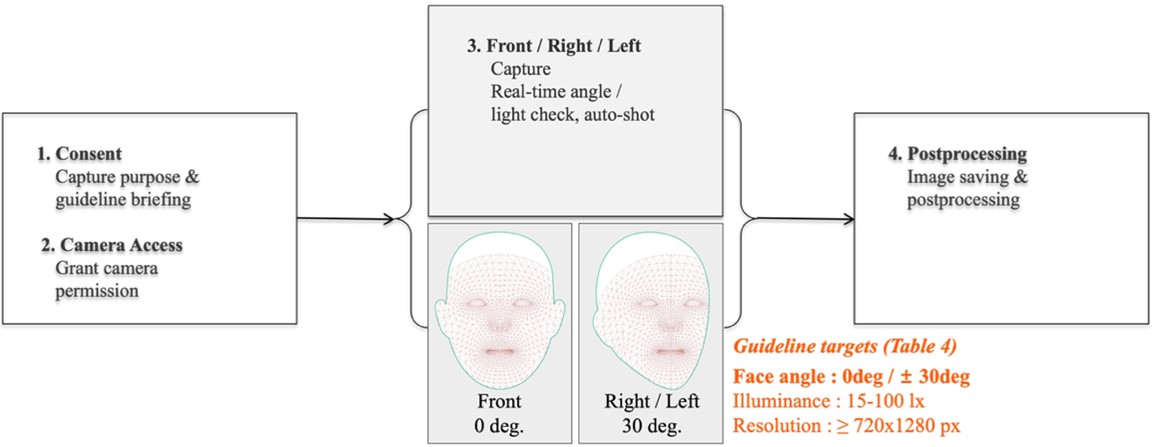
The capture procedure of the developed application, together with the numeric targets (Table 4) recognized and applied in real time at each step, is shown in Figure 2. The capture procedure consists of four steps: (1) capture consent and guideline briefing, (2) granting of camera access permission, (3) automatic capture following real-time recognition of the target angle, illuminance, and resolution, in the order front, right, and left, and (4) image postprocessing (Kim et al., 2025b). For the lateral views, the application used 30°, the lower bound of the guideline's 30~45° range, as its capture target (Figure 2); accordingly, the face-angle validation used target angles of 0° for the front view and ±30° for the lateral views.
2.4 Guideline validation method
2.4.1 Participants and apparatus
Validation of the developed guideline was conducted in two phases. The first-phase validation, targeting the illuminance criterion, was conducted as an environmental validation using data from 20 participants who consented only to the measurement of the capture environment (brightness) and not to the use of the facial images themselves. The second-phase validation, targeting the capture-angle and image-resolution criteria, used data from 33 participants (31 women, 2 men) recruited from customers visiting cosmetics retail sites in Indonesia (Unnis and K-Style Hub Inc.). Each participant was briefed on the purpose of the facial image capture guideline application and consented to the use of the captured data after conversion into a non-identifiable form. Local data collection was conducted with the cooperation of Universitas Multimedia Nusantara (UMN). The images of both samples were captured with the front camera of the same smartphone model (Xiaomi Redmi Note 12, model number 23021RAA2Y) through the application incorporating the facial image capture guideline; for the second-phase validation sample, a total of 99 facial photographs (front, right, and left views; de-identified images) were collected and used jointly for the capture-angle and image-resolution validations.
2.4.2 Illuminance verification
The illuminance of the captured facial images was calculated for the first-phase validation sample (n=20) based on the method of Salmerón-Campillo et al. (2021), which estimates illuminance by combining the smartphone camera's EXIF exposure information (aperture value f, shutter speed t, and ISO sensitivity; ISO 2720:1974) with the mean image brightness. An image-specific calibration constant, k'ᵢ = E₀ × tᵢ / (Ymᵢ × fᵢ²) (with E₀ assumed to equal the target illuminance of 15 lux), was calculated for each image, and the mean calibration constant across the 20 images (k'_avg) was used to back-calculate the facial illuminance of each image, Efᵢ = k'_avg × Ymᵢ × fᵢ² / tᵢ. Here, Ymᵢ denotes the mean brightness (0~255) of the region of interest (the face), measured using ImageJ. Because this study did not use a separate lux meter, the guideline's target illuminance was used for E₀ in place of an empirically measured value; the resulting illuminance values should therefore be interpreted as approximate estimates rather than absolute measurements.
2.4.3 Face angle verification
The problem of back-calculating a three-dimensional rotation angle from a single 2D facial image is referred to in the computer vision literature as head pose estimation, and is broadly classified into geometric methods that exploit the correspondence between facial landmarks and a standard three-dimensional face model (Perspective-n-Point, PnP) and appearance-based regression methods that estimate pose directly from the image (Murphy-Chutorian and Trivedi, 2009), the latter now predominantly implemented with deep learning (Ruiz et al., 2018). The present study adopted the PnP-based geometric approach, as its computational procedure is transparent and reproducible and it is a standard approach reported in the literature for pose estimation in the absence of camera calibration information.
First, the 2D pixel coordinates of six facial landmarks (the nose tip, chin, left and right eye corners, and left and right mouth corners) were extracted using MediaPipe Face Landmarker, which provides a 468-point three-dimensional facial mesh (Kartynnik et al., 2019). This six-point configuration is identical to the standard six-point model widely used in classical dlib 68-landmark-based head-pose estimation, and also corresponds to the minimum number of points required, for a non-planar point configuration, by the initial-estimate algorithm within solvePnP described below.
Next, the six 2D landmarks and the corresponding points of a generic three-dimensional face model (with the nose tip as the origin; standard values reported in the literature) were input into the solvePnP function of OpenCV (Bradski, 2000) to obtain the rotation and translation of the face relative to the camera. This constitutes a Perspective-n-Point (PnP) problem, in which the pose (rotation and translation) of an object relative to the camera is back-calculated from the correspondence between n points in three dimensions and their two-dimensional projected coordinates; the minimal case of this problem (n=3, P3P) was formalized in the computer vision literature by Fischler and Bolles (1981). With its default setting (SOLVEPNP_ITERATIVE), solvePnP solves this problem in two stages. First, an approximate initial pose is obtained via a linear equation (Direct Linear Transform, DLT) that disregards the orthonormality constraint on the rotation matrix; the pose estimate is then iteratively refined through Levenberg–Marquardt optimization, which minimizes the sum of squared reprojection errors, that is, the differences between the 2D projections of the 3D model points under the current pose estimate and the measured 2D landmark coordinates. Such iterative refinement is a well-established approach to accurate pose estimation (Lu et al., 2000). OpenCV also provides non-iterative alternative algorithms with lower computational cost, such as EPnP (Lepetit et al., 2009); the present study, however, used the default method, which explicitly minimizes reprojection error. The resulting rotation vector was converted to a rotation matrix via the Rodrigues transformation, and the rotation matrix was further decomposed into Euler angles (yaw, pitch, and roll) via RQ decomposition. Because the intrinsic camera parameters (e.g., focal length) of the smartphone used for capture were unavailable, the focal length was approximated as the image width, the principal point as the image center, and the lens distortion coefficients as zero, following the standard pinhole camera model (Zhang, 2000). This approximation is commonly used for single-image pose estimation in the absence of camera calibration information.
The six-point 3D face model used in this study (Figure 3) is not derived from measurements of individual participants but is a generic model reflecting the average proportions observed across many faces, applied identically to every image. This use of an averaged 3D face shape for pose estimation is widely adopted in the related literature. Zhang et al. (2019), for example, used a generic 3D model obtained by averaging the face shapes of all their participants directly in the head-pose-estimation stage of a gaze-estimation pipeline, and Ruiz et al. (2018) quantitatively examined how yaw, pitch, and roll estimates change when different average 3D face models are used, thereby empirically characterizing the error introduced by the use of an average model. The rationale shared by these studies is that facial rotation-angle estimation relies primarily not on the absolute millimeter-scale position of each landmark, but on a qualitative depth ordering, broadly common across individuals, in which the nose is the most forward-projecting point while the eye and mouth corners are relatively set back, together with bilateral symmetry. Consequently, rotation-angle estimation remains relatively stable across individual variation in face shape, so long as this qualitative ordering itself is not reversed. This does not imply, however, that the generic model guarantees absolute accuracy; a limitation remains in that estimation error can increase as an individual's actual facial proportions diverge further from the average model. Given that the purpose of this study is not to precisely measure the absolute anatomical rotation angle of individual participants, but rather to examine, using a standardized measurement tool applied identically to every image, how closely the mean capture angle at the group level approaches the guideline's intended target angle, this approximation constitutes a methodological choice appropriate to the study's objective.
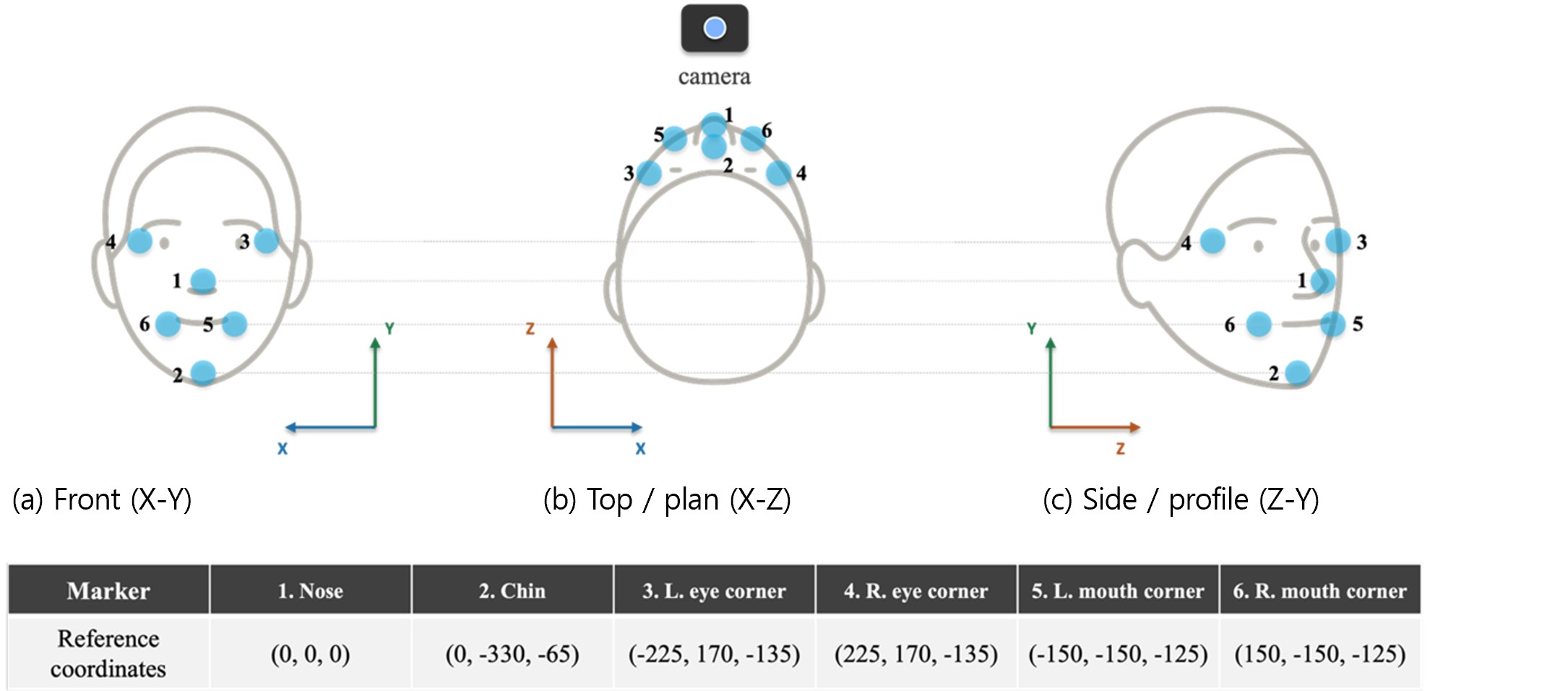
In this computation, the only value actually "measured" anew from each photograph is the set of 2D pixel coordinates of the six landmarks; the remaining inputs (the 3D face model coordinates and the camera parameters) are fixed assumptions applied identically to every image. In other words, this method does not reconstruct each participant's actual three-dimensional facial shape from the photograph, but instead solves the inverse optimization problem of determining the rotation state in which this fixed, standard three-dimensional model, viewed through this approximated camera, best matches the measured 2D coordinates.
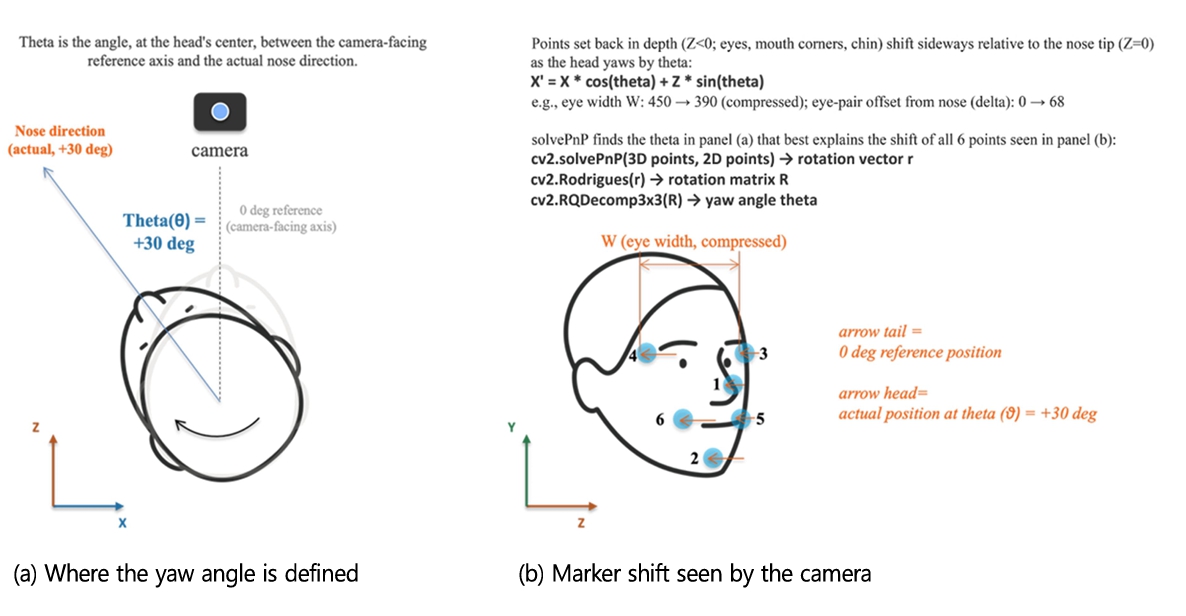
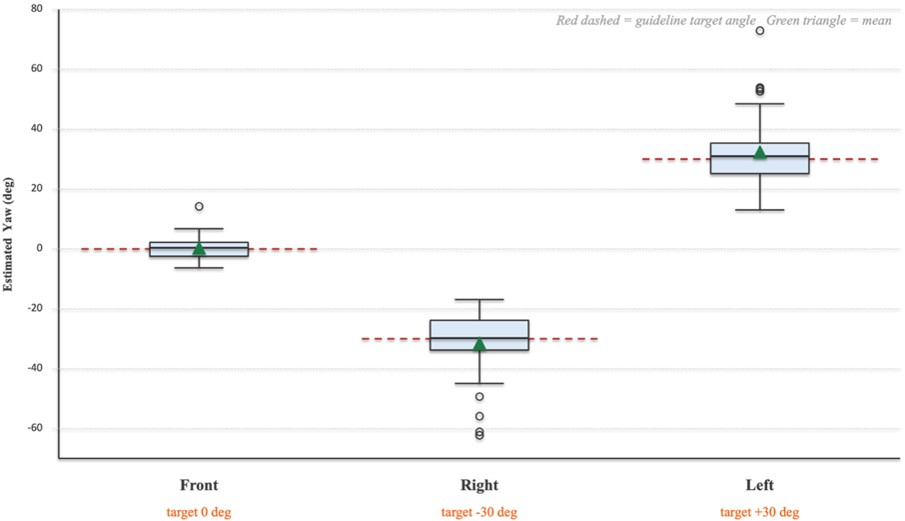
The geometric basis of this yaw estimation is illustrated in Figure 4. Among the six landmarks, the nose tip is defined as the origin of the 3D model (Z=0), whereas the remaining five points (chin, left and right eye corners, and left and right mouth corners) are located behind the nose tip (Z<0). As the head rotates left or right (yaw), the nose tip, located at the origin, moves relatively little, whereas the points located further back shift laterally as a function of the rotation angle (X' = X cosθ + Z sinθ). For example, a 30° leftward rotation narrows the distance between the left and right eye corners (perspective foreshortening) and shifts the center of the eye and mouth points to one side relative to the nose tip (offset). The solvePnP function back-calculates this rotation by finding the three-dimensional rotation matrix R that best explains the 2D displacement pattern observed simultaneously across all six points; the sign of the resulting yaw angle was adjusted to match the guideline's convention (left = +, right = –). This sign correspondence was verified visually using landmark-and-rotation-axis overlays on a small subset of the sample.
For each pose group (front, right, and left), the mean, standard deviation, and 95% confidence interval of the estimated yaw angle were calculated, and a one-sample t-test (α = .05) was conducted to examine whether the mean estimated yaw angle differed from the corresponding target angle (0°, -30°, and +30°).
2.4.4 Image resolution verification
The actual pixel resolution (width × height) was extracted from the frontal images of the second-phase validation sample (n=33) to determine whether the guideline's target resolution (minimum 720×1,280 pixels) was met.
The guideline validation results are presented in the order of the first-phase validation (illuminance) and the second-phase validation (face capture angle and captured image resolution).
3.1 Illuminance validation (first-phase validation)
Analysis of illuminance for the 20-participant first-phase validation sample showed a mean estimated facial illuminance of 15.4 lux, calculated using the method of Salmerón-Campillo et al. (2021), which was close to the target illuminance of 15 lux. Individual values ranged from 11.4 to 19.7 lux (Table 5).
|
No. |
f |
t (s) |
Avg. brightness (Ym) |
k′ᵢ |
Ef (lux) |
|
1 |
2.4 |
0.033 |
110.78 |
0.000784 |
18.69 |
|
2 |
2.4 |
0.033 |
106.63 |
0.000814 |
17.99 |
|
3 |
2.4 |
0.050 |
107.25 |
0.001214 |
12.06 |
|
4 |
2.4 |
0.050 |
100.91 |
0.001290 |
11.35 |
|
5 |
2.4 |
0.033 |
112.50 |
0.000772 |
18.98 |
|
… |
… |
… |
… |
… |
… |
|
20 |
2 |
0.030 |
109.94 |
0.001034 |
14.17 |
3.2 Face angle validation (second-phase validation)
Landmark detection and pose estimation succeeded for all 99 images of the second-phase validation sample (n=33; detection success rate 100%). The mean, standard deviation, and 95% confidence interval of the estimated yaw angle for each pose group (front, right, and left), together with the results of one-sample t-tests against the target angle, are presented in Table 6.
|
Pose |
Target (°) |
n |
Mean yaw (°) |
SD (°) |
95% CI |
t |
p |
|
Front |
0 |
33 |
0.34 |
4.23 |
[-1.16, 1.84] |
0.458 |
0.650 |
|
Right |
-30 |
33 |
-31.51 |
11.56 |
[-35.61, -27.41] |
-0.751 |
0.458 |
|
Left |
30 |
33 |
32.40 |
12.68 |
[27.90, 36.90] |
1.086 |
0.286 |
For all three pose groups, no statistically significant difference was observed between the mean estimated yaw angle and the target angle (all p > .05), and the mean estimates were close to the intended targets (0°/±30°), differing from them by 0.34°, 1.51°, and 2.40° for the front, right, and left poses, respectively. For all three poses, the 95% confidence interval of the mean estimated yaw fell within ±7° of the target angle (Table 6). However, the standard deviation of the right- and left-rotation groups (11.6° and 12.7°, respectively) was markedly larger than that of the front group (4.2°; Figure 5). Some individual cases deviated from the target angle by 20° or more (e.g., measured yaw of +72.9° against a target of +30°, and -62.2° against a target of -30°). Visual inspection of the original images for these cases confirmed that the deviations reflected genuine over-rotation (capture at a near-full profile angle exposing the entire ear) rather than landmark misdetection.
3.3 Image resolution validation (second-phase validation)
Examination of the actual resolution of the frontal images from the second-phase validation sample (n=33) showed that 23 of 33 cases (70%) met the target resolution (minimum 720×1,280 pixels; Table 7). The remaining 10 cases were captured at a resolution below the minimum criterion (e.g., 700×933 and 709×945 pixels). This contrasts with the first-phase validation (N=20), in which all participants (20/20) met the criterion, suggesting that resolution can fall below the target under real-world variation in capture conditions such as capture distance and automatic cropping logic.
|
No. |
Resolution (px) |
Match |
No. |
Resolution (px) |
Match |
|
1 |
975×1,301 |
o |
18 |
1,334×1,779 |
o |
|
2 |
767×1,022 |
x |
19 |
1,356×1,808 |
o |
|
3 |
833×1,111 |
x |
20 |
1,421×1,894 |
o |
|
4 |
972×1,296 |
o |
21 |
1,262×1,683 |
o |
|
5 |
1,023×1,364 |
o |
22 |
1,564×2,086 |
o |
|
6 |
771×1,028 |
x |
23 |
1,484×1,978 |
o |
|
7 |
810×1,080 |
x |
24 |
1,329×1,772 |
o |
|
8 |
761×1,014 |
x |
25 |
1,316×1,755 |
o |
|
9 |
700×933 |
x |
26 |
1,403×1,870 |
o |
|
10 |
762×1,017 |
x |
27 |
1,225×1,633 |
o |
|
11 |
709×945 |
x |
28 |
1,224×1,632 |
o |
|
12 |
750×1,000 |
x |
29 |
1,436×1,914 |
o |
|
13 |
811×1,082 |
x |
30 |
1,518×2,023 |
o |
|
14 |
1,014×1,352 |
o |
31 |
1,561×2,081 |
o |
|
15 |
1,331×1,774 |
o |
32 |
1,348×1,797 |
o |
|
16 |
1,400×1,866 |
o |
33 |
1,238×1,651 |
o |
|
17 |
1,174×1,565 |
o |
|
|
|
This study examined, on the basis of actual capture data, three key elements of a capture guideline (illuminance, capture angle, and image resolution) that are commonly required for multipurpose facial image measurement, analysis, and use across beauty, healthcare, and care farming applications. On average, the estimated illuminance and capture angle were close to their respective target values, and no statistically significant difference from the target angle was observed for any pose. These results suggest that the developed guideline can yield capture conditions close to its intended targets on average and that the literature-derived target criteria are applicable under real mobile capture environments, including an overseas field environment not directly controlled by the Korean research team.
However, individual variability in capture angle was markedly greater for the left- and right-rotation poses (SD 11.6~12.7°) than for the front pose (SD 4.2°). Some participants exceeded the target angle by up to approximately 43° through over-rotation, suggesting that the application's current real-time auto-capture trigger (automatic capture within 3~5s of angle recognition) may not have captured the moment the target angle was reached with sufficient precision. Given that the mean deviations were small for both the left (+2.40°) and right (-1.51°) rotations, there appears to be little need to revise the target angles themselves; rather, improving the application logic, for example by narrowing the tolerance of the real-time recognition stage or extending the hold time after the target angle is reached, would likely be more effective. Considering applications such as rPPG that are particularly sensitive to changes in capture angle, such precision improvements are directly relevant to ensuring the reliability not only of skin-condition analysis but also of biosignal and emotion analysis.
In the image resolution validation, the frontal images of 10 of the 33 participants (30%) fell short of the target resolution, a result that contrasts with the first-phase validation (N=20, all participants met the criterion) despite the use of the same guideline and the same device model. Unlike the first-phase validation, which was conducted on a small, controlled sample, the second-phase data were collected in an actual retail setting with various photographers and under varied conditions, which may account for the difference between the two samples; this indicates a need to pay closer attention to managing variability in capture conditions during real-world deployment, rather than to the guideline's target criteria themselves. Future research should directly examine the relationship between capture distance and image resolution.
This study has the following limitations. First, the PnP algorithm used for angle estimation approximated the intrinsic camera parameters (e.g., focal length) using the image width; although this approximation is commonly used for single-image pose estimation without calibration information, it may introduce error due to wide-angle distortion arising from the close-range capture specified by the guideline. Second, because the illuminance formula substituted the guideline's target illuminance (15 lux) for the calibration reference in place of an actual lux-meter measurement, the resulting illuminance values should be interpreted as approximations rather than absolute measurements. Third, the sex ratio of the second-phase validation sample was imbalanced (31 women and 2 men among the 33 participants), and further validation is needed given that two samples from different countries and cultural contexts (Korean vs. Indonesian) were synthesized as joint evidence for the guideline's applicability when interpreting the results. Fourth, the one-sample t-tests examined whether the mean estimated angle differed from the target angle; the non-significant results therefore indicate the absence of a detectable difference rather than equivalence to the target, and future studies should apply an equivalence test, such as the two one-sided tests (TOST) procedure, with a tolerance margin specified in advance. Future research should also validate all three elements simultaneously within the same sample and capture environment, compare the PnP-estimated angles with reference angles set using a goniometer or a fixed rotation device, and improve the generalizability of the results through empirical calibration using a lux meter and through balanced samples across a range of device models, sexes, and countries.
To enable the acquisition of homogeneous facial images regardless of application, whether in beauty (skin-condition analysis), healthcare (rPPG-based biosignal analysis), or emotional and therapeutic domains such as care farming, this study developed a facial image capture guideline and examined the applicability of its key elements (illuminance, capture angle, and image resolution) using actual capture data. To this end, a reproducible computational procedure was presented that combines facial landmark detection with the Perspective-n-Point (PnP) algorithm to back-calculate the actual rotation angle from a captured 2D facial image alone. This procedure was applied to a sample of 33 participants (99 images) collected in Indonesia in the second-phase validation, and its results were synthesized with the illuminance validation results obtained from the 20-participant first-phase validation sample, thereby completing a line of research from guideline development (Woo et al., 2024) to empirical validation.
The results showed that, on average, the estimated illuminance and capture angle were close to the guideline's intended target values (15 lux, 0°/±30°), with no statistically significant difference from the target angles; this has academic significance in that it provides empirical support for the applicability of a literature-based guideline even in an overseas field capture environment not directly controlled by the research team. At the same time, the individual variability in capture angle and the instances of under-resolution observed in the second-phase validation sample have practical significance, indicating that improving the precision of the real-time capture-assist logic (tolerance, auto-capture trigger, distance guidance, etc.) would contribute more to service quality than revising the guideline's target criteria themselves.
The results and methodology of this study can be applied as follows. First, the target criteria examined in this study and the identified directions for improvement can be directly incorporated into the UI/UX and automatic capture logic of the mobile facial image capture service currently under development, consistent with usability-evaluation-based guideline development approaches applied to other mobile health applications (Kim et al., 2025a). Second, the facial-landmark- and PnP-based capture-angle validation methodology presented in this study is not limited to any specific service or guideline, and can be extended as a general-purpose quality-assurance (QA) tool for quantitatively verifying compliance with capture protocols across mobile applications that capture and analyze facial images. Third, as noted in the Introduction, this guideline is planned for actual application as the capture infrastructure for homogeneously acquiring facial images of participants before and after their participation in care farming programs, with the acquired images to be used for rPPG-based heart-rate-variability analysis to quantitatively evaluate the emotional healing effects of care farming.
Furthermore, the validation framework developed in this study is expected to be extensible to a range of healthcare, emotion-analysis, and therapeutic rehabilitation services that rely on facial images. Addressing the limitations noted above, particularly through the joint validation of illuminance, angle, and resolution within the same sample and capture environment, will further strengthen the generalizability of the guideline.
References
1. Amini, M., Vasefi, F., Valdebran, M., Huang, K., Zhang, H., Kemp, W. and MacKinnon, N.B., Automated facial acne assessment from smartphone images, Proceedings of SPIE, 10497, 82-92, 2018. doi:10.1117/12.2292506
Google Scholar
PIDS App ServiceClick here!
