eISSN: 2093-8462 http://jesk.or.kr
Open Access, Peer-reviewed

eISSN: 2093-8462 http://jesk.or.kr
Open Access, Peer-reviewed
Jong Hyun Kim
, Chang Gi Lee
, Eun Kyoung Woo
10.5143/JESK.2026.45.5.563 Epub 2026 November 08
Abstract
Objective: The aim of this study is to identify pain points in the collaborative transport process between a disinfection service robot and its worker using the service blueprinting technique, and to compare and evaluate three transport method alternatives proposed in light of these pain points (a fixed handle, a mobile cart, and detachable wheels), using a usability evaluation framework that assembles conventional product-user criteria with two exploratory criteria selected to reflect the robot-worker collaboration perspective (Ergonomics/ Comfort and Reliability), in order to derive an evidence-based direction for improving the field usability of the robot's transport method.
Background: As service robots and collaborative robots (cobots) become central to manufacturing and service industries, and as the emerging Physical AI paradigm envisions robots that perceive, reason, and act as real-time collaboration partners for human workers, the quality of worker-robot collaboration is becoming a key determinant of robot commercialization. However, conventional usability evaluation tools such as ISO 9241-11, the System Usability Scale (SUS), and Nielsen's usability heuristics have largely been developed and studied from a product-user perspective, and evaluation criteria that reflect the collaborative robot-worker relationship remain underdeveloped. The practical value of a collaborative disinfection service robot is determined not only by its disinfection performance but also by how easily and safely workers can transport and prepare it across multiple work sites, yet the usability of robot transport, an inherently collaborative physical task and a recurring pain point for workers in the field, has rarely been examined as systematically as robot navigation or manipulation functions.
Method: Based on a customer journey map and service blueprinting analysis of the worker-robot collaboration scenario in the disinfection work process, three pain points were identified in the robot transport stage, and three transport method prototypes were developed to address them without altering the existing robot structure: Type A (Handle), Type B (Mobile Cart), and Type C (Detachable Wheels). A 15-item usability questionnaire was assembled by selecting four conventional product-user usability criteria derived from ISO 9241-11 and the System Usability Scale (SUS), namely Effectiveness, Efficiency, Satisfaction, and Learnability, and two additional criteria reflecting the robot-worker collaborative relationship, namely Ergonomics/Comfort and Reliability. A usability evaluation using this instrument was conducted with ten professionals from the disinfection industry, who performed a standardized 3-meter transport task (attachment-movement-detachment) with each of the three transport methods in randomized order. Given the small sample and the ordinal response format, the collected data were analyzed using the Friedman test with Holm-corrected Wilcoxon signed-rank post-hoc comparisons (α = .05).
Results: The handle-type transport method (Type A) received the highest overall usability score (M = 4.43, SD = 0.19), followed by the mobile cart (Type B, M = 4.06, SD = 0.18) and the detachable wheels (Type C, M = 3.94, SD = 0.14). This overall difference was statistically significant (Friedman χ2(2) = 13.40, p = .001, Kendall's W = .670), and Holm-corrected Wilcoxon signed-rank comparisons showed that Type A scored significantly higher than both Type B and Type C (both p = .015). At the criterion level, significant differences among the three types were found for Effectiveness (χ2(2) = 7.09, p = .029), Efficiency (χ2(2) = 10.72, p = .005), Learnability (χ2(2) = 15.06, p < .001), and Reliability (χ2(2) = 7.72, p = .021). Type A was rated significantly higher than both alternatives on Efficiency and Learnability, whereas for Effectiveness and Reliability it received the highest mean but no pairwise difference remained significant after Holm correction. No significant differences among the three types were found for Satisfaction (χ2(2) = 0.06, p = .972) or Ergonomics/Comfort (χ²(2) = 3.49, p = .175).
Conclusion: Under the tested short-distance, single-trial condition, the handle-type transport method provided the highest overall usability and was significantly more efficient and easier to learn than the other two alternatives for transporting the 25kg robot, while emotional and physical comfort did not differentiate among the three design alternatives. Because Ergonomics/Comfort showed no significant difference among types, this study cannot claim that the handle type resolves the musculoskeletal load that motivated this research; rather, it was selected for its clear advantage in operational usability. The handle type was therefore adopted as the final transport mechanism. The Reliability criterion, a single item on the perceived operational consistency of the transport part, showed an overall difference among types, but as an exploratory, single-session measure it does not constitute a validated indicator of trust or collaborative quality and requires further validation.
Application: These findings can be used as design guidelines for improving the field mobility and transportability of similarly sized (~25kg) service robots, and the two robot-worker items explored here (Ergonomics/Comfort and Reliability) offer a preliminary, exploratory lens that future research should formally validate before adoption as a general-purpose evaluation framework for collaborative service robots.
Keywords
Disinfection service robot Transport method Usability evaluation Human-Robot Collaboration (HRC) Service blueprinting
In recent years, the adoption of collaborative robots (cobots) and service robots has expanded beyond manufacturing into logistics, healthcare, disinfection, and caregiving, and robots are shifting from automated machines confined to controlled industrial settings toward collaborative partners that share tasks with workers in the same physical space (Ajoudani et al., 2018; Villani et al., 2018). At CES 2025, NVIDIA introduced the concept of 'Physical AI', referring to intelligent systems that perceive, reason, and act within the physical world (NVIDIA, 2025), reflecting an industry-wide shift toward robots that collaborate with humans in real time on the shop floor. Within this trend, how fluently a worker and a robot collaborate as a team has become a core competitive factor for the service and collaborative robot industry and a determinant of successful commercialization. This study nonetheless addresses a narrower, foundational precondition for such collaboration: the usability of the passive mechanical interface through which a worker physically shares the robot's transport load.
Despite the growing importance of collaborative robots, however, a usability evaluation methodology capable of adequately assessing them has yet to be firmly established. Conventional usability evaluation tools such as ISO 9241-11 (International Organization for Standardization [ISO], 2018), the System Usability Scale (SUS; Brooke, 1996), and Nielsen's usability heuristics (Nielsen, 1994) have been developed and studied on the premise of a product-user relationship, in which a single user operates a single product or system (Meyer et al., 2021). In collaborative robots, however, the worker does not simply operate the robot but shares tasks with it, requiring an evaluation perspective that also captures how the robot's physical movements and transfer of objects affect the worker. Indeed, Hoffman (2019) proposed team fluency metrics not captured by conventional product usability measures, and Apraiz et al. (2023) proposed HEUROBOX, a heuristic set for evaluating human-robot interaction in industrial settings; Schraick et al. (2024) likewise note that usability research on human-robot collaborative workspaces remains scarce and lacks clear evaluation guidelines. These findings suggest that evaluating the usability of collaborative robots requires more than a conventional product-centered framework and calls for the development of evaluation criteria that reflect the collaborative relationship between the robot and the worker.
A representative example of such a collaborative service robot is the disinfection service robot: following the COVID-19 pandemic, a variety of disinfection service robots have been developed to reduce workers' direct exposure to hazardous chemicals and ultraviolet-C (UV-C) irradiation by automating the repetitive disinfectant-spraying process (Kimmig et al., 2020; Ruan et al., 2021; Tavakoli et al., 2020; Zaman et al., 2022).
The practical field value of a disinfection service robot, however, is not determined by its disinfection performance alone. Because disinfection work is repeatedly carried out across multiple work sites rather than at a single fixed location, the physical burden on workers and the operational inefficiency of loading and unloading the robot from a vehicle or moving it into a workplace become major obstacles to its commercialization: manually handling such heavy loads is a well-documented risk factor for musculoskeletal strain in the wrist and lower back (Wollesen et al., 2017), a concern also emphasized in Korea's occupational safety and health guidance on repetitive heavy-load handling (Korea Occupational Safety and Health Agency [KOSHA], 2025). Situations in which multiple workers must lift and carry the robot together, compounded by difficulty securing sufficient manpower, can further delay work and reduce productivity.
The disinfection service robot is likewise a representative collaborative service robot designed on the premise of physical and cognitive collaboration with workers; however, related HRC research has mainly focused on interaction phases such as robot perception, control, and collision safety (Eder et al., 2014; Valori et al., 2021; Webster et al., 2020), while the usability of the physical process of transporting the robot, and robot-worker-oriented evaluation criteria capable of assessing it, has been relatively neglected. A domestic study reviewing the ergonomic requirements of industrial robots (Kim et al., 2024) similarly noted that as a robot's technology readiness level (TRL) increases, the priority of user requirements shifts from perception and control toward practical usability, and as disinfection service robots approach the commercialization stage, the practical need for transport and handling, together with the need to develop robot-worker-oriented usability evaluation criteria to support it, has become increasingly salient.
Because, as noted above, no established usability evaluation tool is yet tailored to the task- and context-dependent nature of worker-robot collaboration, the physical-workload pain points identified here must be captured through a usability lens extended for this purpose rather than an existing off-the-shelf instrument. These pain points, although rooted in physical workload and musculoskeletal risk, manifest operationally as usability problems in the ISO 9241-11 sense: a transport method that requires two workers, imposes physical strain, and slows repeated site-to-site handling reduces the effectiveness, efficiency, and satisfaction with which the transport task is completed. We therefore treat physical workload as the underlying problem and a usability evaluation approach, assembled from established criteria and extended with an Ergonomics/Comfort criterion that directly operationalizes physical burden, as the measurement lens suited to this collaborative context, through which candidate transport alternatives for the disinfection service robot are compared. This framing choice, and its limits, are revisited in the Discussion.
Accordingly, this study aims to identify pain points in the worker-robot collaboration scenario of a disinfection service robot using the service blueprinting technique, to develop transport method alternatives in light of these pain points, and to empirically compare and evaluate the usability of these alternatives using an evaluation framework that assembles conventional product-user criteria with two exploratory criteria selected to reflect the robot-worker collaboration perspective (Ergonomics/Comfort and Reliability), thereby providing design guidelines for the transport method of the disinfection service robot. Physical workload thus motivates the pain-point analysis, but directly verifying a reduction in workload is beyond the scope of this comparative evaluation. As an initial comparison of this kind, the evaluation reported here is designed and interpreted as a single-session formative evaluation (Russell and Blake, 1988) intended to establish an initial evidence base rather than a summative judgment of long-term field performance.
2.1 Pain point derivation via service blueprinting
In this study, a customer journey map based on service encounter theory (Solomon et al., 1985) and the service blueprinting technique (Bitner et al., 2008) was used to analyze the worker-robot collaboration scenario as a sequence of robot transport, disinfection task preparation, disinfection task, disinfection task wrap-up, and robot transport (Figure 1).
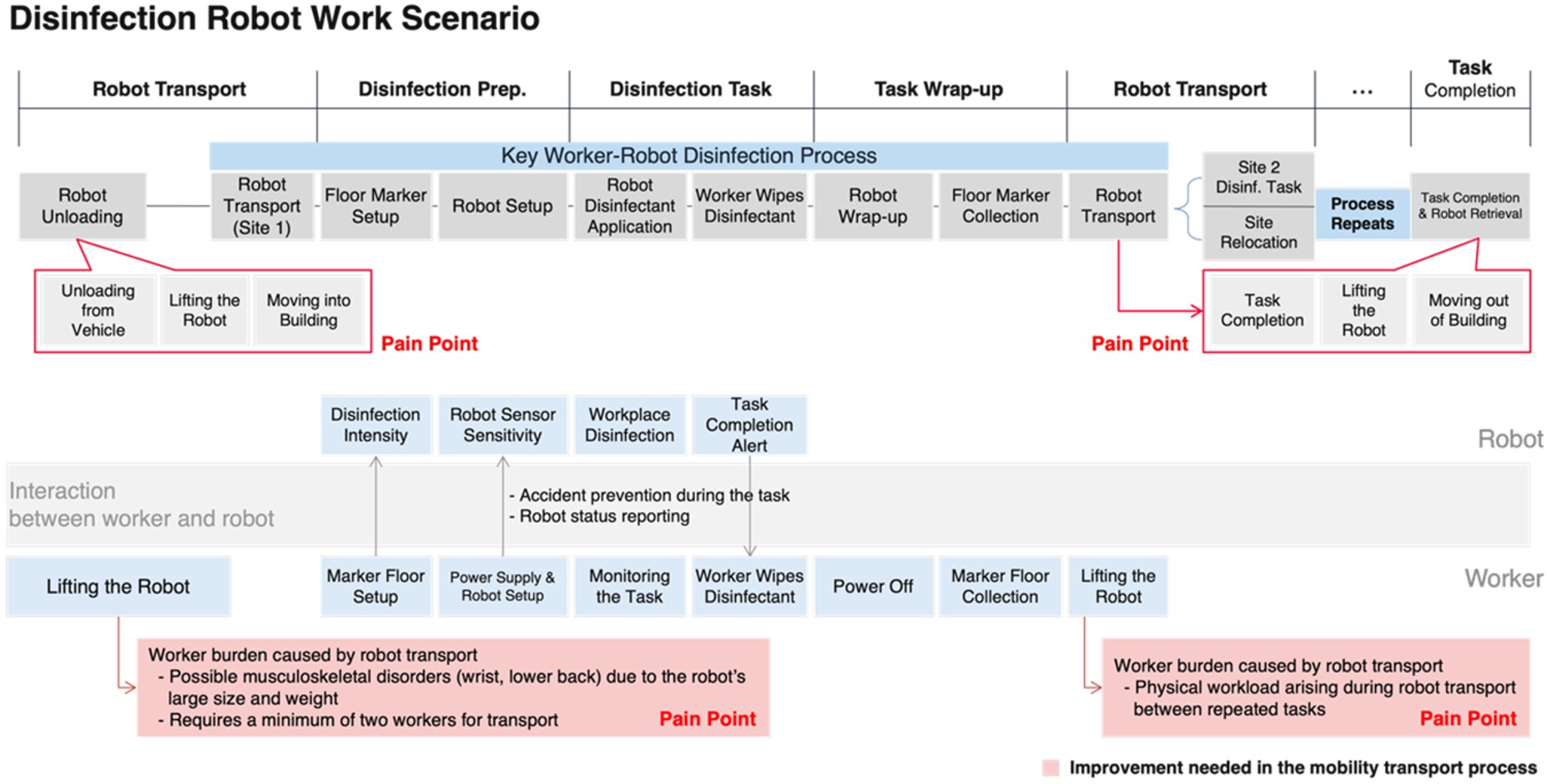
The analysis showed that worker-robot interaction was relatively well designed during the disinfection task itself, whereas distinct pain points were identified in the robot transport stage, which recurred at both the beginning and end of the scenario. Specifically, three pain points were derived: (1) the potential for musculoskeletal strain in the wrist and lower back due to the robot's large size and weight, (2) the need for a minimum of two workers to collaborate during transport, and (3) the accumulation of workload from repeatedly moving the robot across multiple work sites. These findings indicate that the burden on workers is concentrated in the collaborative process of transporting the robot rather than in the disinfection task itself. Accordingly, among the various stages of worker-robot collaboration, this study selected the usability of the transport stage, where pain points were most pronounced, as the target for design improvement (Figure 1).
This analysis was informed by informal, unstructured interviews and field observation conducted on two occasions (June 12 and June 30, 2025) at active work sites prior to the design phase, involving five disinfection workers (three primarily responsible for chemical-spraying tasks and two primarily responsible for chemical wipe-down tasks), in which researchers accompanied workers through the transport and disinfection process and asked about recurring points of physical difficulty and delay. No separate expert panel beyond the research team was involved in this analysis. Findings from the interviews and observation were synthesized qualitatively by the research team and cross-referenced against the service blueprint rather than scored through a formal quantitative importance-frequency procedure; the three pain points reported above were those that (a) recurred across multiple touchpoints of the blueprint (specifically, transport at both the beginning and end of the work scenario) and (b) were independently raised as significant by workers during the interviews, so that recurrence in the blueprint and corroboration in the field served as converging, qualitative indicators of importance. This fieldwork was exploratory and pilot-level rather than a formally coded qualitative study; it was used to corroborate and contextualize the pain points identified through the service blueprinting analysis, not as an independent validated data source.
2.2 Transport method alternatives
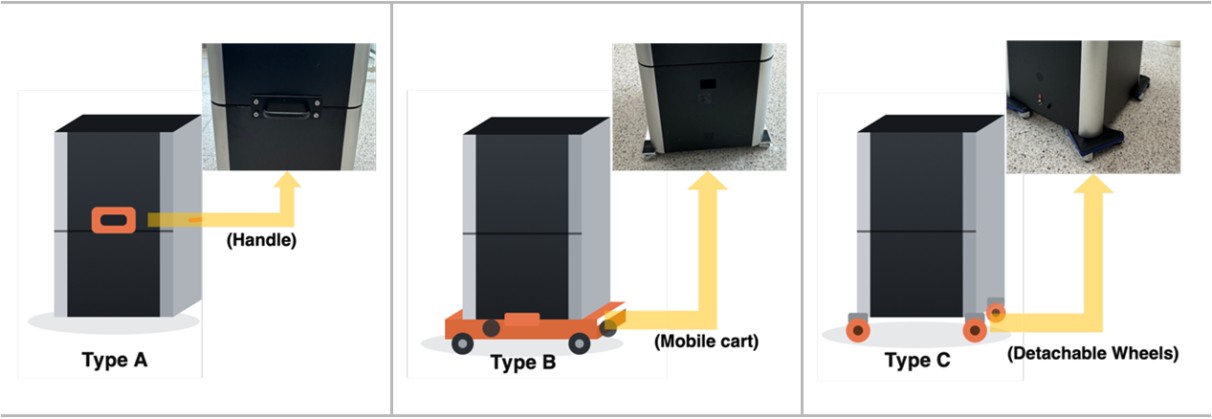
Three transport method prototypes were proposed to address the pain points identified in the transport stage of the collaborative disinfection service robot (Figure 2). Because the existing disinfection service robot sprays disinfectant while rotating 180°, its upper section is not fixed to its lower section, so each alternative was designed to be applicable without altering the robot's existing structure. Type A is a handle fixed to the lower section of the robot; Type B is a separate mobile cart onto which the robot is loaded for transport; and Type C consists of detachable wheel modules attached to the bottom of the robot. The structural advantages and disadvantages of the three alternatives are summarized in Table 1.
|
|
Type A (Handle) |
Type B (Mobile cart) |
Type C (Detachable wheels) |
|
Advantages |
- Easy to manufacture and
apply - Intuitive to use |
- Movable by a single worker; - Relatively easy to load |
- Movable by a single
worker - Requires little force to
move - Easy to maintain |
|
Disadvantages |
- Less demanding than the existing method, but physical burden
still remains - Requires two workers to
move |
- Managing and moving an - Requires two workers to load; - The coupling structure is difficult |
- Attachment/detachment - Requires two workers |
The target robot measures 0.46m (W) × 0.46m (D) × 0.70m (H) and weighs 25kg. Its drive unit and 400Wh battery pack are housed in the lower chassis, while the disinfectant-spraying unit rotates independently in the upper section; this places the robot's center of gravity relatively low and toward the base. Given this weight and form factor, manual lifting via a fixed handle remains within a range typically handled by two adults, but still exceeds single-person safe manual-handling thresholds recommended by ergonomic guidelines (e.g., KOSHA, 2025), which motivated the two load-transferring alternatives (Type B, Type C) evaluated alongside it. Because this study's conclusions are grounded in a single prototype of this specific weight and form factor, their generalization to markedly heavier, lighter, or differently shaped service robots should be made cautiously.
2.3 Selection of usability evaluation criteria
The usability evaluation criteria in this study were selected and combined from the product-user-centered evaluation approach and the robot-worker collaboration perspective introduced earlier, in response to the current lack of an established usability evaluation tool suited to worker-robot collaboration, which varies by task and context. As the product-user-oriented core, four criteria, Effectiveness, Efficiency, Satisfaction, and Learnability, were selected based on the core constructs of ISO 9241-11 (ISO, 2018), namely effectiveness, efficiency, and satisfaction; the repeated-use intention criterion of the System Usability Scale (SUS; Brooke, 1996); and the visibility, consistency, and error-prevention principles from Nielsen's usability heuristics (Nielsen, 1994), which are also applicable to physical products. This approach of selecting and combining multiple standardized usability evaluation models to assemble evaluation criteria has likewise been adopted in prior domestic and international studies (Nik et al., 2021; Tullis and Albert, 2013).
To reflect the robot-worker collaboration perspective, two additional criteria were selected: Ergonomics / Comfort, which evaluates the physical burden that arises when the robot's load is transferred to the worker through the transport method as a physical medium during collaboration, and Reliability, which evaluates, with a single item, the worker's perception that the transport part operates consistently and normally during the collaborative transport task. These two criteria treat the robot as a collaboration partner that shares physical tasks with the worker and are intended to capture the physical and psychological effects of the robot's collaborative behavior on the worker, in line with the problem awareness of prior studies seeking to evaluate the quality of human-robot collaboration (Apraiz et al., 2023; Hoffman, 2019). Integrating these considerations, a 5-point Likert-scale questionnaire comprising 15 items across six evaluation criteria, four from the product-user perspective and two from the robot-worker collaboration perspective, was ultimately assembled (Table 2).
|
|
Usability evaluation criteria |
Items |
|
1 |
Effectiveness |
I was able to accurately perform the intended task using the part. |
|
2 |
No unnecessary errors or mistakes occurred during the task. |
|
|
3 |
The functionality provided by the part was sufficient for
performing the task. |
|
|
4 |
Efficiency |
The process of using the part was fast and simple. |
|
5 |
The structure and form of the part helped improve work efficiency. |
|
|
6 |
I was able to complete the task with minimal effort. |
|
|
7 |
Satisfaction |
The experience of using the part was generally satisfactory. |
|
8 |
I liked the appearance and finish quality of the part. |
|
|
9 |
I want to continue using this part. |
|
|
10 |
Learnability |
It was easy to understand how to use the part. |
|
11 |
I became familiar with using the part in a short amount of time. |
|
|
12 |
Ergonomics
and comfort |
The size and shape of the part were suitable for the user's body
dimensions. |
|
13 |
The force required to operate the part was appropriate. |
|
|
14 |
Physical fatigue was low even with prolonged use. |
|
|
15 |
Reliability |
The part
operated consistently and normally. |
Unlike general physical ergonomics, which evaluates a product's fit to the human body in isolation, the Ergonomics/Comfort criterion here specifically evaluates the physical burden transferred from the robot to the worker through the transport method during an active collaborative handoff. Similarly, whereas Nielsen's and ISO's reliability-adjacent principles concern a system's own operational stability, Reliability as used here captures the worker's perceived consistency of the transport part's operation while sharing the task with the robot. Because it is measured with a single item after brief exposure within a single session, it reflects perceived operational consistency rather than trust accumulated over repeated use, and it was selected as an exploratory indicator motivated by the human-robot team fluency perspective of Hoffman (2019). These criteria are thus collaboration-contingent reinterpretations rather than restatements of existing constructs.
Formal content and face validity procedures, such as a structured item-generation protocol or an expert panel review, were not conducted for this 15-item instrument; no external expert panel beyond the research team was consulted. Content relevance instead rests on the four product-user criteria being drawn directly from already-validated constructs in ISO 9241-11, the System Usability Scale, and Nielsen's heuristics, and on the two collaboration criteria being grounded in the constructs proposed by Hoffman (2019) and Apraiz et al. (2023) rather than generated de novo. This provides a defensible starting point for content relevance but does not substitute for formal content and face validation (e.g., expert panel review, cognitive interviews with intended respondents), which we identify as a necessary step before this instrument is used more broadly.
Internal consistency (Cronbach's alpha, pooled across the three transport-method administrations, N = 30 occasions per item) was computed for each criterion: Effectiveness, alpha = .17, 95% CI [-.52, .58]; Efficiency, alpha = .17, 95% CI [-.51, .58]; Satisfaction, alpha = .31, 95% CI [-.27, .65]; Learnability (2 items), alpha = .46, 95% CI [-.15, .74]; Ergonomics/Comfort, alpha = -.07, 95% CI [-.95, .46]; Reliability (1 item) is not computable by definition. The full 15-item scale yielded alpha = .51, 95% CI [.21, .73]. These values are well below the conventional .70 threshold for most criteria, and the very wide confidence intervals reflect the instability of alpha estimates at N = 10; nonetheless, they indicate that inter-item correlations within several criteria are weak or inconsistent. These values indicate that these criteria are best characterized as a conceptually motivated, exploratory extension (Apraiz et al., 2023; Hoffman, 2019) rather than a validated instrument at this stage; refining and re-testing item wording and count per criterion, ideally with content/expert review and a larger sample, is identified as a necessary next step before these criteria are proposed as a general evaluation framework.
2.4 Procedure
Ten adults (M age = 39.2 years, SD = 13.5, range 24~63) working at a small disinfection-service business participated in the evaluation. At this small business, staff holding managerial titles (president/CEO, division head, department head, deputy department head, manager, and assistant manager; two each of the latter four titles and one each of the first two) also personally perform on-site disinfection and robot-transport work, so job title does not indicate distance from hands-on field operation; all participants reported no difficulty transporting or operating the robot. Prior to the evaluation, participants were briefed on its purpose and procedure, as well as on the structure of the three transport methods.
The evaluation of each transport method followed the same sequence: attaching the transport method to the robot, moving the disinfection service robot 3m, detaching the transport method, and completing the questionnaire. This attach-move-detach sequence was designed so that attachment and detachment represent the preparation and completion steps that bracket loading and unloading the robot at a vehicle, while the 3m relocation represents movement within a work site; together they represent both ends of the robot's transport journey described in the Introduction within a single controlled task, rather than replicating either scenario's exact physical constraints (e.g., vehicle trunk height, curb steps). The three transport methods were presented in randomized order to control for learning effects. Because Type A requires two people to lift the robot together, each participant performed the Type A sequence twice (once as the primary lifter and once as the assisting lifter, each time paired with a fellow participant, in randomized order) and completed the Type A questionnaire based on their performance as the primary lifter, so that all three methods were rated on the same basis (the participant's own primary-role experience). Types B and C, which can be operated by one person, were each performed once, and each participant completed one questionnaire per method (three in total; total evaluation time: approximately one hour). The evaluation was conducted in an obstacle-free experimental space that allowed the disinfection service robot to be driven freely, and each transport method component was rated independently using the same questionnaire items without any comparative wording between methods.
Because each method was evaluated in a single trial rather than under repeated or long-duration use, the results reported here should be interpreted throughout as a single-session formative evaluation (Russell and Blake, 1988) rather than a summative judgment of field performance.
2.5 Data analysis
The collected data were analyzed in two stages using IBM SPSS Statistics (Field, 2013). First, the mean score across the 15 items was calculated for each of the three conditions (A, B, C) per participant, and the overall usability scores of the three conditions were compared using the Friedman test. Second, the same test was applied to the scores for each of the six usability evaluation criteria to compare usability at the criterion level. When the Friedman test was significant, pairwise comparisons (A vs. B, A vs. C, and B vs. C) were conducted using the Wilcoxon signed-rank test, and the resulting p values were adjusted with the Holm procedure to control the familywise error rate across the three comparisons (Holm, 1979). Kendall's W is reported as the effect size for the Friedman test. The significance level for all analyses was set at α = .05.
The Friedman test was adopted as the primary analysis because the data do not uniformly satisfy the assumptions of parametric testing. The sample is small (N = 10), the individual responses are ordinal 5-point ratings, Reliability is measured with a single item rather than a multi-item composite, and Learnability under Type A showed no variance because all ten participants gave the maximum rating; in addition, Shapiro-Wilk tests indicated departures from normality in 9 of the 17 testable criterion-by-type cells (p < .05). Because the Friedman and Wilcoxon signed-rank tests operate on within-participant ranks, they can be applied on the same basis to all eight comparisons: the overall score, the alternative-weighted composite described below, and the six criteria. Repeated measures ANOVA results are listed in Table 3 for reference only (with the Greenhouse-Geisser correction applied to Efficiency, which violated sphericity: F(1.27,11.43) = 9.06, p = .008); they showed the same pattern of omnibus significance, but no inferential conclusion in this paper relies on them. Full Friedman and post-hoc results for all eight comparisons are reported in Table 3.
|
Comparison |
Friedman |
Friedman |
Kendall's |
A vs B p |
A vs C p |
B vs C p |
RM-ANOVA |
|
Overall (15-item) |
13.40 |
.001 |
.670 |
.015 |
.015 |
.152 |
F(2,18)=18.51, |
|
Alt. (6-criterion |
12.60 |
.002 |
.630 |
.015 |
.015 |
.507 |
F(2,18)=27.23, |
|
Effectiveness |
7.09 |
.029 |
.354 |
.131 |
.053 |
.131 |
F(2,18)=8.52, |
|
Efficiency |
10.72 |
.005 |
.536 |
.033 |
.022 |
.574 |
F(1.27,11.43)=9.06, |
|
Satisfaction |
0.06 |
.972 |
.003 |
n/a |
n/a |
n/a |
F(2,18)=0.26, |
|
Learnability |
15.06 |
<.001 |
.753 |
.013 |
.013 |
.726 |
F(2,18)=26.89, |
|
Ergonomics/Comfort |
3.49 |
.175 |
.174 |
n/a |
n/a |
n/a |
F(2,18)=0.77, |
|
Reliability |
7.72 |
.021 |
.386 |
.069 |
.069 |
.589 |
F(2,18)=5.56, |
|
*Efficiency
violated sphericity (p < .05); Greenhouse-Geisser (GG) corrected df reported. Post-hoc comparisons were
conducted only when the Friedman test was significant
(n/a, not applicable) |
|||||||
Item-level scores were equally weighted within each criterion, and the overall usability score was computed as the mean of all 15 items; because criteria comprise unequal numbers of items (3, 3, 3, 2, 3, and 1, respectively), this procedure implicitly weights criteria in proportion to their item count. As a robustness check, we additionally computed, for each participant, an alternative composite as the unweighted mean of the six criterion-level means, and applied the same Friedman and Wilcoxon procedure to this alternative score. This alternative weighting yielded overall means of 4.522 (SD = 0.186, Type A), 4.036 (SD = 0.208, Type B), and 3.953 (SD = 0.124, Type C), compared with 4.433, 4.060, and 3.940 under item-level weighting (Table 4). The difference among types remained statistically significant (χ2(2) = 12.60, p = .002, Kendall's W = .630), with an effect size comparable to that under item-level weighting (Kendall's W = .670). Holm-corrected Wilcoxon comparisons under this alternative weighting likewise showed Type A significantly higher than both Type B (p = .015) and Type C (p = .015), with no significant difference between Type B and Type C (p = .507), preserving the same rank order and pattern of significant pairwise differences as the item-weighted analysis (see Section 3.1).
|
Transport type |
M |
SD |
Variance |
Rank |
|
Type A (Handle) |
4.433 |
0.189 |
0.036 |
1 |
|
Type B (Mobile cart) |
4.060 |
0.179 |
0.032 |
2 |
|
Type C (Detachable wheels) |
3.940 |
0.142 |
0.020 |
3 |
|
|
||||
3.1 Overall Usability Comparison
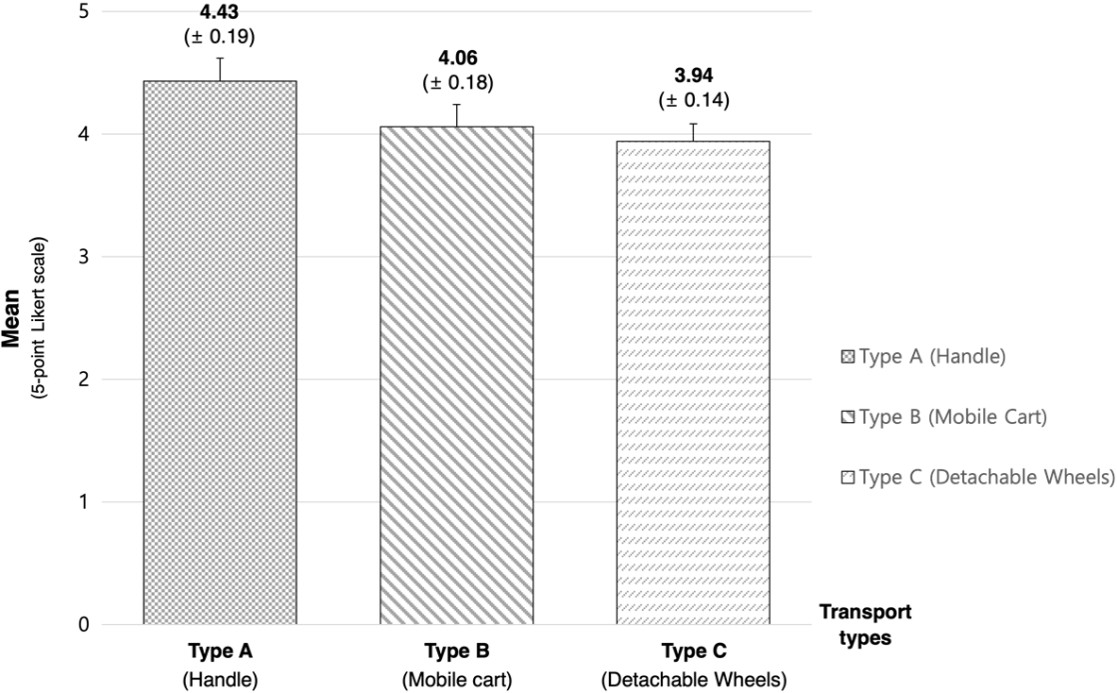
A comparison of the overall usability means across the three transport methods showed that the handle type (Type A) received the highest mean score (M = 4.43, SD = 0.19), followed by the mobile cart (Type B, M = 4.06, SD = 0.18) and the detachable wheels (Type C, M = 3.94, SD = 0.14) (Table 4, Figure 3). A Friedman test indicated that this difference in overall usability across the three types was statistically significant (χ2(2) = 13.40, p = .001, Kendall's W = .670). Holm-corrected Wilcoxon signed-rank comparisons showed that Type A scored significantly higher than both Type B (Z = -2.70, p = .015) and Type C (Z = -2.80, p = .015), whereas Type B and Type C did not differ significantly from each other (Z = -1.43, p = .152). This ranking was also robust to the choice of composite-scoring method: an equal-criterion-weighted alternative (Section 2.5) produced the same ordering and the same pattern of pairwise differences (Type A, M = 4.522 > Type B, M = 4.036 > Type C, M = 3.953; χ2(2) = 12.60, p = .002, Kendall's W = .630). The standard deviations were generally small, indicating limited variability across participants and a consistent pattern of usability perception within each participant across the three conditions.
3.2 Criterion-level usability comparison
A Friedman test conducted separately for each of the six usability evaluation criteria showed statistically significant differences among the transport method types on the core functional usability criteria, Effectiveness, Efficiency, Learnability, and Reliability, whereas no significant differences emerged for the affective and physical criteria, Satisfaction and Ergonomics/Comfort (Table 5). Holm-corrected Wilcoxon post-hoc results for all criteria are reported in Table 3.
|
Criterion |
Type |
Mean (SD) |
Median |
Friedman |
p - value (significance) |
Kendall's W |
|
Effectiveness |
A |
4.50 (± 0.316) |
4.33 |
7.09 |
.029 |
.354 |
|
B |
4.03 (± 0.392) |
4.00 |
||||
|
C |
3.83 (± 0.356) |
3.83 |
||||
|
Efficiency |
A |
4.63 (± 0.258) |
4.67 |
10.72 |
.005 |
.536 |
|
B |
4.13 (± 0.359) |
4.17 |
||||
|
C |
4.00 (± 0.421) |
4.00 |
||||
|
Satisfaction |
A |
4.03 (± 0.620) |
3.83 |
0.06 |
.972 |
.003 |
|
B |
3.90 (± 0.424) |
3.83 |
||||
|
C |
3.87 (± 0.483) |
4.00 |
||||
|
Learnability |
A |
5.00 (± 0.000) |
5.00 |
15.06 |
<.001 |
.753 |
|
B |
3.95 (± 0.553) |
3.75 |
||||
|
C |
3.85 (± 0.337) |
4.00 |
||||
|
Ergonomics/ Comfort |
A |
4.07 (± 0.516) |
4.00 |
3.49 |
.175 |
.174 |
|
B |
4.30 (± 0.290) |
4.33 |
||||
|
C |
4.07 (± 0.516) |
4.00 |
||||
|
Reliability |
A |
4.90 (± 0.316) |
5.00 |
7.72 |
.021 |
.386 |
|
B |
3.90 (± 0.876) |
4.00 |
||||
|
C |
4.10 (± 0.876) |
4.00 |
For Efficiency (χ2(2) = 10.72, p = .005, Kendall's W = .536), the handle type (A) showed the highest mean score and was rated significantly higher than both Type B (Z = -2.39, p = .033) and Type C (Z = -2.68, p = .022) in Holm-corrected Wilcoxon signed-rank comparisons, suggesting that the handle-type transport method provides superior usability in terms of work efficiency. The largest effect size was found for Learnability (χ2(2) = 15.06, p < .001, Kendall's W = .753): the mean for the handle type (A) converged on the maximum score of 5.00 with no standard deviation, and Type A was rated significantly higher than both Type B (Z = -2.72, p = .013) and Type C (Z = -2.86, p = .013), indicating a design that was markedly more intuitive than the other two types in terms of ease of understanding and initial learning. For Effectiveness (χ2(2) = 7.09, p = .029, Kendall's W = .354) and Reliability (χ2(2) = 7.72, p = .021, Kendall's W = .386), the omnibus differences were significant and Type A received the highest mean score, but no pairwise comparison remained significant after Holm correction (Effectiveness: A vs. C, Z = -2.37, p = .053; A vs. B, p = .131; Reliability: A vs. B, Z = -2.23, p = .069; A vs. C, Z = -2.27, p = .069). These two criteria therefore indicate a consistent tendency favoring Type A rather than a confirmed pairwise advantage; for Reliability, this tendency reflects participants' perception that the handle operated consistently and normally during the task. Type B and Type C did not differ significantly from each other on any of the four criteria (all Holm-corrected p > .10).
By contrast, no statistically significant differences among the three types were found for Satisfaction (χ2(2) = 0.06, p = .972, Kendall's W = .003) or Ergonomics/Comfort (χ2(2) = 3.49, p = .175, Kendall's W = .174), with all three types receiving similarly rated evaluations. Taken together, the design type of the transport method had a clear effect on functional usability factors, most clearly Efficiency and Learnability, with a consistent but less conclusive tendency for Effectiveness and Reliability, and a relatively limited effect on affective and physical factors such as Satisfaction and Ergonomics/Comfort.
We note that the zero-variance cell for Learnability under Type A (M = 5.00, SD = 0.00; all ten participants gave the maximum rating) and the near-ceiling distribution for Reliability under Type A (9 of 10 participants at the maximum, M = 4.90, SD = 0.32) reflect genuine ceiling effects rather than data errors; Reliability/Type A departed significantly from normality (Shapiro-Wilk W = .37, p < .001), and Learnability/Type A, being a constant, could not be tested for normality. These ceiling effects may be partly attributable to the additional repetition Type A received (performed twice, once per role, before its questionnaire; see Section 2.4), which could have accelerated learning independent of the handle design itself. These distributional characteristics, together with departures from normality in more than half of the criterion-by-type cells (10 of 18, including the constant Learnability/ Type A cell), are why rank-based nonparametric tests were adopted as the primary analysis (Section 2.5).
By empirically comparing the usability of the three proposed transport method alternatives for the disinfection service robot, this study confirmed that the handle type (Type A) was the most favorable alternative in terms of functional usability, most clearly in Efficiency and Learnability. This finding is consistent with prior research showing that the handle and wheel design of industrial transport carts directly affects workers' ease of operation and work efficiency (Wollesen et al., 2017). That is, rather than adding a structurally more complex transport aid such as a cart or detachable wheels, a simple handle attached directly to the robot itself appears to impose a lower cognitive and procedural burden in terms of ease of understanding, learning, and perceived operational consistency. In particular, the very large effect size found for Learnability (Kendall's W = .753) indicates that, unlike the cart and wheel types, which require a separate attachment/detachment procedure, the handle type is an intuitive design that can be used immediately without additional learning.
This result surfaces a tension between two distinct evaluation lenses used in this study. Types B and C directly target the original pain points by converting lifting into rolling, reducing the load transferred to the worker's body and, in principle, removing the two-person requirement. Type A, by contrast, still requires two workers and leaves the robot's full 25kg weight on the worker's arms and back, and therefore does not structurally resolve the musculoskeletal and manpower pain points that motivated this study. Because it requires no attachment/detachment procedure, Type A nonetheless outscored B and C on Efficiency and Learnability and received the highest means on Effectiveness and Reliability (although no pairwise difference on these two criteria remained significant after Holm correction; see Section 3.2). It did not, however, differ from B or C on Ergonomics/Comfort under the single-trial condition tested here (noting also that Type A received twice the physical repetition of B and C prior to rating; see Sections 2.4 and 3.2). In other words, our final selection prioritized operational and procedural usability over demonstrated pain-point resolution, because the latter did not manifest as a measurable difference in this short-task design. We therefore present the adoption of Type A as the alternative best suited to fast, low-friction daily handling under the conditions tested, rather than as a resolution of the underlying physical workload problem; if repeated or long-distance transport reveals an ergonomic advantage for B or C that this design could not detect, a hybrid or context-dependent recommendation may be more appropriate than a single universal design guideline.
The ranking of the three types is further supported by the fact that it does not depend on how the composite usability score is calculated: weighting the six criteria equally rather than weighting by item count produced the same ordering, the same pattern of pairwise differences, and a comparable effect size (Section 2.5). This convergence across scoring methods strengthens confidence that the handle type's overall advantage reflects a genuine pattern in the data rather than an artifact of the particular way the fifteen items were combined.
These results are also notable in that the two criteria added in this study to reflect the robot-worker collaboration perspective, Ergonomics/Comfort and Reliability, showed different patterns. Reliability, a single item asking whether the transport part operated consistently and normally during the task, showed a significant overall difference among the transport method types (χ2(2) = 7.72, p = .021), although no pairwise difference remained significant after Holm correction, whereas Ergonomics/Comfort, which asks about physical burden, did not (χ2(2) = 3.49, p = .175). This finding suggests that workers' perceived consistency of the transport part's operation may be a meaningful, if preliminary, dimension of collaborative robot usability, while also suggesting that the physical effects of collaboration, such as physical burden, may not be fully revealed by a single short task session. Because Reliability was measured with a single item and Types B and C were each experienced only once before rating, this result does not establish workers' trust in the robot or the quality of human-robot collaboration under repeated use; future studies should examine these constructs directly, for example with established trust measures and the team fluency metrics proposed by Hoffman (2019), over repeated and long-term use. In this limited sense, the robot-worker-oriented criteria selected in this study offer an exploratory complement to conventional product-user-centered criteria (Effectiveness, Efficiency, Satisfaction, and Learnability).
The overall usability mean of 4.43 (on a 5-point scale) corresponds to approximately 88.7 points when converted to a 100-point scale. This exceeds the project's internal quantitative target score of 85 points (an engineering acceptance criterion, not a normed usability benchmark), supporting the conclusion that the handle-type transport method met the project's practical usability target; because this study's 15-item instrument differs from the validated System Usability Scale, established SUS adjective-rating norms (e.g., Bangor et al., 2008) do not directly apply to this score.
At the same time, the finding of no significant differences among the three types on Satisfaction and Ergonomics/Comfort warrants attention. This suggests that, under the short transport distance (3m) and single-trial task conditions common to all three alternatives, differences in physical fatigue or emotional satisfaction may not have been clearly revealed, and that the results could differ under repeated, long-duration transport in actual field settings. The results of this study therefore have the character of a formative evaluation based on a single session (Russell and Blake, 1988), and a subsequent summative evaluation reflecting accumulated use experience should be conducted after the transport method is applied in the field.
This study has a limitation in that the evaluation task consisted of a short-distance (3m) transport performed in a single session, and thus did not fully reflect the physical burden and usability associated with the repeated, long-distance, long-duration transport or more complex task conditions encountered in actual field settings. Future research should extend the findings of this study through field studies incorporating diverse workplace environments and more complex task conditions and should apply the robot-worker-oriented evaluation criteria proposed here to other types of collaborative and service robots to verify their generalizability.
Several limitations should be acknowledged. First, gender and anthropometric measures (e.g., hand dimensions) were not recorded for this sample; we plan to collect fuller demographic and anthropometric data by design in future studies. Second, the pain points motivating this study were derived from service blueprinting analysis corroborated by small-scale, informal interviews and field observation with five workers rather than a larger structured qualitative study; a more systematic field study would strengthen this foundation. Third, internal consistency for the six usability criteria was mostly weak (alpha = -.07 to .46 across the five multi-item criteria; Section 2.3), confirming that these criteria, and particularly the single-item Reliability construct, remain conceptually motivated but not yet psychometrically validated; refining item wording and count with expert input and a larger sample is a necessary next step. Fourth, Type A involved twice the physical repetition of Types B and C prior to questionnaire completion (Section 2.4), so part of its advantage in Effectiveness, Efficiency, and especially Learnability could reflect this additional practice rather than the handle design alone; future replications should equalize repetition count across types. Fifth, with N = 10 the Holm-corrected Wilcoxon comparisons had limited statistical power, so the significant omnibus differences for Effectiveness and Reliability could not be attributed to specific pairs of transport methods; a larger sample is needed to confirm these tendencies. Finally, as discussed above, the single 3m, single-trial task design may not have provided sufficient physical load to reveal differences in Ergonomics/Comfort, and the resulting selection of Type A should be understood as optimizing operational usability under these specific conditions rather than as a demonstrated resolution of the underlying musculoskeletal pain points.
This study compared the usability of three transport method alternatives proposed to improve the transport method of a disinfection service robot (the handle type, the mobile cart type, and the detachable wheel type) with professionals from the disinfection industry, using a usability framework that supplemented conventional criteria with two exploratory robot-worker collaboration criteria. The results showed that the handle-type transport method achieved the highest overall usability, was rated significantly higher than both alternatives on Efficiency and Learnability, and received the highest means on Effectiveness and perceived Reliability, although it did not outperform the other alternatives on Ergonomics/Comfort and therefore should not be read as having resolved the musculoskeletal pain points that originally motivated this study. Accordingly, the handle-type transport method was adopted as the final transport method for this disinfection service robot, and this transport method was in fact applied to the subsequent commercialized model (Disinfection Service Robot v1.0), confirming the practical validity of this study's findings for the specific field context tested.
The findings of this study suggest that, when designing the transport method of collaborative service robots of comparable weight and form factor (here, approximately 25kg, 0.46m × 0.46m × 0.70m), an intuitive and simple mechanism should be prioritized over a structurally more complex transport aid under conditions similar to those tested, and this may serve as a starting point for design guidelines for enhancing the field mobility of similarly sized service robots. In addition, the two exploratory robot-worker collaboration criteria selected in this study (Ergonomics/Comfort and Reliability) suggest a possible direction for capturing aspects of the worker's collaborative experience, such as perceived operational consistency and physical burden, that conventional product-user-centered criteria alone may miss; realizing this potential as a general-purpose evaluation framework for collaborative and service robots will require future work to establish their reliability and validity, examine trust and collaboration quality directly with established measures, extend evaluation to repeated and long-duration use, and test generalizability across robots of different weights and forms. Furthermore, complementary future research that analyzes quantitative workload during the use of the transport method using biomechanical measures such as electromyography (EMG), thereby more objectively verifying and demonstrating the efficiency and effectiveness of human-robot collaboration, is expected to further enhance the reliability of usability evaluation for collaborative service robots.
References
1. Ajoudani, A., Zanchettin, A.M., Ivaldi, S., Albu-Schäffer, A., Kosuge, K. and Khatib, O., Progress and prospects of the human-robot collaboration, Autonomous Robots, 42(5), 957-975, 2018.
Google Scholar
PIDS App ServiceClick here!
