eISSN: 2093-8462 http://jesk.or.kr
Open Access, Peer-reviewed

eISSN: 2093-8462 http://jesk.or.kr
Open Access, Peer-reviewed
Chang-Geun Oh
10.5143/JESK.2026.45.4.419 Epub 2026 September 02
Abstract
Objective: This study compared the subjective workload associated with conventional paper charts and an Electronic Flight Bag (EFB) during visual flight rules (VFR) navigation and interpreted the findings from a human information processing perspective. The effects of different familiarization methods with EFBs were also investigated.
Background: Tablet-based EFBs have become a de facto standard navigation aid in modern flight operations. Although previous studies have reported that EFBs improve usability and operational efficiency, limited research has examined how they influence pilots' information processing during navigation or whether different familiarization methods affect perceived workload.
Method: Twenty-seven pilots performed VFR cross-country navigation in a six-degree-of-freedom flight simulator under a 1,500-ft ceiling, 7-statute-mile visibility, and light turbulence. Participants completed paper-chart and ForeFlight-based EFB scenarios in a within-subject design and were assigned to one of three EFB familiarization groups (self-exploration, video-based training, or previous ForeFlight experience; n = 9 each). Subjective workload was assessed using the 0-20 NASA Task Load Index (NASA-TLX).
Results: The overall Raw-TLX score was significantly lower with the EFB than with the paper chart (p = .037), and a Wilcoxon sensitivity analysis yielded the same conclusion (p = .045). No NASA-TLX subscale remained statistically significant after Holm-Bonferroni correction, and workload change did not differ significantly among the three familiarization groups. All participants completed the navigation task and reached the destination under both navigation conditions, with no navigation or landing failures observed.
Conclusion: The findings indicate that EFB use was associated with lower overall subjective workload during VFR navigation, consistent with previous studies. However, the observed pattern suggests that this benefit may be associated with differences in information-processing strategy rather than a reduction in a single workload component. From a human information processing perspective, paper-chart navigation requires repeated position estimation, whereas EFB navigation supports continuous position confirmation while simultaneously introducing interface-based information processing. Accordingly, EFBs may improve navigation by supporting a different information-processing strategy, potentially allowing pilots to devote greater attention to information integration and other flight-related tasks.
Application: The proposed conceptual human information processing model provides a theoretical framework for interpreting how EFBs influence pilots' cognitive resource allocation. The findings also suggest that pilot training should emphasize complementary competencies in both EFB operation and conventional paper-chart navigation rather than treating the two navigation methods as mutually exclusive.
Keywords
Electronic flight bag NASA-TLX Mental workload General aviation Human information processing
Electronic Flight Bag (EFB)은 종이 항공차트를 대체하는 디지털 운항지원 시스템으로, 현재 일반항공과 상업항공 모두에서 사실상의 표준 운항도구로 자리잡고 있다(Federal Aviation Administration [FAA], 2024a). EFB는 Moving Map, GNSS 기반 Own-ship 표시, 공항 및 항행정보, 기상정보, 거리 및 ETA 계산 등 다양한 기능을 통합적으로 제공하여 조종사의 상황인식과 운항효율을 향상시키는 것으로 알려져 있다(FAA, 2024b).
기존 연구에서는 EFB가 Paper Chart보다 작업부하를 감소시키고 사용성을 향상시킨다고 보고하였다(Winter et al., 2018; Yu and Dattel, 2025). 그러나 이러한 연구들은 대부분 EFB가 작업부하를 감소시킨다는 결과(what)를 제시하는 데 초점을 두었으며, 왜 그러한 차이가 발생하는지(why)에 대한 인간공학적 설명은 충분하지 않았다. 또한 기존 연구는 대부분 EFB 사용경험이나 숙련효과를 제한적으로 다루었으며, 새로운 인터페이스에 대한 적응 과정이 작업부하에 어떠한 영향을 미치는지에 대한 논의도 부족하였다(Misra and Halleran, 2019). 인간공학적 관점에서 VFR 항법은 단순한 지도 판독이 아니라 항공기 통제, 계기감시, 외부환경 감시 및 무선교신을 동시에 수행하는 대표적인 다중과업(multitasking)이다. Wickens (2008)의 Multiple Resource Theory에 따르면 이러한 과업들은 동일한 시각 ·공간적 인지자원을 공유하며, 특정 과업의 정보처리 방식이 변화하면 전체 인지자원의 배분에도 영향을 미칠 수 있다. 또한 Endsley (1995)는 상황인식이 다양한 정보원을 효율적으로 통합하는 과정에서 형성된다고 설명하였다. 그러나 Paper Chart와 EFB가 조종사의 정보처리 과정에 어떠한 차이를 만들어내는지에 대해서는 아직 충분한 연구가 이루어지지 않았다.
이에 본 연구에서는 실제 VFR 항법환경을 모사한 비행시뮬레이터에서 Paper Chart와 태블릿 기반 EFB의 작업부하를 비교하고, EFB Familiarization 방식이 작업부하에 미치는 영향을 분석하였다. 또한 실험결과를 인간 정보처리(Human Information Processing) 관점에서 해석하여, 기존 연구에서 보고된 EFB의 작업부하 감소 효과를 설명할 수 있는 개념적 정보처리 모델(conceptual human information processing model)을 제안한다. 또한 이를 바탕으로 디지털 항법환경에서의 조종사 교육과 운용에 대해 논의한다.
2.1 Participants
본 연구에는 Kent State University의 민간조종사 총 27명이 참여하였으며, EFB familiarization 조건에 따라 Self-exploration, Video training 및 Experienced 그룹에 각각 9명씩 배정되었다. 전체 실험참가자 27명 중 23명만 총 비행시간을 보고하였는데, Self-exploration 그룹은 평균 179.9시간(SD = 85.5; median = 180; range = 90-340, n = 7), Video training 그룹은 평균 1,056.8시간(SD = 1,414.6; median = 778; range = 46-4,400, n = 8), Experienced 그룹은 평균 574.9시간(SD = 278.9; median = 470; range = 325-1,200, n = 8)이었다. Self-exploration과 Video training 그룹(총 18명)은 실험 이전 ForeFlight 사용경험이 없었고, Experienced 그룹은 실제 비행 또는 비행교육에서 ForeFlight를 지속적으로 사용한 경험이 있었음을 확인하였다. 모든 참가자는 실험 전에 연구 목적과 절차에 대한 설명을 들은 후 동의서에 서명하였으며, 본 연구는 Kent State University IRB 승인을 받았다.
2.2 Experimental apparatus
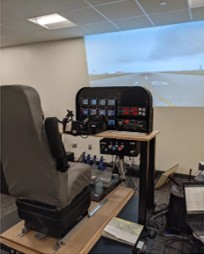
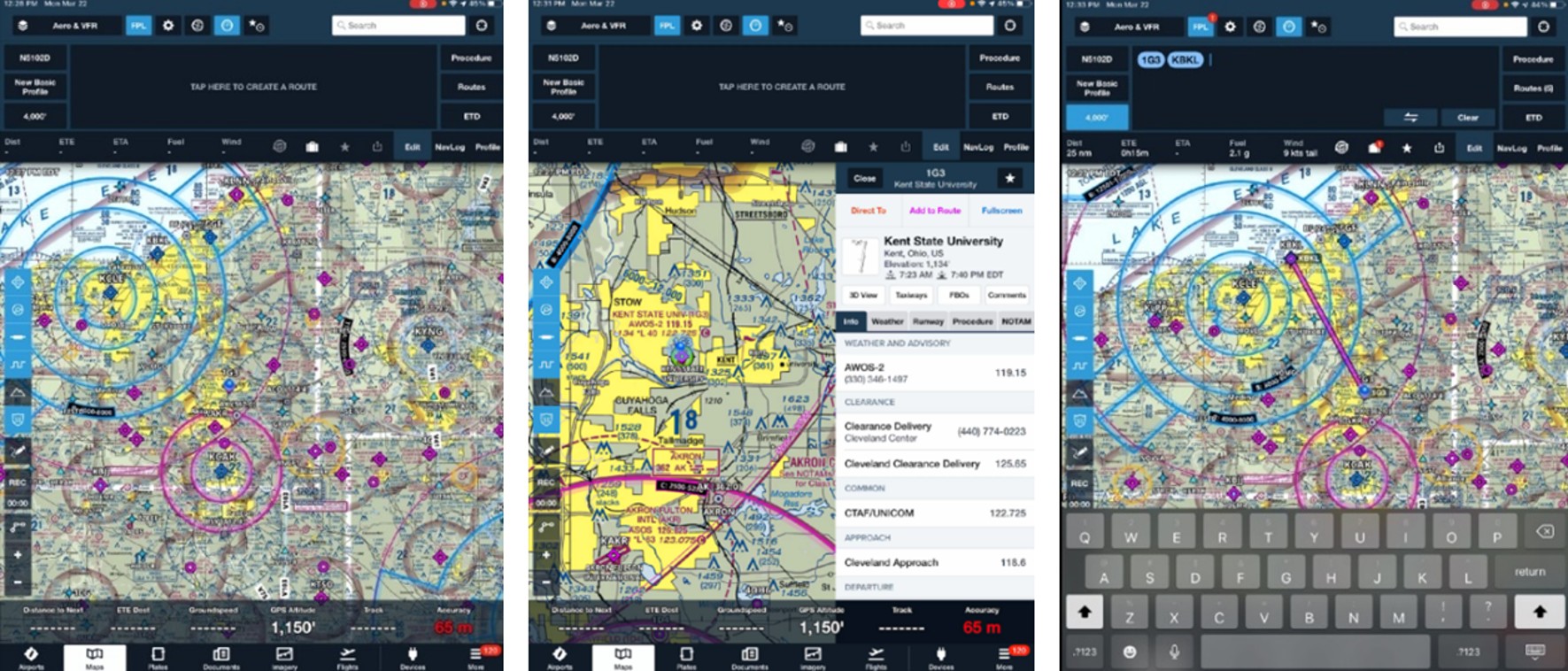
실험은 6-자유도(DOF) 모션 플랫폼 기반 비행시뮬레이터에서 수행하였다(Figure 1). 조종석은 Cessna 172와 유사한 형태로 구성하였으며, 아날로그 비행계기, 요크(yoke), 스로틀(throttle), 러더 페달(rudder pedals) 및 조종석 시트를 설치하였다. 외부 시야(Out-the-window scene)는 전면 프로젝터로 제공하였으며, 시뮬레이션 소프트웨어는 X-Plane 11을 사용하였다. EFB는 10-inch Apple iPad (8th generation)에 설치된 ForeFlight 13.1을 사용하였고(Figure 2), Paper Chart 조건에서는 Detroit Sectional Chart (SDET)를 사용하였다.
2.3 Task
참가자는 먼저 약 5분 동안 비행시뮬레이터 조작을 연습한 후 두 개의 VFR 횡단비행 시나리오를 수행하였다. 이 연습은 시뮬레이터 조작 숙지를 위한 것이었다. 두 시나리오 모두 운고 1,500ft, 시정 7 statute miles 및 경도 난기류(light turbulence)의 동일한 비행환경에서 수행되었으며, 참가자는 항공기 통제, 계기감시, 무선교신 및 항법을 동시에 수행하였다. 연구자는 항공교통관제사 역할을 수행하였고, 참가자는 실제 VFR 운항 절차에 따라 항공기 조종과 무선교신을 수행하였다.
Paper Chart 조건에서는 Detroit Sectional Chart를 이용하여 외부 지형 및 랜드마크와 차트정보를 비교하면서 항법을 수행하였고, EFB 조건에서는 ForeFlight의 Moving Map과 GNSS 기반 Own-ship 정보를 이용하여 동일한 유형의 VFR 항법과업을 수행하였다.
2.4 Experimental design and familiarization
실험은 모든 참가자가 Paper Chart와 EFB 조건을 모두 수행하는 반복측정(within-subject) 설계로 진행하였으며, 조건 수행순서는 참가자 간에 분산하여 순서효과를 줄였다. EFB familiarization은 Self-exploration, Video training 및 Experienced의 세 조건으로 구성하였다. Self-exploration 그룹은 구조화된 교육자료 없이 ForeFlight 인터페이스와 항법기능을 직접 탐색한 후 EFB 시나리오를 수행하였다. Video training 그룹에는 약 9분 분량의 튜토리얼 영상을 제공하였으며, Moving Map과 Own-ship 표시, 확대 · 축소, 공항정보 조회, 출발지 ·도착지 입력, 항로 및 Waypoint 생성, 고도별 기상정보, ETA 및 거리 확인 등 기본 기능을 설명하였다(Figure 2). Experienced 그룹은 별도의 familiarization training 없이 EFB 시나리오를 수행하였다.
2.5 Outcome variables
각 비행 종료 후 주관적 작업부하는 NASA Task Load Index (NASA-TLX)를 이용하여 측정하였다(Hart and Staveland, 1988). Mental Demand, Physical Demand, Temporal Demand, Performance, Effort 및 Frustration의 여섯 하위척도를 0~20점으로 평가하였으며, 높은 점수는 높은 주관적 작업부하를 의미한다. 또한 별도의 가중치를 적용하지 않은 Raw-TLX를 사용하였고, 여섯 하위척도의 평균을 Overall Raw-TLX로 산출하였다. 본 연구는 주관적 작업부하를 주 종속변수로 설계하였으며, 항로편차, 위치추정 오차 및 착륙정확도와 같은 정량적 flight-performance metric은 사전에 설정하지 않았다. 다만 각 조건에서 navigation task completion과 목적지 착륙 여부를 확인하였다.
2.6 Statistical analysis
Paper Chart와 EFB의 Overall Raw-TLX 비교에는 paired-samples t-test를 사용하였고 Cohen's dz를 효과크기로 제시하였다. Paired difference score의 정규성은 Shapiro-Wilk 검정으로 확인하였으며(W = .983, p = .916), 소표본에서 분석결과의 강건성을 확인하기 위해 Wilcoxon signed-rank test를 sensitivity analysis로 추가하였다. Familiarization 효과는 참가자별 workload change score (Delta Raw-TLX = EFB - Paper Chart)를 이용한 one-way ANOVA로 분석하였으며, 각 그룹의 정규성(모두 p > .32)과 분산동질성(Levene p = .211)을 확인하였다. 추가적으로 Kruskal-Wallis 검정을 수행하여 결론의 일관성을 확인하였다. 비행시간은 비정규 분포를 보여(Shapiro-Wilk W = .553, p < .001) workload change score와의 관계에는 Spearman rank correlation을 사용하였다. NASA-TLX 여섯 하위척도의 반복검정에는 Holm-Bonferroni 보정을 적용하였으며, Wilcoxon signed-rank sensitivity analysis에서도 Holm 보정 후 동일한 유의성 결론이 확인되었다. 유의수준은 alpha = .05로 설정하였다.
3.1 Overall workload comparison
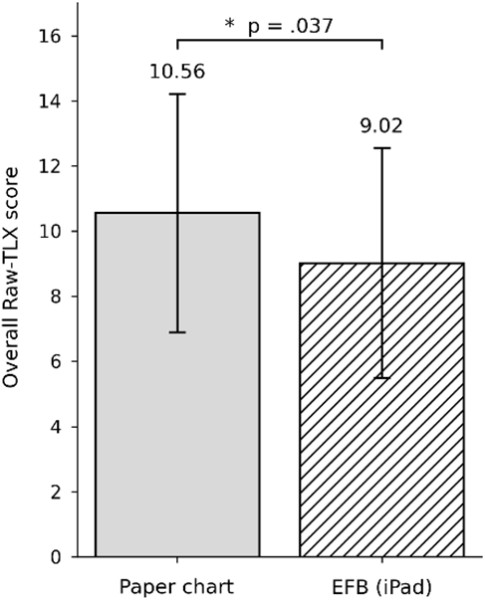
Figure 3은 Paper Chart와 EFB 조건에서 측정된 Overall Raw-TLX 결과를 나타낸다. EFB 조건의 평균 Raw-TLX는 9.02±3.53으로 Paper Chart의 10.56±3.66보다 유의하게 낮았다(t(26) = -2.21, p = .037, Cohen's dz = 0.42). Wilcoxon signed-rank sensitivity analysis에서도 동일하게 유의한 차이가 확인되었다(W = 105.5, p = .045).
3.2 Effects of familiarization
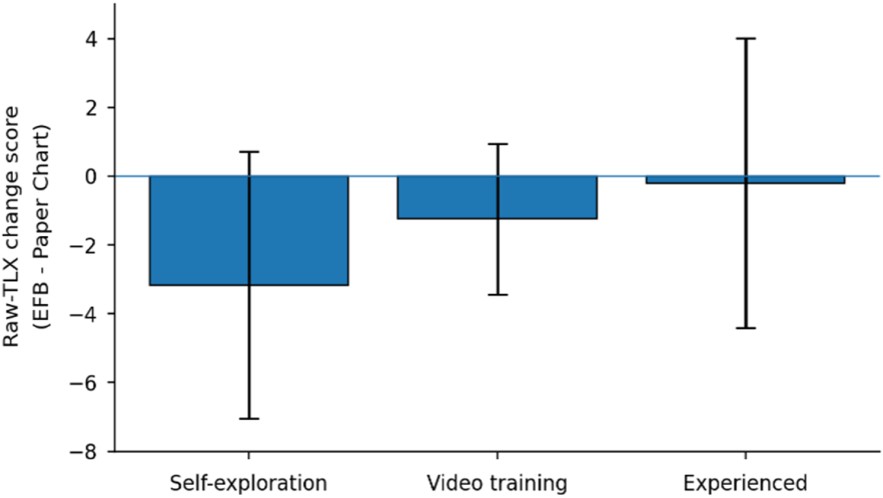
Familiarization 효과는 참가자별 workload change score (Delta Raw-TLX = EFB - Paper Chart)를 이용하여 분석하였다(Figure 4). 세 그룹 간 차이는 유의하지 않았으며(F(2,24) = 1.62, p = .218), Kruskal-Wallis sensitivity analysis에서도 동일한 결론이 확인되었다(H(2) = 2.25, p = .325). 총 비행시간과 workload change score 간에는 양의 Spearman 상관관계가 확인되었다(rho = .432, n = 23, p = .039).
3.3 NASA-TLX subscale
Table 1은 NASA-TLX 하위척도 분석 결과를 제시한다. Holm-Bonferroni 보정 후 Mental Demand, Physical Demand, Temporal Demand, Performance, Effort 및 Frustration을 포함한 모든 하위척도에서 Paper Chart와 EFB 간 통계적으로 유의한 차이는 확인되지 않았다. Wilcoxon signed-rank sensitivity analysis에서도 Holm 보정 후 동일하게 모든 하위척도가 유의하지 않았다.
|
Subscale |
Paper chart (Mean ± SD) |
EFB (Mean ± SD) |
p-value (Holm-adjusted) |
|
Mental demand |
11.70±4.70 |
9.78±3.99 |
.401 |
|
Physical demand |
11.00±4.22 |
9.48±4.76 |
.073 |
|
Temporal demand |
10.00±4.76 |
8.59±4.27 |
.401 |
|
Performance |
8.93±5.25 |
7.81±4.74 |
.422 |
|
Effort |
12.19±4.35 |
10.81±5.36 |
.401 |
|
Frustration |
9.52±5.58 |
7.63±5.05 |
.159 |
3.4 Task completion
모든 참가자는 Paper Chart와 EFB 조건에서 요구된 VFR 항법과업을 완료하고 목적지에 도달하여 착륙하였다. 두 조건 모두에서 navigation failure 또는 landing failure는 관찰되지 않았다. 별도의 정량적 flight-performance metric을 사전에 설정하지 않았으므로, 이 결과는 두 항법조건 모두에서 과업완료가 가능하였음을 보여주는 수준으로 해석하였다.
4.1 Human information processing perspective of Paper Chart and EFB navigation
본 연구의 가장 중요한 결과는 EFB가 전체적인 주관적 작업부하를 감소시켰지만, 이러한 차이를 설명하는 특정 NASA-TLX 하위척도는 확인되지 않았다는 점이다. 이는 EFB의 효과를 Mental Demand나 Effort와 같은 단일 작업부하 요소의 감소로 설명하기 어렵다는 것을 의미한다.
본 연구에서는 이러한 결과를 인간 정보처리(Human Information Processing) 관점에서 해석하였다(Figure 5). Paper Chart 기반 항법에서는 조종사가 지속적으로 외부 지형과 차트를 비교하며 현재 위치를 추정하는(Position Estimation) 정보처리를 수행한다. 반면 EFB에서는 GNSS 기반 Moving Map을 이용하여 현재 위치를 확인(Position Confirmation)하고 필요한 운항정보를 통합하는 방식으로 정보처리 전략이 변화한다.
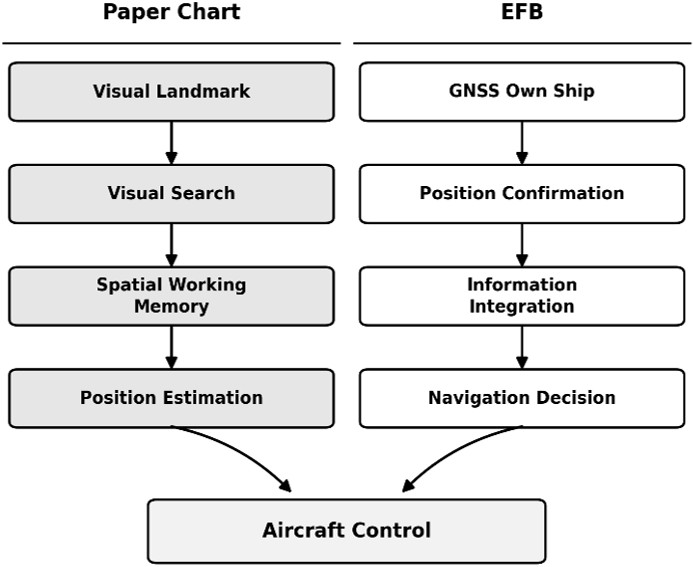
중요한 점은 이러한 변화가 특정 작업부하 요소를 직접 감소시키기보다는 항법과업을 수행하는 방식 자체를 변화시킨다는 것이다. 따라서 본 연구에서 확인된 전체 작업부하의 감소는 개별 NASA-TLX 하위척도의 변화보다는 조종사가 항법을 수행하는 정보처리 전략의 변화와 관련될 가능성이 있다. 이는 Multiple Resource Theory (Wickens, 2008)에서 설명하는 정보처리 자원의 배분과도 일치하는 해석이다. 한편 모든 참가자가 두 항법조건에서 과업을 완료하였다는 점은 주관적 workload 차이가 수행 성공 여부의 차이와 동일한 의미는 아님을 보여준다. 즉, 본 연구결과만으로 EFB가 Paper Chart보다 객관적인 비행수행을 향상시켰다고 해석할 수는 없다. 본 연구에서는 이러한 인지과정을 직접 측정하지 않았으므로 Figure 5는 실험결과를 설명하기 위한 개념적 모델로 이해할 필요가 있다.
4.2 Interpretation of the experienced group
세 familiarization 그룹 간 workload change의 차이는 유의하지 않았으며, 기존 ForeFlight 사용경험이 있는 Experienced 그룹에서도 Paper Chart 대비 뚜렷한 추가 감소는 확인되지 않았다. 또한 탐색적 분석에서 총 비행시간과 workload change score (EFB - Paper Chart) 간 양의 상관관계가 확인되었으며(rho = .432, p = .039), 이는 비행시간이 많은 참가자일수록 EFB 사용에 따른 상대적 workload 감소폭이 작아지는 방향을 의미한다. 다만 총 비행시간은 ForeFlight 사용경험 자체를 의미하지 않으므로 이 결과는 탐색적으로 해석할 필요가 있다. 가능한 설명은 Paper Chart 역시 비행경험이 축적된 조종사에게 이미 숙련된 항법도구라는 점이다. 반복적인 비행훈련을 통해 Paper Chart를 이용한 위치확인과 항법절차가 숙련된 인지적 · 절차적 처리과정으로 형성되어 있다면, EFB 사용경험이 있더라도 Paper Chart 대비 추가적인 workload 감소가 크게 나타나지 않을 수 있다.
또한 본 연구에서 참가자들은 평소 훈련에 사용하는 항로를 비행하였지만, 익숙한 항법방식을 그대로 수행한 것이 아니라 새로운 인터페이스를 사용하여 동일한 항법과업을 수행해야 했다. 특히 운고 1,500ft, 시정 7 statute miles 및 경도 난기류 조건에서 항공기 통제, 계기감시, 무선교신 및 항법을 동시에 수행해야 했기 때문에 새로운 인터페이스에 적응하는 과정 자체가 추가적인 인지부하로 작용했을 가능성도 있다. 이러한 결과는 EFB 사용경험만으로 작업부하가 크게 감소한다고 단정하기보다, 실제 운항환경에서 새로운 정보처리 전략을 충분히 숙달하는 과정이 필요함을 시사한다.
4.3 Practical implications
현재 EFB는 선택적 장비가 아니라 일반항공과 상업항공 모두에서 표준적인 항법도구로 자리잡고 있다(Techau, 2018). 그러나 조종사가 EFB를 신뢰하고 수용하는 정도는 인터페이스 설계와 제공되는 정보의 방식에 따라 달라질 수 있으며(Pittorie et al., 2021; Yeh et al., 2019), 상용 EFB 애플리케이션 간에도 사용성에 차이가 있는 것으로 보고되었다(Schwartzentruber, 2017). 한편 자동화 시스템에 대한 과도한 의존은 automation misuse와 같은 위험을 초래할 수 있으며(Parasuraman and Riley, 1997), EFB 사용에서도 정보 의존 및 상황인식과 관련된 잠재적 위험이 보고되어 왔다(Chandra and Kendra, 2009; Chase and Hiltunen, 2014; Wilkins, 2018; Burnside, 2020). EFB 사용과 관련된 위험요인을 정량적으로 분석한 연구도 보고된 바 있다(Kafalı and Ateş, 2021). 따라서 조종사 교육은 단순한 기능 습득보다 실제 비행상황에서 정보를 효율적으로 통합하고 활용하는 능력을 향상시키는 방향으로 이루어질 필요가 있다. 동시에 GNSS 이상이나 전자장비 고장과 같은 비정상 상황에 대비하여 Paper Chart 기반 항법능력 역시 유지되어야 한다. 본 연구결과는 두 항법체계를 대체관계가 아닌 상호보완적 관계로 활용하는 교육전략이 필요함을 시사한다.
4.4 Limitations and future research
본 연구는 실제 VFR 비행과 유사한 환경에서 Paper Chart와 EFB의 작업부하를 비교하였지만 몇 가지 한계를 가진다. NASA-TLX를 이용하여 주관적 작업부하를 평가하였으며, 조종사의 실제 정보처리 과정을 직접 측정하지 않았다. 따라서 본 연구에서 제안한 Human Information Processing 모델은 실험결과를 설명하기 위한 개념적 해석으로 이해할 필요가 있다. 또한 위치추정 정확도, 위치확인 시간, 항로편차, 목적지 도달시간 및 착륙정확도와 같은 객관적 task-performance 지표를 별도로 측정하지 않았다. 모든 참가자가 두 항법조건에서 과업을 완료하였으므로 task completion만으로는 두 항법수단 간 수행차이를 구분하기 어렵고, 주관적 workload 차이를 객관적인 비행수행 향상으로 직접 해석하는 데에는 한계가 있다.
향후 연구에서는 위치추정 정확도와 소요시간, EFB에서의 위치확인 및 정보검색 시간, 항로편차와 같은 객관적 항법수행 지표를 함께 측정할 필요가 있다. 특히 목적지 변경, 항로 수정, 기상악화, GNSS 장애 및 EFB 고장과 같이 높은 수준의 정보처리가 요구되는 시나리오와 SAGAT 등의 상황인식 측정을 적용한다면, 본 연구에서 제안한 Position Estimation과 Position Confirmation의 차이를 보다 직접적으로 검증할 수 있을 것이다.
본 연구는 VFR 항법에서 EFB가 Paper Chart 대비 조종사의 전반적인 주관적 작업부하를 유의하게 감소시킴을 확인하였으며, 비모수 sensitivity analysis에서도 동일한 결론이 확인되었다. 그러나 특정 NASA-TLX 하위척도에서는 Holm-Bonferroni 보정 후 유의한 차이가 확인되지 않았고, Familiarization 방식에 따른 workload change 차이도 나타나지 않았다. 또한 모든 참가자가 두 항법조건에서 항법과업을 완료하였으므로 EFB 사용에 따른 객관적인 수행성과의 우위를 확인할 수는 없었다. 이는 EFB의 이점이 단순한 수행향상이나 개별 workload 요소의 감소보다 조종사가 항법과업을 수행하는 정보처리 전략의 변화와 관련될 가능성을 시사한다.
본 연구에서 제시한 인간 정보처리 관점은 Paper Chart 기반의 반복적 위치추정과 EFB 기반의 위치확인 · 정보통합이라는 서로 다른 항법 전략을 개념적으로 설명하지만, 객관적 항법수행 지표를 통한 추가 검증이 필요한 이론적 틀이다. 따라서 조종사 교육과 항법절차는 EFB를 Paper Chart의 단순 대체수단이 아니라 정보처리 전략의 전환을 요구하는 도구로 인식하고, 두 항법체계를 상호보완적으로 활용하는 방향으로 설계되어야 한다.
References
1. Burnside, J., EFB dependence, Aviation Safety, January 31, 2020.
2. Chandra, D.C. and Kendra, A., Review of safety reports involving electronic flight bags, Proceedings of the 2009 International Symposium on Aviation Psychology, 407-412, 2009.
Google Scholar
3. Chase, S. and Hiltunen, D., An examination of safety reports involving electronic flight bags and portable electronic devices (DOT-VNTSC-FAA-14-12), U.S. DOT Volpe National Transportation Systems Center, Cambridge, MA, 2014.
Google Scholar
4. Endsley, M.R., Toward a theory of situation awareness in dynamic systems, Human Factors, 37(1), 32-64, 1995.
Google Scholar
5. Federal Aviation Administration, Authorization for Use of Electronic Flight Bags, Advisory Circular 120-76E, Washington, DC, 2024a.
6. Federal Aviation Administration, Use of Electronic Flight Bags, Advisory Circular 91-78A, Washington, DC, 2024b.
7. Hart, S.G. and Staveland, L.E., Development of NASA-TLX (Task Load Index): Results of empirical and theoretical research, In P.A. Hancock and N. Meshkati (Eds), Human Mental Workload, North-Holland, Amsterdam, 139-183, 1988.
Google Scholar
8. Kafalı, H. and Ateş, S.S., Risk analysis with decision tree method on the use of electronic flight bags: A case study on pilots, European Journal of Science and Technology, 25, 562-570, 2021.
Google Scholar
9. Misra, S. and Halleran, M., The effect of electronic flight bags in flight training on preflight skill development and aeronautical decision making, Collegiate Aviation Review International, 37(2), 16-37, 2019. https://doi.org/10.22488/okstate.19.100214
Google Scholar
10. Parasuraman, R. and Riley, V., Humans and automation: Use, misuse, disuse, abuse, Human Factors, 39(2), 230-253, 1997.
Google Scholar
11. Pittorie, W., Rebensky, S., Hunt, L., Narkushian, A., Chaparro, M. and Carroll, M., Factors influencing pilot trust in electronic flight bag information, Proceedings of the 21st International Symposium on Aviation Psychology, 158-164, 2021.
Google Scholar
12. Schwartzentruber, J., A usability study for electronic flight bag (EFB) flight planning applications on tablet devices for ab-initio pilots, International Journal of Aviation, Aeronautics, and Aerospace, 4(2), Article 3, 2017. https://doi.org/10.15394/ijaa.2017.1162
Google Scholar
13. Techau, T.E., General aviation pilot acceptance and adoption of electronic flight bag technology (Doctoral dissertation), Embry-Riddle Aeronautical University, Daytona Beach, FL, 2018.
Google Scholar
14. Wickens, C.D., Multiple resources and mental workload, Human Factors, 50(3), 449-455, 2008.
Google Scholar
15. Wilkins, S.A., Examining head-down time in transportation: Case study in single-pilot general aviation operations, Transportation Research Record, 2672(23), 137-145, 2018.
Google Scholar
16. Winter, S.R., Milner, M.N., Rice, S., Bush, D., Marte, D.A., Adkins, E., Roccasecca, A., Rosser, T.G. and Tamilselvan, G., Pilot performance comparison between electronic and paper instrument approach charts, Safety Science, 103, 280-286, 2018. https://doi.org/10.1016/j.ssci.2017.12.016
Google Scholar
17. Yeh, M., Jaworski, J. and Chase, S., Pilot perceptions on the integration of electronic flight bag information in new flight deck designs, Proceedings of the Human Factors and Ergonomics Society Annual Meeting, 63(1), 91-95, 2019.
Google Scholar
18. Yu, D. and Dattel, A.R., The impact of electronic flight bags on general aviation pilots' situation awareness, Proceedings of the Human Factors and Ergonomics Society Annual Meeting, 69(1), 52-57, 2025.
Google Scholar
PIDS App ServiceClick here!
