eISSN: 2093-8462 http://jesk.or.kr
Open Access, Peer-reviewed

eISSN: 2093-8462 http://jesk.or.kr
Open Access, Peer-reviewed
Choongjin Kim
, Jaein Lee
10.5143/JESK.2026.45.4.377 Epub 2026 September 02
Abstract
Objective: This study analyzed research trends, methodological approaches, and research gaps in Korean agricultural safety and health studies, with agricultural machinery safety examined as a major subdomain.
Background: Agricultural work involves substantial risks from machinery accidents, physical hazards, and work-environmental factors, particularly for older and female farmers. Although Korean studies have addressed accidents, technical countermeasures, safety education, and institutional systems, behavioral and cultural factors remain less examined.
Method: This study conducted a PRISMA-flow-informed literature-based content analysis rather than a statistical meta-analysis. From five Korean academic databases, 598 records were identified, and 42 journal articles published between 2010 and 2025 were selected through duplicate removal, title and abstract screening, formal eligibility review, and content eligibility review. The selected studies were classified by research topic, methodological approach, and research gap, and agricultural machinery safety was reviewed as a major subdomain.
Results: The selected studies mainly addressed agricultural machinery safety, accident characteristics, safety management, education programs, institutional systems, and ergonomics and work environment. Technical and institutional approaches were dominant, while safety culture, risk perception, and safety behavior were not identified as independent research categories. No study was identified that systematically examined agricultural safety culture, risk perception, or safety behavior using validated behavioral or cultural measures, and no longitudinal study on changes in safety culture or safety behavior was found.
Conclusion: Korean agricultural safety and health research has largely relied on reactive approaches centered on accidents, physical risk factors, technical countermeasures, education, and institutional systems. Future research should more explicitly incorporate behavioral and cultural perspectives, including farmers' risk perception, safety behavior, safety norms, and safety communication.
Application: These findings provide a literature-based foundation for future agricultural safety and health research on safety education evaluation, behavioral change, safety communication, policy evaluation, and safety management strategies for vulnerable agricultural populations.
Keywords
Agricultural safety Agricultural machinery Safety culture Risk perception Safety behavior
농업은 전통적으로 고위험 산업으로 분류되며, 농업인은 근골격계 질환, 농기계 사고, 추락, 농약 중독 등 다양한 직업적 위험요인에 노출되어 있다(Jung et al., 2025a). 특히 국내 농기계 보급의 확대는 농작업의 효율을 향상시킨 동시에, 기계 관련 교통사고와 현장 안전사고 위험을 동시에 증가시켜 체계적인 대응 방안 마련의 필요성이 지속적으로 제기되어 왔다(Oh et al., 2021; Kwak and Son, 2017). 또한, 국내 농업 인구는 급속히 감소하고 있으나, 고령 농업인과 여성 농업인의 비율은 높아지는 추세로 이들에게 특화된 안전 접근의 필요성이 강조되고 있다(Kwon and Yang, 2010). 2008년부터 2012년까지의 농작업 종사자 산업재해 특성을 분석한 Kim et al. (2014b)은 추락 · 끼임 사고의 높은 발생률을 보고하였으며, Oh et al. (2021)은 농기계 교통사고의 도로 유형 · 시간대 · 계절별 뚜렷한 패턴 차이를 규명하였다. 또한 Shin et al. (2023a)은 사고 원인 조사를 통해 작업 관련 요인과 환경적 요인의 복합적 상호작용을 확인하였으며, Jung and Kim (2024)은 최근 농작업 사고 유형 분석을 통해 유지 · 보수 작업 중 사고 예방 지침 마련의 시급성을 부각하였다.
국내 농기계 안전 연구는 Kwak and Son (2017)이 연구 동향을 체계적으로 분석한 이후, 재귀반사 장치의 야간 시인성 평가(Kim et al., 2022, 2023b), ICT 기반 자동 상황 전파 시스템 개발(Oh and Kim, 2018), 전기 농업용 트랙터 안전시험(Han and Kim, 2025) 등 기술적 안전 연구가 점차 다양화되어 왔다. 그러나 이러한 연구들이 기계 · 기술적 측면에 집중되어 온 반면, 농업인이 농기계를 사용하는 현장에서 형성되는 안전문화(safety culture), 위험인식(risk perception), 안전행동(safety behavior) 등 안전문화적 관점의 연구는 거의 수행되지 않았다는 점이 주목된다.
안전문화(safety culture)는 조직 구성원 전체가 공유하는 안전에 대한 가치관, 태도, 인식 및 행동 양식과 관련된 개념으로, 안전보건 관리 방식과 구성원의 안전실천에 영향을 미치는 중요한 맥락 요인이다(Health and Safety Commission, 1993). 안전풍토(safety climate)는 안전 정책 · 절차 · 관행에 대해 구성원들이 특정 시점에 형성하는 지각(perception)으로 설명되며, 안전문화가 비교적 장기적이고 심층적인 가치체계를 강조한다면 안전풍토는 특정 시점에서 관찰되는 안전 관련 인식의 상태를 보여주는 개념으로 이해할 수 있다(Zohar, 1980; Griffin and Curcuruto, 2016). 위험인식(risk perception)은 농업인이 작업환경 내 위험 요소의 발생 가능성과 심각성을 주관적으로 판단하는 과정이며, 안전행동(safety behavior)은 안전수칙 준수와 자발적 안전참여를 포함하는 실천적 행동 범주로, 사고 예방과 직접적으로 관련되는 요인으로 작용한다(Griffin and Neal, 2000; Neal and Griffin, 2006).
농업현장에서 이러한 행동 · 문화적 관점이 중요한 이유는 농업의 작업체계가 일반 산업조직과 다르기 때문이다. 농업은 제조업이나 건설업과 달리 가족노동과 자영농 중심의 노동 구조, 고령 농업인 및 여성 농업인의 높은 비율(Kwon and Yang, 2010), 비공식적 작업환경, 경험 기반 작업관행, 지역사회 기반 관계망 등의 특성을 가진다(Jung et al., 2025a). 이러한 특성은 농작업 안전문제가 단순히 기계적 결함이나 개인 부주의만으로 설명되기 어렵고, 농업인의 위험인식, 안전실천, 비공식적 안전소통, 교육참여, 지역사회 지원과 같은 요인을 함께 고려할 필요가 있음을 시사한다. 따라서 국내 농업안전 연구는 사고 · 재해 및 기술 중심의 반응적 접근(reactive approach)을 넘어, 행동 · 문화적 요인을 포함하는 선제적 접근(proactive approach)으로 확장될 필요가 있다.
따라서, 본 연구는 PRISMA 2020의 문헌선정 보고 흐름을 참고하여 국내 농업안전보건 연구 전반의 주제 동향, 연구방법 특성 및 연구 공백을 문헌기반 내용분석 방식으로 검토하고자 한다. 본 연구의 주된 분석 범위는 국내 농업안전보건 연구 전반이며, 농기계 안전은 이 분야에서 높은 비중을 차지하는 핵심 하위영역으로 별도 검토하였다. 이를 통해 기존 연구가 어떠한 주제와 방법에 집중되어 왔는지, 그리고 향후 행동 · 문화적 관점의 연구가 어떤 방향으로 확장될 수 있는지를 제시하고자 한다.
본 연구의 핵심 질문은 다음과 같다.
Key Question 1: 국내 농업안전 연구는 지금까지 어떠한 주제와 관점에서 수행되어 왔는가?
Key Question 2: 국내 농업안전 연구는 어떠한 연구방법과 접근 방식으로 수행되어 왔는가?
Key Question 3: 국내 농업안전보건 연구에서 확인되는 주요 연구 공백은 무엇이며, 향후 행동 · 문화적 관점의 연구에 어떤 시사점을 제공하는가?
2.1 Literature search strategy
본 연구는 개별 연구의 효과를 통계적으로 종합하는 메타분석이 아니라, PRISMA 2020 (Preferred Reporting Items for Systematic Reviews and Meta-Analyses)의 문헌선정 보고 흐름을 참고하여 국내 농업안전보건 연구의 주제 동향, 연구방법 특성 및 연구 공백을 분석한 문헌기반 내용분석 연구이다(Page et al., 2021). 특히 농기계 안전 및 농기계 사용 농업인 관련 연구가 국내 농업안전보건 연구에서 어떠한 비중과 의미를 갖는지도 함께 검토하였다. 문헌검색은 국내 학술논문 검색에 활용도가 높은 5개 데이터베이스를 대상으로 수행하였다.
검색 대상 데이터베이스는 KCI (Korea Citation Index, https://www.kci.go.kr), RISS (Research Information Sharing Service, https:// www.riss.kr), DBpia (https://www.dbpia.co.kr), KISS (Korean Studies Information Service System, https://kiss.kstudy.com), ScienceON (https://scienceon.kisti.re.kr)을 기준으로 하였다.
문헌검색의 대상 기간은 2010년 1월 1일부터 2025년 12월 31일까지로 설정하였다. 2010년을 시작점으로 설정한 근거는 다음과 같다. 첫째, 2010년대 이후 농어업인 안전보험 시범사업(2011년)과 농어업인의 안전보험에 관한 법률 제정(2017년) 등 농업안전 제도적 기반이 본격적으로 형성된 시점이다. 둘째, 선행 연구인 Kwak and Son (2017)이 분석한 농기계 사고 · 안전 연구 동향과의 연속성을 고려하여, 2010년 이후의 연구 생산량 변화를 포괄적으로 파악할 필요가 있다. 셋째, 2010년 이후 국내 농업안전 연구가 질적 · 양적으로 확대되어 문헌기반 내용분석의 적절한 대상이 된다고 판단하였다. 문헌검색은 2026년 5월 16일에 최종 수행하였다. 검색어는 농업안전보건 전반을 포괄하는 용어, 농기계 사고 및 농작업 재해 관련 용어, 행동 · 문화적 요인 탐색을 위한 용어로 구분하여 구성하였다. 일부 검색어가 의미상 유사하거나 포함관계를 가질 수 있으나, 국내 학술데이터베이스에서 색인 방식과 제목 · 초록 표현이 다양하다는 점을 고려하여 누락을 최소화하기 위해 함께 적용하였다.
본 연구에 적용한 검색어는 Table 1과 같다.
|
Search domain |
Korean keyword |
Purpose of inclusion |
|
Broad agricultural safety |
농업안전 |
To identify overall trends
in agricultural safety research |
|
Farm work safety |
농작업 안전 |
To identify studies on
safety management and practices |
|
Agricultural occupational |
농작업 안전보건 |
To identify studies on
occupational safety and health issues |
|
Agricultural machinery |
농기계 사고 |
To identify studies on
accidents and safety issues related to agricultural machinery |
|
Farm work injury terms |
농작업 재해 |
To identify studies on injuries and
accidents during farm work |
|
Farmers' safety and
health |
농업인안전보건 |
To identify studies focusing on farmers as
safety and |
|
Behavioral factor terms |
농업인위험인식 |
To identify studies on farmers'
perception and interpretation |
|
Behavioral factor terms |
농업인안전행 |
To identify studies on farmers'
safety practices and |
|
Cultural factor terms |
농업안전문화 |
To identify studies using safety culture,
safety climate, or |
검색은 각 데이터베이스의 기본 검색창을 활용하되, 가능한 경우 제목, 초록, 키워드 및 본문 검색 결과를 함께 확인하였다. 검색 결과는 데이터베이스명, 검색어, 검색일, 검색건수, 논문 제목, 저자, 연도, 학술지명, URL 또는 DOI를 포함하여 엑셀 파일로 정리하였다. 동일 논문이 여러 데이터베이스에서 중복 검색되는 경우에는 제목, 저자, 연도 및 학술지명을 기준으로 중복 여부를 확인하였다. 검색어 선정과 분석 범주의 설정은 본 연구의 목적이 농업안전보건 전반의 연구 동향을 파악하되, 농기계 안전과 행동 · 문화적 연구 공백을 함께 확인하는 데 있음을 고려하여 이루어졌다.
2.2 Literature selection process
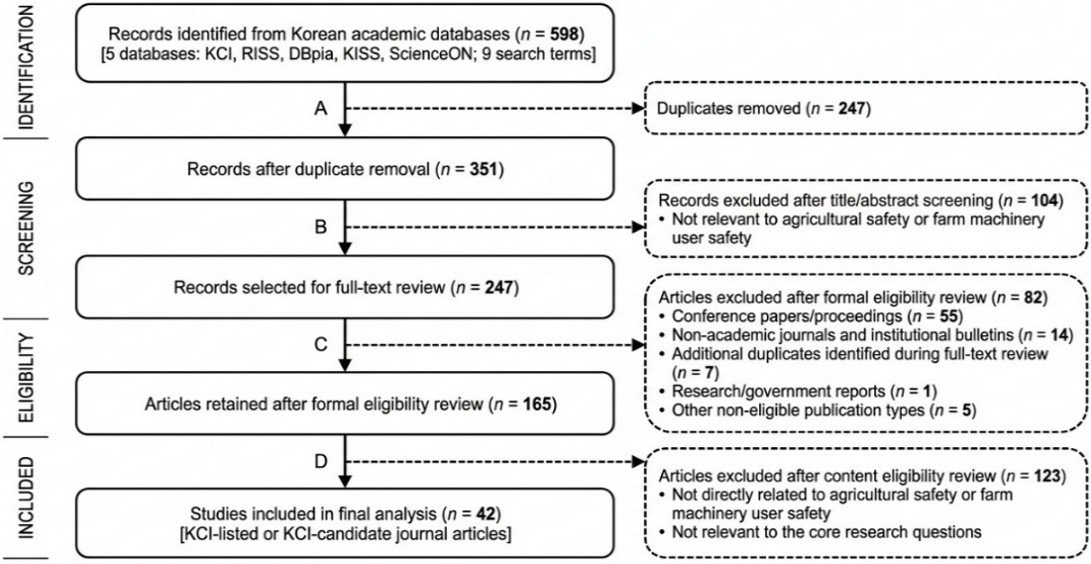
본 연구의 문헌선정 절차는 다음과 같다. 첫째, 국내 5개 학술데이터베이스에서 9개 검색어를 활용하여 총 598건의 문헌을 수집하였다. 둘째, 제목, 저자, 연도 및 학술지명을 기준으로 중복 문헌을 제거하여 351건을 확보하였다. 셋째, 제목 · 초록 검토를 통해 농업안전보건, 농작업 안전, 농기계 안전 또는 농업인 안전보건과의 관련성이 낮은 문헌 104건을 제외하고 247건을 원문 검토 대상으로 선별하였다. 넷째, 원문 검토 과정에서 학술대회 발표문(n=55), 비학술지 간행물 및 기관 회보(n=14), 원문 검토 과정에서 추가 확인된 중복 문헌(n=7), 연구보고서(n=1), 기타 형식적 기준에 부합하지 않는 문헌(n=5) 등 총 82건을 제외하여 165건을 확보하였다. 다섯째, 165건에 대한 내용 적격성 검토를 수행하여 국내 농업안전보건, 농작업 안전, 농기계 안전 또는 농업인 안전보건과 직접적으로 관련되지 않은 문헌 123건을 추가 제외하였다. 최종적으로 KCI 등재지 또는 후보지에 게재된 학술논문 중 본 연구 목적에 부합하는 42편을 분석대상으로 확정하였다. 포함 기준은 국내 농업안전보건, 농작업 안전, 농기계 안전, 농업인 안전보건과 직접 관련된 학술논문으로 설정하였으며, 제외 기준은 학술대회 발표문, 기관 회보, 연구보고서, 중복 문헌, 원문 확인이 어려운 문헌, 농업안전보건과 직접 관련성이 낮은 문헌으로 설정하였다. 이러한 문헌선정 과정은 Figure 1에 제시하였다.
2.3 Classification and coding of selected studies
선정된 42편의 문헌은 연구주제, 연구방법, 주요 연구대상, 연구 접근 방식, 안전문화 · 위험인식 · 안전행동 관련성 여부를 기준으로 정리하였다. 연구주제 범주는 각 논문의 주된 연구목적과 중심 분석대상을 기준으로 1차 범주를 부여하였다. 하나의 문헌이 여러 범주와 관련될 수 있으나, 중복 집계를 피하기 위해 가장 중심이 되는 연구목적을 기준으로 하나의 범주에 배정하였다. 예를 들어 농기계 사고를 분석하면서 정책 제언을 포함한 연구는 정책 연구가 아니라 사고 특성 분석 또는 농기계 안전 범주로 분류하였다. 연구방법은 단면조사 및 현황 분석, 프로그램 · 시스템 · 장치 개발, 문헌 검토 및 연구동향 분석, 법 · 제도 분석, 실험 및 공학적 평가, 사고자료 분석으로 구분하였다. 이러한 분류 기준을 통해 연구 동향을 단순 빈도뿐 아니라 연구관점과 방법론적 특성의 차원에서 해석하였다.
3.1 Key question 1: Research topics and perspectives
최종 선정된 42편의 국내 농업안전 연구를 분석한 결과, 연도별 분포를 살펴보면, 2010-2014년 13편, 2015-2019년 13편, 2020-2025년 16편으로 최근 5년간 소폭 증가 추세를 보였다(Table 2). 특히, 2017년(n=7)과 2023-2025년(n=9)에 논문이 집중 발표되었으며, 이는 2017년 농어업인의 안전보험에 관한 법률 제정 시기 및 최근 농업안전 규제 강화와 연동된 연구 관심의 증대를 반영하는 것으로 해석할 수 있다(Kim, 2017; Jung et al., 2025a).
|
Period |
Number of studies (n) |
Percentage (%) |
Notable years |
|
2010-2014 |
13 |
31.0 |
|
|
2015-2019 |
13 |
31.0 |
2017
(n=7) |
|
2020-2025 |
16 |
38.1 |
2023-2025
(n=9) |
|
Total |
42 |
100.0 |
|
게재 학술지는 총 15개로 분산되었으며, 대한인간공학회지(n=7, 16.7%)가 가장 많은 편수를 기록하였다(Table 3). 이어서 농촌지도와 개발(n=5, 11.9%), 농업교육과 인적자원개발(n=4, 9.5%), 한국안전학회지(n=4, 9.5%) 순이었다(Lee et al., 2010; Kong et al., 2017; Son, 2018; Kim et al., 2018a; Kim et al., 2022; Kim et al., 2023b).
|
Journal |
Number of studies (n) |
Percentage (%) |
|
Journal of the Ergonomics Society of Korea |
7 |
16.7 |
|
Journal of Agricultural Extension & Community Development |
5 |
11.9 |
|
Journal of Agricultural Education and Human Resource Development |
4 |
9.5 |
|
Journal of the Korean Society of Safety |
4 |
9.5 |
|
Other journals |
22 |
52.4 |
|
Total |
42 |
100.0 |
연구주제는 각 논문의 연구목적을 기준으로 6개 범주로 분류하였다(Table 4). 안전관리 및 현장조사가 10편(23.8%)으로 가장 높은 비중을 차지하였으며, 농기계 안전(n=8, 19.0%)과 안전교육 및 프로그램 개발(n=8, 19.0%)이 공동 2위를 기록하였다. 사고 발생 및 특성은 7편(16.7%), 법 · 제도 · 정책은 5편(11.9%), 인간공학 및 작업환경은 4편(9.5%) 순이었다. 농기계 안전 범주와 사고 발생 및 특성 범주를 합산하면 15편(35.7%)으로, 농기계 관련 안전 이슈가 국내 농업안전보건 연구에서 중요한 하위영역을 차지함을 보여준다(Kwak and Son, 2017; Oh et al., 2021).
|
Research topic category |
Number of studies (n) |
Percentage |
Included studies |
|
Safety management and |
10 |
23.8 |
Lim et al. (2010); Lee et al. (2012); Choi (2012); Kim et al.
(2015b); Kim et al. (2017a); Kim et al. (2018a); Kim et al. (2018b); Choi et
al. (2020); Jung et al. (2021); Park (2025) |
|
Agricultural machinery |
8 |
19.0 |
Oh and Kim (2018); Moon et al. (2020); Oh et al. (2021); Kim et
al. (2022); Kim et al. (2023a); Kim et al. (2023b); Shin et al. (2023b); Han and
Kim (2025) |
|
Safety education and |
8 |
19.0 |
Kim et al. (2010); Kim et al. (2013); Kim et al. (2014a); Kim et
al. (2015a); Kim et al. (2017b); Lee et al. (2022); Jung et al. (2025a); Jung
et al. (2025b) |
|
Accident occurrence and |
7 |
16.7 |
Kwak (2014); Kim et al. (2014b); Kwak and Son (2017); Son (2018);
Lee et al. (2018); Shin et al. (2023a); Jung and Kim (2024) |
|
Law, policy, and |
5 |
11.9 |
Kim (2017); Kim et al. (2017c); Kim (2019); Kim (2020); Lee (2024) |
|
Ergonomics and |
4 |
9.5 |
Lee et al. (2010); Chong et al. (2010); Kwon and Yang (2010); |
|
Note.
Studies were assigned to one primary category based on their main research
objective, although some studies may be related to more than one category |
|||
농기계 안전 범주는 다시 사고 유형 및 정책 권고, 기계 구조 및 부품 안전성 분석, 안전장치 및 기술 개발, ICT 기반 사고 대응 시스템 개발로 세분화되었다(Table 5). Oh et al. (2021)은 농기계 교통사고의 도로 유형 · 시간대 · 계절별 패턴 차이를 분석하고 정책 권고안을 제시하였고, Shin et al. (2023b)은 전남 지역 농기계 탑승자 인적 피해 교통사고의 지역 특화로 저감 대책을 제기하였다. Moon et al. (2020)은 다목적 농작업기 부변속기의 안전계수를 동적으로 분석하고, Kim et al. (2023a)은 농산물 수집기의 연결 장치에 대한 동적 시뮬레이션을 수행하였다. 안전 장치 기술 연구로는 농기계 교통사고 예방을 위한 안전 재귀반사 장치의 설치 기준 설계(Kim et al., 2022)와 야간 시인성 평가 및 활용 가이드 개발(Kim et al., 2023b)이 수행되었고, ICT 접목 연구로는 사고 발생 시 자동 상황 전파를 위한 ICT 기반 시스템 개발(Oh and Kim, 2018)과 전기 농업용 트랙터 안전시험 및 평가 계획 수립(Han and Kim, 2025)이 포함되었다.
|
Subcategory |
Main focus |
Representative studies |
|
Accident type analysis and policy |
Traffic accident patterns,
accident characteristics, policy suggestions |
Oh et al. (2021); Shin et
al. (2023b) |
|
Structural and component safety analysis |
Safety factor, structural
stability, |
Moon et al. (2020); Kim et
al. (2023a) |
|
Safety device and visibility improvement |
Reflective devices, night
visibility, |
Kim et al. (2022); Kim et
al. (2023b) |
|
ICT-based accident response systems |
Automatic accident
detection, |
Oh and Kim (2018) |
|
Electric tractor safety testing |
Safety test and evaluation
plans for |
Han and Kim (2025) |
사고 발생 및 특성 범주 Table 6를 살펴보면 Kwak and Son (2017)은 농기계 사고와 안전에 관한 연구 동향을 분석하여 국내 농기계 관련 연구의 주요 흐름과 과제를 제시하였으며, Son (2018)은 작목별 농작업 재해 유형을 분석하여 작목 특화적 사고 패턴을 보고하였다. Kim et al. (2014b)은 2008-2012년 농작업 종사자 산업재해 특성을 분석하여 추락 · 끼임 사고의 높은 발생률을 확인하였다. Lee et al. (2018)은 농작업 사고가 대체 노동력 고용에 미치는 영향을 분석하여 사고로 인한 농가의 사회경제적 부담을 강조하였으며, Shin et al. (2023a), Jung and Kim (2024)은 유지 · 보수 작업 중 발생하는 사고 예방을 위한 구체적 지침 마련의 시급성을 부각하였다.
|
Subcategory |
Main focus |
Representative studies |
|
Research trend analysis of |
Research trends and future tasks in machinery |
Kwak and Son (2017) |
|
Crop-specific injury analysis |
Injury types according to
crop and work characteristics |
Son (2018) |
|
Industrial injury characteristics |
Occupational injury
patterns among agricultural workers |
Kim et al. (2014b) |
|
Accident cause analysis in |
Root causes of accidents during maintenance and |
Shin et al. (2023a); |
|
Socioeconomic
burden |
Replacement labor and farm-level burden after |
Lee et al. (2018) |
3.2 Key question 2: Research methods and approaches in domestic agricultural safety research
전체 42편의 연구방법론적 특성을 분석한 결과, 국내 농업안전보건 연구로 단면조사 또는 현황 분석, 프로그램 · 시스템 · 장치 개발, 문헌 검토 및 연구동향 분석, 비교법적 분석, 실험 및 공학적 평가 등으로 구분되었다(Table 7). 전반적으로 기존 연구는 농업안전 문제의 발생 현황을 파악하거나, 사고 예방을 위한 기술적 · 교육적 · 제도적 대안을 제시하는 방식으로 수행되었다.
|
Subcategory |
Main focus |
Representative studies |
|
Cross-sectional survey and |
Survey on safety status, risk factors, |
Kong et al. (2017); Lim et al. (2010); |
|
Program, system, and |
Development of safety education programs, |
Kim et al. (2010); Kim et al. (2013); |
|
Literature review and |
Review of research trends in agricultural safety, |
Kwak (2014); Kwak and Son (2017) |
|
Legal and policy analysis |
Comparative legal review and institutional |
Kim (2017); Kim (2019); Kim (2020) |
|
Experimental and |
Visibility test, safety factor analysis, dynamic |
Kim et al. (2022); Kim et al. (2023b); Moon et al. (2020); Han and
Kim (2025) |
|
Accident data analysis |
Analysis of accident types, causes, injury |
Oh et al. (2021); Shin et al. (2023a); |
개발 연구로는 RP (Rapid Prototyping) 기법을 활용한 농작업 안전 직무교육 프로그램 개발(Kim et al., 2010), 학습 영역별 교수 설계 틀 개발(Kim et al., 2013), 위험성 평가 기반 e-learning 체험 프로그램 개발(Kim et al., 2014a), 농작업 안전보건 인증 평가항목 설계(Kim et al., 2015b), ICT 기반 농업시설 안전관리 시스템 개발(Kim et al., 2018a) 등이 포함되었다. 이들 연구는 농업현장의 안전관리 역량을 높이기 위한 교육적 · 기술적 개입 방안을 제안했다는 점에서 의의가 있다.
실험적 · 공학적 접근으로는 재귀반사 장치의 야간 시인성 평가(Kim et al., 2022; Kim et al., 2023b), 다목적 농작업 기계의 동적 안전계수 분석(Moon et al., 2020), 전기 농업용 트랙터 안전시험 및 평가 계획 수립(Han and Kim, 2025) 등이 수행되었다. 이러한 연구들은 농기계 및 농업장비의 물리적 안전성을 개선하기 위한 공학적 근거를 제공하였다.
설문조사 기반 연구는 농업인의 작업위험, 안전관리 실태, 안전보건정보 이해도, 안전보험 가입 및 이용 현황 등을 파악하는 데 활용되었다. 예를 들어, 인삼 재배 작업 위험요인 조사(Kong et al., 2017), 안전보건정보 표시 이해도 조사(Lim et al., 2010), 한우 농가의 안전관리 실태 조사(Kim et al., 2017a), 농업인 안전보험 가입 영향요인 분석(Kim et al., 2018b), 농업인 안전보험 이용 실태 분석(Choi et al., 2020) 등이 이에 해당한다. 법제 분석 연구로는 농업인 안전재해 예방과 농작업 안전보건 규율체계를 다룬 (Kim, 2017, 2019, 2020)의 비교법적 연구가 대표적이다.
방법론적 측면에서 주요 한계는 기존 연구들이 대체로 단면조사, 현황 분석, 사고자료 분석 또는 기술 · 교육 · 제도적 대안 제시에 집중되어 있다는 점이다(Table 8). 이러한 연구들은 특정 시점의 안전상태나 사고 특성을 파악하는 데 유용하지만, 농업인의 위험인식이나 안전행동이 시간에 따라 어떻게 변화하는지, 그리고 교육이나 제도적 개입이 실제 현장 안전실천으로 이어지는지를 설명하기에는 한계가 있다. 따라서 향후 연구에서는 농업인의 위험인식, 안전실천, 안전행동 및 안전소통을 분석할 수 있는 개념적 · 방법론적 기반을 보다 명확히 마련할 필요가 있다.
|
Methodological issue |
Findings from selected
studies |
Implication |
|
Dominance of cross-sectional |
Most survey-based studies examined |
Longitudinal designs are needed to examine changes in safety
behavior and culture |
|
Focus on technical and |
Many studies proposed devices, systems, |
Behavioral and cultural determinants should be incorporated |
|
Limited use of structured |
No study was identified that systematically |
Future studies should develop conceptual and methodological bases
for analyzing farmers' behavioral and cultural safety factors |
|
Limited evaluation of |
Only a small number of studies evaluated |
Future studies should assess changes in |
|
Limited behavioral and |
Safety culture was rarely treated as an |
Behavioral and cultural perspectives |
4.1 Key question 3: Research gaps and implications for behavioral and cultural perspectives
앞선 분석 결과를 종합하면, 국내 농업안전보건 연구에서 확인되는 주요 공백은 세 가지로 정리할 수 있다(Table 9).
|
Research gap |
Evidence from selected
studies |
Implications for future
research |
|
Technical, educational, and institutional focus |
Previous studies mainly focused on machinery accidents, structural
safety, visibility, ICT |
Agricultural safety research should be extended to behavioral and
cultural factors in addition to technical and institutional approaches |
|
Limited longitudinal and behavioral/cultural analysis |
Most studies used cross-sectional, status-analysis, accident-data,
or development-oriented approaches; longitudinal changes |
Future research should examine whether education, policies, and
support systems lead to sustained changes in safety practice and behavior |
|
Insufficient attention to |
Older farmers and female farmers were often recognized as
vulnerable groups, but their behavioral and cultural safety characteristics
were not separately analyzed |
Group-specific risk perception, safety behavior, and communication
patterns should be considered in future interventions and evaluations |
첫째, 기존 연구는 사고 발생 특성, 농기계 구조 및 장치 안전성, 안전교육 프로그램, 법, 제도 개선 등 기술적, 교육적, 제도적 접근에 강점을 보여왔다. 그러나 농업인이 위험을 어떻게 인식하고, 안전수칙을 어떻게 실천하며, 가족, 이웃, 지역기관과 어떤 방식으로 안전정보를 공유하는지와 같은 행동문화적 요인은 상대적으로 제한적으로 다루어졌다.
둘째, 연구방법 측면에서 기존 연구는 단면조사, 현황 분석, 개발 연구, 사고자료 분석 중심의 경향을 보였다. 이러한 접근은 국내 농업안전보건 연구의 기초자료를 축적하는 데 기여했지만, 교육이나 정책 개입 이후 농업인의 위험인식, 안전행동, 안전실천이 지속적으로 변하는지를 설명하기에는 충분하지 않다. 특히, 안전교육 효과를 평가한 연구가 일부 확인되었으나, 행동 변화나 문화적 변화의 지속성을 추적하는 종단적 설계는 최종 분석 문헌 내에서 확인되지 않았다.
셋째, 고령 농업인, 여성 농업인, 농기계 사용 농업인과 같이 위험 노출 양상이 다른 집단의 행동 · 문화적 특성을 별도로 분석한 연구가 부족하였다. 또한 법 · 제도 및 보험 관련 연구는 제도 개선의 방향을 제시하는 데 기여했지만, 이러한 제도적 변화가 현장의 안전인식, 안전실천, 안전소통과 어떻게 연결되는지를 실증적으로 검토한 연구는 제한적이었다. 따라서 본 연구의 결과는 향후 농업안전보건 연구가 물리적 위험요인과 제도적 대응뿐 아니라 농업인의 행동, 인식, 관행, 소통 구조를 함께 고려하는 방향으로 확장될 필요가 있음을 시사한다.
4.2 Implications for future agricultural safety and health research
앞서 식별된 연구 공백을 종합하면, 국내 농업안전보건 연구는 사고 · 재해 발생 이후의 원인 분석과 기술적 · 제도적 대응을 넘어, 농업인의 위험인식, 안전행동, 안전규범, 안전소통과 같은 행동 · 문화적 요인을 함께 다루는 방향으로 확장될 필요가 있다.
첫째, 향후 연구에서는 농업안전보건 문제를 단순한 사고 발생이나 개인 부주의의 결과로만 해석하기보다, 농업인의 작업관행과 안전규범이 안전실천에 미치는 영향을 검토할 필요가 있다. 특히 농기계 사용 과정에서 나타나는 안전수칙 미준수, 보호장구 미착용, 위험작업의 일상화는 기술적 요인뿐 아니라 농업현장의 작업관행과 안전인식의 문제와도 관련될 수 있다.
둘째, 안전교육 및 중재 연구는 단기적인 지식 향상이나 만족도 평가를 넘어, 교육 이후 농업인의 위험인식, 안전실천, 안전행동이 실제로 변화하는지를 평가하는 방향으로 발전할 필요가 있다. 이를 위해서는 농업안전보건 교육의 효과를 일정 기간 추적하며, 교육 내용이 현장 실천으로 연결되는지를 확인할 수 있는 연구 설계가 요구된다.
셋째, 법, 제도 및 정책 연구는 제도적 개선 방향을 제시하는 수준을 넘어, 정책과 지원체계가 농업현장의 안전실천과 안전소통에 어떠한 영향을 미치는지를 검토할 필요가 있으며, 농업인 안전보험, 농작업 안전보건 기술지침, 농장 단위 안전관리 및 인증제도 등은 향후 현장 수준의 안전실천과 연계하여 평가될 필요가 있다.
따라서 본 연구의 결과는 국내 농업안전보건 연구가 향후 행동문화적 관점을 포함하는 방향으로 확장될 필요가 있음을 시사한다. 또한, 장기적으로는 농업인의 위험인식, 안전행동, 안전규범 및 안전소통을 설명하고 평가할 수 있는 개념과 방법론적 기반을 발전시키는 연구가 요구된다.
본 연구는 세 가지 핵심 질문을 중심으로 PRISMA 2020의 문헌선정 보고 흐름을 참고하여 국내 농업안전보건 관련 학술논문 42편을 분석하고, 국내 농업안전보건 연구의 주제 동향, 연구방법 특성 및 연구 공백을 검토하였다. 분석 결과, 국내 농업안전보건 연구는 농기계 사고, 기술적 안전대책, 안전교육, 현장조사 및 법 · 제도 개선을 중심으로 수행되어 왔으며, 농기계 안전은 국내 농업안전보건 연구에서 중요한 하위영역을 차지하는 것으로 나타났다. 또한 기존 연구는 단면조사, 현황 분석, 개발 연구 및 사고자료 분석 중심의 방법론적 특성을 보였으며, 농업인의 위험인식, 안전행동, 안전소통과 같은 행동문화적 요인을 독립적으로 다룬 연구는 제한적이었다.
본 연구는 국내 농업안전보건 연구의 주요 흐름과 구조적 한계를 문헌기반 내용분석을 통해 정리하였다는 점에서 의의를 가진다. 특히 기존 연구가 사고 · 재해 발생 이후의 원인 분석, 기술적 안전대책, 교육 프로그램 개발 및 법 · 제도 개선과 같은 반응적 접근에 집중되어 온 반면, 농업인의 위험인식, 안전행동, 안전규범 및 안전실천 문화와 같은 선제적 · 행동문화적 접근은 충분히 축적되지 않았음을 확인하였다. 이는 국내 농업안전보건 연구가 향후 물리적 위험요인과 제도적 대응을 넘어, 농업인의 행동과 문화적 특성을 함께 고려하는 방향으로 확장될 필요가 있음을 시사한다.
향후 연구에서는 산업안전 분야에서 발전된 안전문화, 안전풍토, 안전행동 및 위험인식 개념을 검토하되, 이를 농업의 작업 특성과 구조적 특수성에 맞게 신중하게 재구성할 필요가 있다. 농업은 가족노동, 자영농 중심 구조, 고령화, 비공식 작업환경, 경험 기반 작업관행 및 지역사회 기반 관계망이라는 특성을 가지므로, 제조업이나 건설업 중심의 안전문화 개념을 그대로 적용하기보다는 농업현장에 적합한 개념적 · 방법론적 기초연구가 요구된다.
나아가 본 연구에서 확인된 연구 공백은 향후 농업현장에 적합한 행동 · 문화적 안전연구로 확장될 수 있으며, 이러한 논의는 장기적으로 농업인의 위험인식, 안전행동, 안전소통 및 안전실천 문화를 설명하고 평가할 수 있는 선제적 접근 연구의 기반을 마련하는 데 기초자료로 활용될 수 있을 것이다.
References
1. Choi, D., Lee, K., Kim, K., Kim, K., Lee, H. and Choi, W., Utilization and accident conditions of farmers' safety insurance, Journal of the Korean Society of Community Living Science, 31(4), 765-777, 2020.
2. Choi, G., Cost-benefit analysis of safety certification for farm work convenience equipment, Journal of the Korean Society of Safety, 30(2), 119-129, 2012.
Google Scholar
3. Chong, B., Yang, C. and Oh, G., Comparison of subjective symptoms of musculoskeletal disorders and quality of life between greenhouse and general farm workers, Journal of the Korean Society of Safety, 27(6), 68-75, 2010.
Google Scholar
4. Griffin, M.A. and Curcuruto, M., Safety climate in organizations, Annual Review of Organizational Psychology and Organizational Behavior, 3, 191-212, 2016. doi:10.1146/annurev-orgpsych-041015-062414
Google Scholar
5. Griffin, M.A. and Neal, A., Perceptions of safety at work: A framework for linking safety climate to safety performance, knowledge, and motivation, Journal of Occupational Health Psychology, 5(3), 347-358, 2000. doi:10.1037/1076-8998.5.3.347
Google Scholar
6. Han, T. and Kim, Y., Safety test and evaluation plan for agricultural electric tractors, Drive & Control, 22(3), 99-101, 2025.
7. Health and Safety Commission, ACSNI Study Group on Human Factors: Third Report: Organising for Safety, H.M. Stationery Office, London, 1993.
8. Jung, C. and Kim, D., Study on analysis of farm work accidents and accident prevention measures, Journal of the Korean Institute of Hazardous Materials, 11(2), 50-57, 2024.
9. Jung, W., Kim, H., Lee, M. and Kim, J., Direction of safety and health management in agriculture and rural areas, Rural Society, 35(2), 7-40, 2025a.
10. Jung, W., Kim, H., Lee, M. and Kim, J., Effects of farm work safety and health guidance projects: focused on crop-specific safety management practice pilot projects, Journal of Agricultural Extension and Community Development, 32(4), 165-179, 2025b.
11. Jung, W., Kim, K., Seo, M. and Kim, H., A study on selection of safety and health technical guideline items applicable to farm work sites, Journal of the Korean Society of Occupational and Environmental Hygiene, 31(4), 385-395, 2021.
12. Kim, I., Chae, H., Lee, K. and Kim, K., Framework and evaluation item design for establishing Korean-type farm work safety and health farm certification system, Journal of the Korean Society of Community Living Science, 26(4), 749-760, 2015b.
13. Kim, I., Kim, K., Kim, H., Seo, M., Kim, K. and Ko, M., A study on ICT-based agricultural facility safety management system for farmers' safety activities, Journal of the Ergonomics Society of Korea, 37(4), 489-502, 2018a.
14. Kim, I., Lee, K., Kim, H., Chae, H., Kim, K. and Choi, D., Survey on farm work safety and health status and safety management level of Hanwoo farms, Journal of Environmental Health Sciences, 43(1), 42-54, 2017a.
15. Kim, I., Park, S., Chae, H., Kim, S. and Kim, K., Design study on installation standards for safety retroreflective devices to prevent agricultural machinery traffic accidents, Journal of the Ergonomics Society of Korea, 41(6), 467-480, 2022.
16. Kim, I., Park, S., Chae, H., Kim, S. and Kim, K., Evaluation of nighttime visibility of safety retroreflective devices for agricultural machinery and development of usage guide, Journal of the Ergonomics Society of Korea, 42(6), 675-687, 2023b.
17. Kim, J., Lee, K., Kim, D., Lee, K., Kong, Y., Jung, M. and Lee, I., A case study on development of farm work safety management e-learning experiential program based on risk assessment, Journal of the Korean Society of Safety, 29(4), 140-146, 2014a.
18. Kim, J.H., Hwang, S. and Nam, J., Safety analysis of coupling device of agricultural by-product collector through dynamic simulation, Drive & Control, 20(3), 42-49, 2023a.
19. Kim, J.M., Kong, M., Lee, J. and Lee, Y., Development of farm work safety job training program based on rapid prototyping (RP) approach, Journal of Agricultural Education and Human Resource Development, 42(4), 1-26, 2010.
20. Kim, J.M., Lee, K., Hwang, Y., Song, M., Kim, M. and Kim, H., Development of teaching plan framework for farm work safety manager training program according to learning domains, Journal of Agricultural Education and Human Resource Development, 45(3), 125-146, 2013.
21. Kim, J.M., Hwang, Y., Sohn, K. and Cai, L., Design of learner-participatory safety and health education program for farmers, Journal of Agricultural Extension and Community Development, 22(2), 205-219, 2015a.
22. Kim, J.M., Hwang, Y., Sohn, K., Yoo, Y., Lee, E., Jung, J. and Kim, M., Effectiveness evaluation of farm work safety and health education program for farmer leaders, Journal of Agricultural Education and Human Resource Development, 49(4), 19-41, 2017b.
Google Scholar
23. Kim, J.S., Nam, J. and Han, K., Study on the current status and challenges of farmers' farm work disaster compensation: application of the disaster compensation system perspective, Social Security Studies, 33(3), 1-27, 2017c.
24. Kim, K., Yun, S., Kim, K., Cho, D., Choi, W., Lee, H. and Lee, K., Current status and influencing factors of farmers' safety insurance subscription, Journal of the Korean Society of Community Living Science, 29(4), 591-603, 2018b.
25. Kim, Y., Comparative legal review of legislation on prevention of safety accidents for farmers, Labor Law Review, 40, 149-177, 2017.
26. Kim, Y., Comparison and implications of legislation systems of each country for prevention of safety accidents for farmers, Labor Law Review, 47, 209-259, 2019.
27. Kim, Y., A study on the establishment of a regulatory system for farm work safety and health in the Occupational Safety and Health Act, Labor Law Review, 50, 263-333, 2020.
28. Kim, Y., Kim, D. and Park, K., A study on characteristics of industrial accidents of farm workers (2008-2012), Journal of the Korean Society of Safety, 29(6), 132-136, 2014b.
29. Kong, Y., Lee, I., Lee, K., Choi, K., Kang, D. and Lee, J., Hazard risk factors and safety countermeasures in ginseng cultivation work: a survey study for development of safety education materials for ginseng-cultivating farmers, Journal of the Ergonomics Society of Korea, 36(5), 545-557, 2017.
30. Kwak, H. and Son, B., Analysis of research trends on agricultural machinery accidents and safety, Journal of Rehabilitation Engineering and Assistive Technology, 11(3), 223-229, 2017.
31. Kwak, H., Research trends on application of ergonomics for health and safety of farmers, Journal of the Korea Academia-Industrial Cooperation Society, 15(7), 4165-4176, 2014.
32. Kwon, G. and Yang, W., A study on safety accident prevention measures for female and elderly farm workers due to mechanization of farm work, Journal of the Korean Institute of Industrial Management Engineering, 15(2), 25-34, 2010.
33. Lee, D., Prevention of agricultural machinery accidents and proposed legislation of rational punishment regulations in the event of DUI and accidents, Korean Criminological Review, 35(3), 307-331, 2024. doi:10.36889/KCR.2024.9.30.3.299
Google Scholar
34. Lee, H., Chae, H., Park, S. and Kim, I., Development of training curriculum for farm work safety and health management experts, Journal of Agricultural Extension and Community Development, 29(3), 131-142, 2022.
Google Scholar
35. Lee, K., Kim, H., Chae, H., Cho, Y. and Min, K., A study on utilization effect of farmers' health and safety information center, Journal of the Korean Society of Community Living Science, 23(4), 441-446, 2012.
36. Lee, K., Kim, H., Chae, H., Kim, K., Lee, S. and Lim, D., Research on trends of agricultural safety technology for ergonomic work improvement, Journal of the Ergonomics Society of Korea, 29(2), 225-239, 2010.
37. Lee, Y., Park, H., Kim, H., Kim, K. and Lee, K., Characteristics of substitute labor employment due to farm work accidents, Journal of the Korean Society of Occupational and Environmental Hygiene, 28(4), 346-351, 2018.
38. Lim, C., Lim, K., Hwang, H., Choi, S. and Song, Y., A survey study on farmers' understanding of safety and health information labels in farm work, Journal of the Korean Society of Safety Management and Science, 12(1), 27-33, 2010.
39. Moon, S., Baek, S., Lee, N., Park, S., Choi, Y., Choi, C. and Kim, Y., Analysis of sub-transmission safety factor of multipurpose agricultural machinery transmission, Drive & Control, 17(4), 141-151, 2020.
40. Neal, A. and Griffin, M.A., A study of the lagged relationships among safety climate, safety motivation, safety behavior, and accidents at the individual and group levels, Journal of Applied Psychology, 91(4), 946-953, 2006. doi:10.1037/0021-9010.91.4.946
Google Scholar
41. Oh, J., Jung, M. and Jeon, J., Safety measures and policy recommendations based on characteristics of agricultural machinery traffic accidents, Transportation Research, 28(2), 33-49, 2021.
42. Oh, Y. and Kim, E., Development of ICT-based system for automatic situation propagation in agricultural machinery safety accidents, The Journal of Korean Institute of Communications and Information Sciences, 13(6), 1365-1371, 2018.
43. Page, M.J., McKenzie, J.E., Bossuyt, P.M., Boutron, I., Hoffmann, T.C., Mulrow, C.D., Shamseer, L., Tetzlaff, J.M., Akl, E.A., Brennan, S.E., Chou, R., Glanville, J., Grimshaw, J.M., Hróbjartsson, A., Lalu, M.M., Li, T., Loder, E.W., Mayo-Wilson, E., McDonald, S., McGuinness, L.A., Stewart, L.A., Thomas, J., Tricco, A.C., Welch, V.A., Whiting, P. and Moher, D., The PRISMA 2020 statement: an updated guideline for reporting systematic reviews, BMJ, 372, n71, 2021. doi:10.1136/bmj.n71
Google Scholar
44. Park, G., Current status of safety management in domestic agricultural work and living, Journal of The Korean Institute of Plant Engineering and Safety, 30(1), 5-11, 2025.
45. Shin, Y., Kim, H., Kim, K. and Kim, D., Study on characteristics of farm work safety accidents through accident cause investigation: focusing on maintenance and repair work, Journal of Agricultural Extension and Community Development, 30(2), 119-129, 2023a.
46. Shin, Y., Yun, K., Kim, K., Choi, D., Hong, S. and Lee, M., Characteristics by type of traffic accidents involving human damage of agricultural machinery riders in Jeonnam region and reduction measures, Journal of the Korean Data Analysis Society, 25(4), 1577-1595, 2023b.
47. Son, B., Analysis of farm work accident types by crop, Journal of the Ergonomics Society of Korea, 37(4), 543-549, 2018.
48. Zohar, D., Safety climate in industrial organizations: Theoretical and applied implications, Journal of Applied Psychology, 65(1), 96-102, 1980. doi:10.1037/0021-9010.65.1.96
Google Scholar
PIDS App ServiceClick here!
