eISSN: 2093-8462 http://jesk.or.kr
Open Access, Peer-reviewed

eISSN: 2093-8462 http://jesk.or.kr
Open Access, Peer-reviewed
Dae Sung Kim
, Kwang Tae Jung
, Ye Ram Yang
10.5143/JESK.2026.45.3.239 Epub 2026 July 05
Abstract
Objective: The aim of this study is to empirically analyze the differences in safety awareness among subcontractor workers in the domestic power generation industry and to provide a foundational basis for the establishment of a robust safety culture.
Background: Internalizing a safety culture tailored to specific workplace characteristics is essential for effectively reducing industrial accidents. In the power generation sector, where complex contracting structures exist, the safety awareness of subcontractor workers serves as a critical determinant of overall operational safety and accident prevention.
Method: A safety awareness survey was conducted with 831 workers from eight subcontractor organizations affiliated with the 'T' Power Plant Headquarters of Power Company 'A'. The measurement scale comprised 47 items across six dimensions: safety knowledge, safety belief, safety behavior, safety management, perceived safety management, and safety orientation. Data were analyzed using independent t-tests and one-way ANOVA to identify differences based on demographic and organizational characteristics.
Results: Statistically significant differences were observed in all six safety awareness factors depending on the specific subcontractor organization. Individual characteristics, including gender, age, and job type, significantly influenced safety awareness levels. Notably, female workers and older age groups (50s) exhibited higher awareness in several dimensions. Conversely, hierarchical organizational factors such as job position and tenure showed only limited effects on safety awareness.
Conclusion: The findings suggest that the safety culture within subcontractor organizations is formed independently, influenced by unique organizational environments and individual-contextual factors rather than mere hierarchical structures. This highlights the necessity of recognizing subcontractors as autonomous entities with distinct safety climates.
Application: These results suggest that when establishing safety management policies in the power generation industry, a "one-size-fits-all" approach should be avoided. Instead, a segmented strategy that accounts for the specific characteristics of each subcontractor and individual demographic groups is required to enhance the practical efficacy of safety management systems.
Keywords
Safety awareness Subcontractors Contracting structure Power generation industry Industrial accident prevention
국내 건설 및 제조업 현장에서 발생하는 산업재해는 작업자의 생명과 직결되는 중대한 사회문제로, 이를 예방하기 위해 정부와 사업장 관계자는 지속적인 현장 개선을 위해 노력하고 있다. 고용노동부 자료를 인용한 Baek et al. (2024)에 따르면, 2017~2021년 산업재해 사망사고 중 약 40%가 협력사업장에서 발생하였고, 이 중 추락 · 끼임 · 부딪힘 등 기본 안전수칙 준수로 예방 가능한 사고가 전체의 62.6%를 차지하는 것을 실증하였다. 이는 협력업체 작업자의 안전의식 수준이 산업재해 예방의 핵심 요인임을 명확히 보여준다. 안전의식은 작업자가 안전에 관심을 갖고 이를 행동으로 실천하는 정도를 의미하며, 건설작업자 연구에서는 안전의식을 '안전에 관한 지식을 실제 행동으로 옮기는 실행 의지의 강도'로 정의하며, 평소의 안전교육과 훈련을 통해 형성되는 후천적 특성임을 시사한다(Choi and Lee, 2019). 특히 발전산업은 대용량의 석탄, 가스, 원자력 등을 연료로 사용하여 전력을 생산하는 고위험 산업으로, Kang and Choi (2018)는 국내 발전소의 소방안전경영시스템 구축을 위한 실태를 평가한 결과, 화재 · 폭발사고 및 대규모 정전 등으로 인한 사회 · 경제적 피해를 예방하기 위해서는 체계적인 소방안전경영시스템과 더불어 발전소 구성원의 소방안전의식 수준 향상이 필수적이라고 지적하였다. 발전산업 현장은 도급사와 다수의 협력업체로 구성된 복잡한 도급구조를 가지고 있으며, 이러한 구조적 특성으로 인해 협력업체 작업자의 안전의식 수준과 안전문화 형성이 도급사와 상이하게 나타날 가능성이 있다. 최근 국내 주요 기업들은 협력업체 안전을 '관리대상'이 아닌 '공동운영의 대상'으로 전환하고 있지만, 협력업체 안전책임의 경계를 도급사와 수급사가 각각 감독책임과 실행책임 만을 주장할 경우 양자 사이에 관리 사각지대가 형성되어 중대재해가 발생할 수 있다고 지적한다(Maeil Business Newspaper, 2024). 이러한 상황에서 협력업체 작업자의 안전의식이 소속 기관, 성별, 연령, 직무, 직급, 근무연수 등 다양한 인구통계학적 특성에 따라 어떠한 차이를 보이는지에 대한 실증적 연구는 여전히 부족한 실정이다. 특히 발전산업 협력업체 구성원 간 안전의식 수준의 차이를 체계적으로 비교 분석한 연구는 매우 제한적이다.
따라서 본 연구에서는 발전산업 현장 협력업체 작업자를 대상으로 안전의식 수준을 측정하고, 인구통계학적 특성에 따른 안전의식의 차이를 실증적으로 분석하고자 한다. 구체적으로 다음의 내용을 알아보고자 한다. 첫째, 협력업체 소속 작업자의 안전의식 수준을 안전지식, 안전신념, 안전행동, 안전관리, 안전관리(체감), 안전성향 등 6개 차원으로 측정한다. 둘째, 소속 협력업체, 성별, 연령, 직무, 직급, 근무형태, 근무연수 등 인구통계학적 특성에 따른 안전의식의 차이를 통계적으로 검증한다. 셋째, 분석 결과를 토대로 발전산업 협력업체 안전관리 정책 수립 시 고려해야 할 시사점을 도출한다.
2.1 Concept and components of safety awareness
안전의식(Safety Awareness)은 작업자가 작업 중 발생할 수 있는 위험을 인지하고, 안전의 중요성을 이해하며, 이를 실천하고자 하는 심리적 · 행동적 상태를 의미한다. Neal and Griffin (2006)의 분석에 따르면, 개인이 보고한 안전행동 수준이 높을수록 이후 기간 동안의 사고 경험은 낮아지는 경향을 보인다. 이 결과는 안전규칙 준수와 안전활동 참여와 같은 안전행동이 산업재해 감소와 직접적으로 연결되는 안전의식의 행동적 표현임을 시사한다.
안전의식은 단순히 안전에 대한 지식을 갖추는 것을 넘어, 안전에 대한 태도와 신념, 그리고 실제 안전행동으로 이어지는 포괄적 개념이다. 선행연구들은 안전의식을 다양한 하위 요인으로 구분하여 측정하고 있다. 또한, Neal and Griffin (2006)은 안전의식을 안전지식과 안전동기로 구분하였으며, 이들이 안전행동(Safety Behavior)에 영향을 미친다고 제안하였다.
Clarke (2006)는 안전문화(Safety Culture)와 안전풍토(Safety Climate)가 안전의식 형성에 핵심적 역할을 한다고 주장하였고, 특히, 메타분석을 통해 조직의 안전풍토가 작업자의 안전행동과 유의한 정(+)적 상관을 가지며, 또한, 조직의 안전풍토가 작업자의 안전행동을 통해 사고와 손상에 영향을 미친다는 모형을 지지하는 증거를 제시하면서, 안전풍토를 개선하는 조직 차원의 개입이 안전성과 향상에 정당한 전략임을 시사하였다. 국내 연구에서는 Choi and Lee (2022)은 4M 위험성 평가를 기반으로 산업재해 원인 인식과 작업자의 안전의식 수준 간의 관계를 분석하였다. 그 결과, 성별 · 연령 · 근속기간 · 직책 등 인구통계학적 특성에 따른 안전의식 수준 차이는 유의하지 않았으나, 안전교육 이수 빈도는 안전의식 수준과 유의한 정(+)의 관계를 보였다. 또한 인적, 기계적, 물질 및 환경적 요인에 대한 인식 수준이 높을수록 안전의식이 향상되는 반면, 관리적 요인 인식은 유의한 영향을 미치지 않는 것으로 나타나, 산업재해 예방을 위해서는 인적 요인 중심의 인식 제고와 반복적인 안전교육이 중요하다는 점을 시사한다(Choi and Lee, 2022).
2.2 Previous studies on safety awareness and safety behavior of subcontractors
산업재해 예방을 위해 협력업체 작업자의 안전의식과 안전행동에 관한 연구들이 활발히 진행되고 있다. Baek et al. (2024)은 한국산업안전보건공단의 2021년 협력업체 실태조사 자료를 활용하여, 원청의 안전지원 수준이 높을수록 협력사업장 작업자의 안전행동 수준이 유의하게 향상되는 것으로 나타났다고 보고하였다. 또한 원청의 안전지원은 협력사업장 작업자의 안전행동 수준에 직접적인 정(+)의 영향을 미칠 뿐만 아니라, 협력사업장 내 안전문화 수준을 매개로 간접적인 영향도 동시에 행사하는 것으로 확인되었다. 다시 말해, 원청의 안전지원이 협력사업장의 안전문화를 강화하고, 강화된 안전문화가 작업자의 안전행동을 촉진하는 경로가 유의하게 검증되었다(Baek et al., 2024). Kim (2019)은 제조업 종사자를 대상으로 안전문화가 안전의식과 안전행동에 미치는 영향을 분석한 결과, 안전문화(안전풍토)가 안전의식(중요성 인식)에 정(+)의 영향을 미치고, 안전행동(안전계획, 안전점검)에도 직접적인 정(+)의 영향을 미치는 것으로 보고하였다. 또한 안전의식은 안전행동에 유의한 정(+)의 영향을 주며, 안전문화와 안전행동 간의 관계에서 부분 매개효과를 갖는 것으로 나타나, 안전문화가 안전의식을 통해 안전행동을 촉진하는 경로가 검증되었다. 물류센터 작업자를 대상으로 한 연구에서 안전의식 수준이 높을수록 안전행동 수준도 함께 높아지는 경향이 확인되었으며, 이는 택배 작업자의 안전의식 제고가 현장의 안전행동 향상을 위한 중요한 선행과제임을 시사한다(Park et al., 2021). 국외 연구에서는 Bena et al. (2013)이 연령, 성별, 산업, 사업장 규모 등을 통제한 후에도, 근속기간이 짧을수록 재해위험이 높고 근속기간이 길수록 재해위험이 낮아지는 경향이 유지되는 것으로 보고하였다. Gyekye (2006)는 장기근속 작업자가 단기근속 작업자에 비해 작업장 안전풍토에 대한 인식이 더 긍정적이고, 직무만족과 안전보건경영시스템에 대한 헌신 수준이 높으며, 그 결과 재해 · 질병 발생률이 더 낮은 것을 실증하였다. 그러나 기존 연구들은 주로 제조업이나 건설업을 대상으로 하였으며, 발전산업 협력업체의 안전의식을 체계적으로 분석한 연구는 매우 부족한 실정이다. 또한 협력업체별 안전의식의 차이를 비교 분석한 연구 또한 제한적이다.
2.3 Relationship between demographic characteristics and safety awareness
안전의식은 개인의 인구통계학적 특성에 따라 다르게 나타날 수 있다. 여러 연구에서 여성 작업자가 남성 작업자에 비해 안전규정 준수 수준이 높고 위험행동 수준은 낮다는 결과가 보고되고 있다. 예를 들어, Scott et al. (2024)은 미국 트럭 운송산업에서 남성 운전자보다 여성 운전자의 안전규정 준수 수준이 높고, 위험운전 위반률은 남성에게서 더 높게 나타났음을 확인하였다. 연령의 경우 경험이 축적될수록 안전의식이 향상된다는 연구 결과가 있다. Ghana 산업 작업자를 대상으로 한 연구에서 연령이 증가할수록 작업장 안전지각과 안전규정 준수 수준이 높아지고, 사고 관여율은 낮아지는 경향이 보고되었다(Gyekye, 2006). 직무의 경우, 위험도가 높은 작업에 종사하는 작업자일수록 안전교육을 더 많이 받고 안전의식이 높다는 연구 결과가 있다. 국내 건설 현장 작업자를 대상으로 한 연구에서는, 안전보건교육 이수 후 산업재해 예방 측면에서 교육이 긍정적 영향을 준다고 인식한 응답자가 다수를 차지하였고, 교육 이후 자신의 안전의식 수준이 향상되었다고 응답한 비율이 높게 나타났다. 이는 고위험 작업환경에 종사하는 작업자들이 위험을 인식하고, 교육을 통해 안전의식을 적극적으로 강화하는 경향이 있음을 시사한다(Park, 2020). 반면, 일상적으로 반복되는 작업의 경우 안전의식이 저하될 수 있다는 상반된 결과도 보고되었다. 직무요구 수준이 높고 심리적 · 육체적 부담이 큰 작업환경에서 직무소진이 증가하고, 이로 인해 안전관련 규칙이나 절차가 무시되는 경향이 나타나는 것으로 보고되었다. 이는 반복적 · 단조로운 작업이 작업부담과 피로를 높여 안전참여를 저하시킬 수 있음을 시사한다(Ahn, 2014). 직급의 경우, 건설관리자와 건설작업자의 안전의식을 비교한 연구에서는 건설작업자의 안전의식이 관리자보다 낮고, 안전관리의 중요성에 대한 인식에서도 차이가 있는 것으로 나타났다(Lim et al., 2024).
반면, Choi and Lee (2022)의 연구에서는 직급에 따른 안전의식 수준의 차이가 유의하지 않다는 결과를 제시하였다. 근무연수의 경우, 장기근속자가 안전인식이 높고 사고율이 낮다는 연구 결과가 일반적이다(Gyekye, 2006). 이처럼 인구통계학적 특성과 안전의식의 관계는 산업 및 조직 특성에 따라 다르게 나타날 수 있으며, 발전산업 협력업체를 대상으로 한 실증 연구가 필요한 상황이다.
3.1 Participants and data collection
본 연구는 국내 A 발전회사의 T 발전본부 상주 협력업체 총 11개사 중 8개사 소속 작업자를 대상으로 설문조사를 실시하였다. 설문조사는 2024년 10월에 실시되었으며, 총 1,119명의 작업자가 설문에 참여하였다. 이 중 30인 이하 소규모 협력사 소속 작업자 및 불성실 응답자를 제외한 총 831명의 응답을 최종 분석에 사용하였다.
조사 대상 협력업체는 OES, 금화PSC, 동방, 두산중공업, 코웨포서비스, 한국발전기술, 한전KPS, 한전산업개발 등 8개 기관으로, 발전정비, 운송, 시설관리 등 다양한 업종을 포함하고 있다. 이들 협력업체는 T 발전본부와 장기간 계약관계를 유지하고 있으며, 발전소 운영 및 정비에 핵심적 역할을 수행하고 있다.
3.2 Demographic characteristics of participants
본 연구의 연구대상자 831명의 특성을 살펴보면, 남성 작업자가 84.4%로 대부분을 차지하였고, 통상(일근) 근무형태가 62.5%로 교대 근무보다 높은 비율을 보였다. 소속 협력사별로는 코웨포서비스(31.2%), 한전산업개발(23.7%), 한국발전기술(13.1%) 순으로 많았다. 직무별로는 화공분야(27.7%)가 가장 많았고, 기계분야(21.5%), 전기분야(16.8%) 순이었다. 연령별로는 30대(30.8%)가 가장 많았으며, 50대(23.7%), 40대(23.1%) 순이었다. 직급별로는 일반직원(86.2%)이 대다수를 차지하였고, 근무연수별로는 5~10년 경력자(39.4%)가 가장 많았다(Table 1).
|
Characteristics |
Category |
N |
% |
|
Gender |
Male |
701 |
84.4 |
|
Female |
130 |
15.6 |
|
|
Work shift |
Day shift |
519 |
62.5 |
|
Rotation shift |
312 |
37.5 |
|
|
Organization |
OES Co., Ltd. |
47 |
5.7 |
|
Geumhwa PSC Co., Ltd. |
55 |
6.6 |
|
|
Dongbang Co., Ltd. |
69 |
8.3 |
|
|
Doosan Enerbility |
50 |
6.0 |
|
|
KOWEPO Service Co., Ltd. |
259 |
31.2 |
|
|
Korea Power Engineering (KEPS) |
109 |
13.1 |
|
|
KEPCO KPS |
45 |
5.4 |
|
|
Korea Electric Power Industrial Development (KEPID) |
197 |
23.7 |
|
|
Job type |
Mechanical |
179 |
21.5 |
|
Chemical |
230 |
27.7 |
|
|
General laborer |
22 |
2.6 |
|
|
Administrative |
46 |
5.5 |
|
|
Facilities/Maintenance |
26 |
3.1 |
|
|
Electrical |
140 |
16.8 |
|
|
Cleaning/Security |
71 |
8.5 |
|
|
Others |
117 |
14.1 |
|
|
Age group |
20s |
118 |
14.2 |
|
30s |
256 |
30.8 |
|
|
40s |
192 |
23.1 |
|
|
50s |
197 |
23.7 |
|
|
60s and older |
68 |
8.2 |
|
|
Job position |
Department manager |
33 |
4.0 |
|
Staff |
716 |
86.2 |
|
|
Field supervisor |
82 |
9.9 |
|
|
Tenure |
Less than 1 year |
107 |
12.9 |
|
1 to 3 years |
159 |
19.1 |
|
|
3 to 5 years |
127 |
15.3 |
|
|
5 to 10 years |
327 |
39.4 |
|
|
10 to 15 years |
50 |
6.0 |
|
|
15 years or more |
61 |
7.3 |
|
|
Total |
831 |
100.0 |
3.3 Measures
본 연구에서는 A 발전사의 안전문화증진시스템 구축을 목적으로 개발된 안전의식 수준 진단도구를 활용하였다. 이 도구는 안전지식, 안전신념, 안전행동, 안전관리, 안전관리(체감), 안전성향 등 6개 요인으로 구성되어 있으며, 초기 63문항으로 구성되었다. 측정도구의 내적 일관성을 검증하기 위하여 신뢰도 분석을 수행하였고, 그 결과를 반영하여 16개 문항이 제거되어 최종적으로 47개 문항을 분석에 사용하였다(Table 2). 최종적으로 각 요인에 대한 Cronbach's α가 0.70 이상으로 나타나 양호한 신뢰도를 확보하였다. 각 요인에 포함된 측정항목은 Table 2와 같다. 각 문항에 대한 설문은 Likert 5점 척도(1=전혀 그렇지 않다, 5=매우 그렇다)로 구성되었으며, 부정적으로 서술된 문항은 분석 전 역코딩하였다.
|
Evaluation factor |
Measurement items |
Cronbach's α |
|
Safety knowledge |
Safety rules and procedures, safe use of machinery and equipment,
use |
0.791 |
|
Safety belief |
Causing accidents due to carelessness, perceived likelihood of
accidents, difficulty in following safety guidelines, possibility of
accidents due to |
0.921 |
|
Safety behavior |
Compliance with work procedures, restricted access to hazardous
areas, |
0.776 |
|
Safety management |
Support for health protection measures, delivery of safety
messages, |
0.857 |
|
Perceived safety |
Complexity of work, risk level of work, provision of appropriate
on-site |
0.870 |
|
Safety orientation |
Frequent boredom during work, paying close attention to safety,
difficulty |
0.732 |
3.4 Data analysis methods
수집된 자료는 IBM SPSS Statistics 27.0 프로그램을 이용하여 분석하였다. 구체적인 분석방법은 다음과 같다. 첫째, 측정도구의 내적 일관성을 검증하기 위해 신뢰도 분석을 수행하여 Cronbach's α 계수를 산출하였으며, 신뢰도를 저해하는 문항을 제거하여 최종 척도를 구성하였다. 둘째, 각 안전의식 요인별 기술통계량(평균, 표준편차, 최소값, 최대값)을 산출하였다. 셋째, 성별과 근무형태에 따른 안전의식의 차이를 분석하기 위해 독립표본 t-검정을 실시하였다. 넷째, 소속 협력사, 직무, 연령, 직급, 근무연수에 따른 안전의식의 차이를 분석하기 위해 일원배치 분산분석(one-way ANOVA)을 실시하였다.
4.1 Descriptive statistics of safety awareness among subcontractors
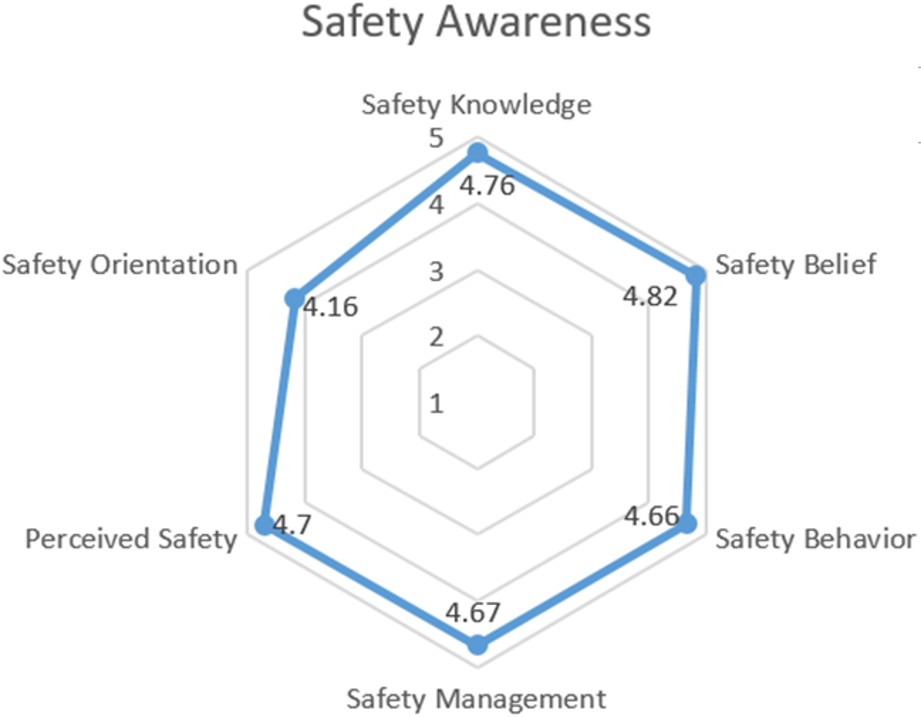
전체 협력업체 연구대상자 831명의 안전의식 6개 요인에 대한 기술통계량은 Figure 1과 같다. 전반적으로 모든 요인에서 평균 4.0 이상의 높은 점수를 보였으며, 특히 안전신념(M=4.82)이 가장 높았고, 안전성향(M=4.16)이 상대적으로 낮게 나타났다.
4.2 Differences in safety awareness by gender
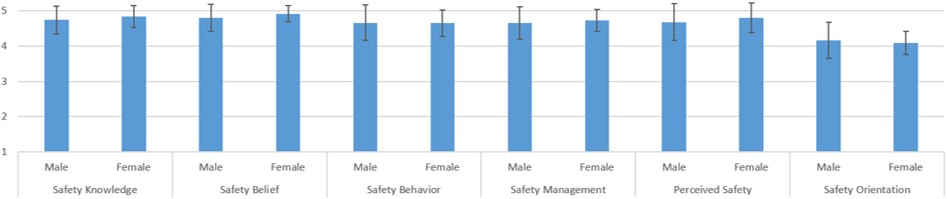
안전의식 요인별로 성별에 따라 유의한 차이가 존재하는지를 분석한 결과(Figure 2), 안전지식(t=-3.179, p=.002), 안전신념(t=-5.056, p=.001), 안전관리(t=-2.304, p=.022), 안전관리(체감)(t=-2.966, p=.003)에서 여성이 남성보다 유의하게 높은 점수를 보였다. 반면 안전성향(t=2.398, p=.017)은 남성이 여성보다 유의하게 높았다. 안전행동 요인에서는 성별 간 통계적으로 유의한 차이가 나타나지 않았다(t=0.318, p=.751). 이러한 결과는 여성 작업자가 안전지식 습득과 안전관리 체계에 대한 인식이 높고, 안전에 대한 신념이 강하다는 것을 보여준다. 반면 남성 작업자는 스트레스 관리나 집중력 등 안전성향 측면에서 여성보다 상대적으로 강하다는 것을 보여준다.
4.3 Differences in safety awareness by work shift
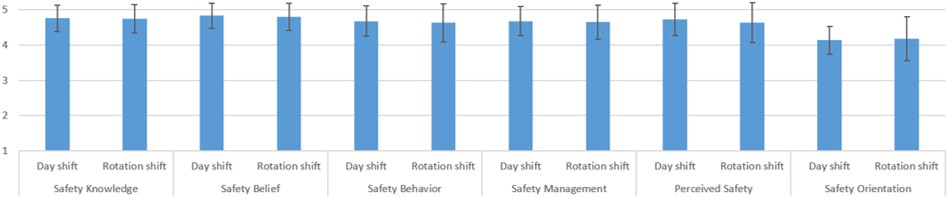
근무형태(일근/교대)에 따른 안전의식의 차이를 분석한 결과(Figure 3), 안전체감에서만 일근 근무자와 교대 근무자 사이에 유의한 차이가 나타났으며(t=2.386, p=.017), 일근 근무자가 교대 근무자보다 안전의 중요성을 더 높게 체감하는 것으로 확인되었다. 이 결과로 부터 교대 근무자의 경우, 야간작업으로 인한 관리자 부재, 안전교육 기회 감소 등으로 안전의 중요성을 상대적으로 낮게 체감할 수 있음을 시사한다. 반면 안전지식, 안전신념, 안전행동, 안전관리, 안전성향에서는 근무형태에 따라 통계적으로 유의한 차이가 발견되지 않았다.
4.4 Differences in safety awareness by subcontractor organization
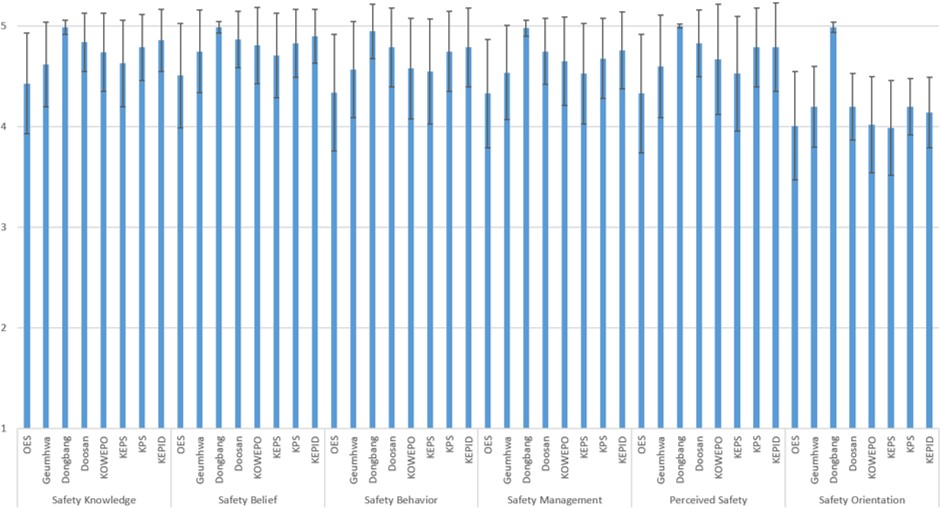
소속 협력업체별 안전 관련 6개 요인별 의식의 차이를 분석한 결과(Figure 4), 안전지식(F=15.136, p=0.00), 안전신념(F=10.926, p=0.00), 안전행동(F=12.593, p=0.00), 안전관리(F=14.134, p=0.00), 안전체감(F=11.699, p=0.00), 안전성향(F=48.840, p=0.00) 모두 통계적으로 유의한 차이가 나타났다. 협력업체 중 동방이 가장 높은 인식 수준을 보인 반면, OES는 가장 낮은 경향을 보였다. 특히 동방은 안전신념(M=4.99), 안전관리(체감)(M=5.00), 안전성향(M=4.99) 등 대부분 요인에서 최고점에 근접했으나, 표준편차가 이례적으로 작아(0.02~0.07) 최고점 응답이 과도하게 집중되는 양상이 관찰되었다. 동방은 하역/운송업종으로 20~25년 기간 동안 산업재해 발생건수가 1건에 불과한 반면, OES는 발전정비업으로 동일 기간 산업재해가 2건 발생한 사업장이다. 2024년 T 발전본부에서 수행한 안전활동 수준 평가에서는 두 기관 모두 동일하게 2등급에 해당하는 것으로 평가되었으나, 본 연구의 안전의식 측정 결과에서는 명확한 차이가 나타났다. 한전산업개발, 두산중공업, 한전KPS 등은 대부분 요인에서 평균 이상의 안전의식 수준을 보였으며, 코웨포서비스와 한국발전기술은 중간 수준, OES와 금화PSC는 상대적으로 낮은 수준을 보였다. 이러한 결과는 협력업체의 안전문화가 각 기관의 고유한 환경, 안전관리 체계, 조직문화 등에 따라 상이하게 형성되었을 가능성을 시사한다.
4.5 Differences in safety awareness by job type
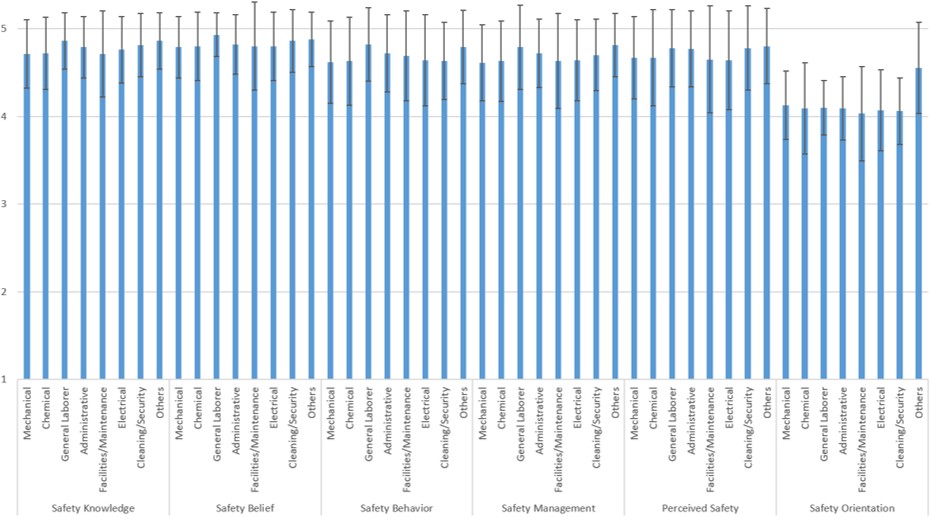
직무에 따른 안전의식 차이를 분석한 결과(Figure 5), 안전지식(F=2.492, p=.015), 안전행동(F=2.231, p=.030), 안전관리(F=2.923, p=.005), 안전성향(F=14.468, p<.001) 요인에서 통계적으로 유의한 차이가 나타났으나, 안전신념(F=1.175, p=.314)과 안전관리(체감)(F=1.652, p=.118)는 유의한 차이가 나타나지 않았다. 안전지식, 안전행동, 안전관리 요인에서는 보통인부 및 기타 직무의 인식 수준이 높은 반면, 기계직무의 인식은 상대적으로 낮게 나타났다. 특히 안전성향은 기타 직무(M=4.55)가 가장 높았으며, 시설/유지보수 직무(M=4.03)가 가장 낮게 나타났다. 기계직무의 경우 일상정비업무로 인해 반복작업에 따른 안전불감증이 발생할 수 있으며, 스트레스나 기분 등 개인적 요인의 영향을 더 많이 받을 수 있다. 반면 기타 직무의 경우 상대적으로 다양한 업무를 수행하며 안전교육 기회가 많아 안전성향이 높을 수 있다.
4.6 Differences in safety awareness by age
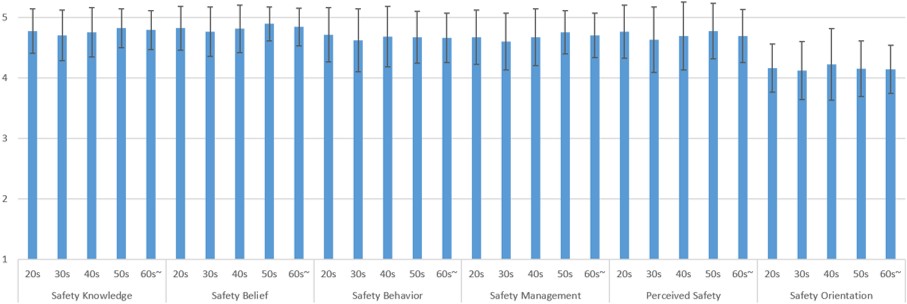
연령에 따른 요인별 안전의식 차이를 분석한 결과(Figure 6), 안전지식(F=2.974, p=.019), 안전신념(F=3.523, p=.007), 안전관리(F=3.055, p=.016), 안전관리(체감)(F=2.729, p=.028)에서 연령 간 유의한 차이가 나타났다. 반면 안전행동(F=0.953, p=.432)과 안전성향(F=1.054, p=.378) 요인에서는 통계적으로 유의한 차이가 나타나지 않았다. 안전지식, 안전신념, 안전관리, 안전관리(체감)는 전반적으로 50대 연령대에서 가장 높은 인식 수준을 보였으며(각각 Mean=4.82, 4.89, 4.75, 4.77), 30대 연령대에서 상대적으로 낮게 나타났다(각각 Mean=4.70, 4.76, 4.60, 4.63). 이는 현장 경험이 축적되고 안전교육을 지속적으로 받을수록 안전에 대한 지식과 신념, 조직의 안전관리 체계에 대한 이해가 향상되기 때문으로 해석된다. 반면 30대는 상대적으로 경력이 짧고 업무 숙련도가 낮아 안전의식이 상대적으로 낮게 나타난 것으로 분석된다.
4.7 Differences in safety awareness by job position
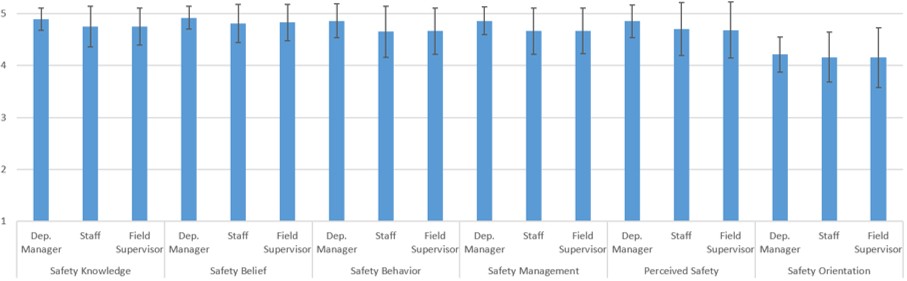
직급에 따른 안전의식 차이를 분석한 결과(Figure 7), 안전관리 요인에서만 유의한 차이가 있었고(F=3.297, p=.037), 나머지 요인에서는 유의하지 않았다. 부서장의 안전관리 의식(M=4.86)이 일반직원(M=4.66) 및 현장 감독자(M=4.67)보다 유의하게 높은 것으로 확인되었다. 이는 부서장급이 조직의 안전관리 체계와 정책에 대해 더 많이 이해하고 있으며, 안전관리 책임의식이 높기 때문으로 해석된다. 반면 안전지식, 안전신념, 안전행동, 안전성향 등에서는 직급 간 유의미한 차이가 없었다. 이러한 결과는 Choi and Lee (2022)의 연구에서 직급에 따른 안전의식 수준의 차이가 유의하지 않았다는 결과와 부분적으로 일치한다. 이는 협력업체의 안전의식이 직급이라는 조직 내 위계적 특성보다는 개인의 특성이나 조직문화 등에 더 큰 영향을 받을 수 있음을 시사한다.
4.8 Differences in safety awareness by tenure
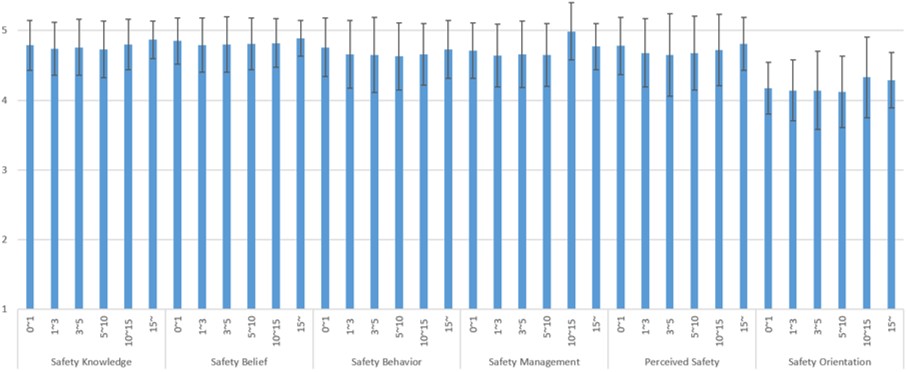
근무연수에 따른 요인별 인식의 차이를 분석한 결과(Figure 8), 안전성향 요인에서만 유의한 차이가 나타났다(F=2.667, p=.021). 10~15년 근무경력자가 가장 높은 안전의식 수준(M=4.33)을 보였으며, 5~10년 경력자(M=4.12)가 상대적으로 낮은 안전인식 수준을 보였다. 안전지식, 안전신념, 안전행동, 안전관리, 안전관리(체감) 요인에서는 근무연수에 따른 통계적으로 유의한 차이가 나타나지 않았다. 이는 Choi and Lee (2022)의 연구 결과와 일치하며, 협력업체의 교육체계가 표준화되어 있고 근무연수와 무관하게 일정 수준 이상의 안전교육이 제공되기 때문으로 해석된다. 다만 일부 선행연구에서는 근무연수가 증가할수록 안전의식이 향상되고 재해위험이 감소한다는 결과를 보고하였다(Scott et al., 2024; Gyekye and Salminen, 2009). 본 연구에서 근무연수에 따른 차이가 유의하지 않은 것은 연령, 교육시간, 사고경험 등의 변수를 통제하지 못했기 때문일 수 있으며, 향후 연구에서는 이러한 변수들을 함께 고려할 필요가 있다.
본 연구는 A 발전사 T 발전본부 협력업체 8개 기관 소속 작업자 831명을 대상으로 안전의식 수준을 측정하고, 인구통계학적 특성을 포함한 다양한 요인에 따른 차이를 실증적으로 분석하였다. 주요 연구 결과를 요약하면 다음과 같다. 첫째, 작업자 안전의식에 가장 두드러진 영향을 미치는 요인은 소속 협력업체로 나타났다. 6개 안전의식 요인(안전지식, 안전신념, 안전행동, 안전관리, 안전관리(체감), 안전성향) 모두에서 협력업체 간에 통계적으로 유의한 차이가 확인되었다. 둘째, 성별, 연령, 직무 등 개인적 특성 또한 대부분의 안전의식 요인에서 유의한 차이를 보였다. 여성이 남성보다 안전지식, 안전신념, 안전관리 인식이 높았고, 50대가 30대보다 대부분의 요인에서 높은 안전의식을 보였으며, 기계직무가 기타 직무보다 낮은 안전의식을 보였다. 셋째, 직급과 근무연수 같은 조직 내 위계적 특성은 안전의식에 제한적 영향만을 미쳤다. 직급은 안전관리 요인에서만, 근무연수는 안전성향 요인에서만 유의한 차이를 보였다. 넷째, 교대 근무자가 일근 근무자보다 안전체감을 유의하게 낮게 인식하였다.
본 연구는 발전산업 협력업체 작업자의 안전의식을 다차원적으로 측정하고 비교 분석함으로써 안전문화 연구의 실증적 기반을 확대하였다. 그리고 협력업체별 안전의식의 차이를 실증적으로 규명함으로써, 안전문화가 각 조직의 고유한 환경에 따라 개별적으로 형성될 수 있음을 확인하였다. 또한, 직급이나 근무연수보다 소속 조직, 성별, 연령, 직무 등이 안전의식에 더 큰 영향을 미친다는 것을 밝힘으로써, 안전의식 형성 메커니즘에 대한 이해를 심화하였다.
본 연구 결과는 화력발전 회사 협력업체의 안전관리 정책 수립에 관한 주요한 시사점을 제공한다. 첫째, 협력업체별 맞춤형 안전관리 프로그램이 필요하다. 협력업체마다 안전의식 수준과 패턴이 상이하므로, 획일적인 안전정책보다는 각 협력업체의 특성을 고려한 세분화된 접근이 요구된다. 특히 안전의식 수준이 낮은 협력업체에 대해서는 집중적인 안전지원과 컨설팅이 필요하다. 둘째, 30대 작업자와 기계직무 종사자를 대상으로 한 집중적인 안전교육이 필요하다. 이들 집단은 상대적으로 낮은 안전의식을 보였으므로, 맞춤형 안전교육 프로그램과 멘토링 제도를 운영할 필요가 있다. 셋째, 교대 근무자를 위한 안전관리 체계 강화가 필요하다. 야간 안전관리자 배치, 교대조별 안전교육 프로그램 운영, 24시간 안전소통 채널 구축 등을 통해 교대 근무자가 안전관리를 충분히 체감할 수 있도록 해야 한다. 넷째, 여성 작업자의 높은 안전의식을 활용한 안전문화 확산 전략이 필요하다. 여성 작업자를 안전 리더로 육성하거나 안전활동 모범 사례를 공유하는 등의 방안을 고려할 수 있다. 다섯째, 객관적 안전활동 수준 평가와 함께 작업자의 주관적 안전의식 수준을 주기적으로 측정하여 안전관리 정책에 반영해야 한다. 객관적 지표만으로는 포착하기 어려운 현장의 안전문화 수준을 파악할 수 있다.
하지만, 본 연구는 몇 가지의 한계를 갖는다. 첫째, 단일 발전본부 협력업체만을 대상으로 하였으므로, 연구 결과를 일반화하는 데 한계가 있다. 향후 다양한 발전본부와 업종의 협력업체를 포함한 후속 연구가 필요하다. 둘째, 정량적 지표만을 사용하였으며, 정성적 지표(조직문화, 리더십, 안전소통 등)를 함께 고려하지 못한 한계가 있다. 향후 혼합연구방법을 활용하여 양적 · 질적 측면을 모두 고려한 연구가 필요하다. 셋째, 횡단 연구(Cross-sectional Study)로 설계되어 안전의식의 변화 추이를 파악하지 못하였다. 향후 종단 연구(Longitudinal Study)를 통해 안전의식의 변화 패턴과 영향요인을 규명할 필요가 있다. 넷째, 동방의 경우 응답의 편향 가능성이 제기되었으나, 이를 검증할 수 있는 질적 연구나 추가 분석을 수행하지 못하였다. 향후 심층 인터뷰나 관찰 연구를 통해 조직문화의 특수성을 규명할 필요가 있다. 다섯째, 안전의식과 실제 안전행동, 산업재해 발생률 간의 관계를 분석하지 못하였다. 향후 안전의식이 실제 안전성과에 미치는 영향을 검증하는 연구가 필요하다. 향후 연구에서는 최적 설문 문항을 통해 안전문화와 조직풍토를 측정하고, 파악된 요인들과 종합적으로 분석하여 안전시스템 관점의 통합 안전관리 방안을 도출할 필요가 있다. 또한 원청의 안전지원이 협력업체의 안전의식 형성에 미치는 영향을 매개효과 분석을 통해 규명하는 연구도 의미가 있을 것이다. 마지막으로, T 발전본부 협력업체 구성원 안전의식 사례를 통한 교훈을 활용하여, 발전산업 전반의 안전문화 구축과 현장 기반 안전보건관리체계 유지를 위한 지속적인 실행, 개선방안 도출 및 환류가 필요하다.
References
1. Ahn, K.Y., Appling the Job Demands-Resources Model to Safety Participation and the Moderating Effect of Safety Self-Efficacy, Journal of the Korea Safety Management & Science, 16(1), 109-117, 2014, https://doi.org/10.12812/ksms.2014.16.1.109.
2. Baek, S.S., Jang, G.S. and Park, C.K., The Effect of the Contractor's Safety Support on the Safety Behavior Level of Subcontractor Workers: Focusing on the Mediating Effect of Safety Culture, Journal of Safety Culture, 10, 185-200, 2024.
3. Bena, A., Giraudo, M., Leombruni, R. and Costa, G., Job tenure and work injuries: a multivariate analysis of the relation with previous experience and differences by age, BMC Public Health, 13, 1-9, 2013, https://doi.org/10.1186/1471-2458-13-869.
Google Scholar
4. Choi, J.D. and Lee, S.J., The Effect of Safety Awareness Perceived by Construction Workers on Unsafe Act: Mediation Effect of Job Satisfaction and the Adjustment Effect of Perceived Organizational Support, Journal of the Korea Academia-Industrial Cooperation Society, 20(6), 27-32, 2019, https://doi.org/10.5762/KAIS.2019.20.11.27.
5. Choi, J.H. and Lee, S.I., A Study on the Safety Consciousness Level of Workers according to the Perception of the Causes of Industrial Accidents, Proceeding of 2022 Fall Conference of Korean Institute of Fire Science and Engineering, 2022.
6. Clarke, S., The relationship between safety climate and safety performance: A meta-analytic review, Journal of Occupational Health Psychology, 11(4), 315-327, 2006, https://doi.org/10.1037/1076-8998.11.4.315.
Google Scholar
7. Gyekye, S., Organizational tenure and safety perceptions: a comparative analysis, Journal of Occupational Health and Safety, 22(4), 359-371, 2006.
Google Scholar
8. Kang, G.S. and Choi, J.W., Evaluation of the Actual Conditions for the Construction of a Firefighting Safety Management System in Domestic Power Plants, Journal of Korean Institute of Fire Science and Engineering, 32(1), 89-98, 2018, https://doi.org/ 10.7731/KIFSE.2018.32.1.089.
9. Kim, J.H., The Influence of Safety Culture on Safety Awareness and Safety Behavior of Manufacturing Workers: Focusing on the Mediating Effect of Safety Awareness, Journal of the Korea Contents Association, 19(12), 151-163, 2019, https://doi.org/10.5392/ JKCA.2019.19.12.151.
10. Lim, J.H., Pyeon, S.H. and Lee, B.K., A Study on the Difference of Safety Perception between Workers and Managers in Residential Construction Sites, Journal of the Korea Institute of Construction Safety, 7(2), 8-14, 2024, https://doi.org/10.20931/JCS.2024.7.2.008.
11. Maeil Business Newspaper, The Boundary of Subcontractor Safety Responsibility, 2024, https://www.mk.co.kr/news/business/ 11454153 (retrieved July 23, 2025).
12. Neal, A. and Griffin, M.A., A study of the lagged relationships among safety climate, safety motivation, safety behavior, and accidents at the individual and group levels, Journal of Applied Psychology, 91(4), 946-953, 2006, https://doi.org/10.1037/0021-9010.91.4.946.
Google Scholar
13. Park, H.J., Jeong, M.J., Jeong, R.N. and Heo, J.H., Correlation Analysis of Factors Affecting Safety Behavior of Logistics Center Workers, Journal of the International Culture and Digital Technology, 9(4), 155-161, 2021.
14. Park, Y.H., Analysis of Awareness on Safety and Health Education and Research on Improvement Plans, Journal of the Korea Academia-Industrial Cooperation Society, 21(4), 346-355, 2020, https://doi.org/10.5762/KAIS.2020.21.4.346.
15. Scott, A., Davis-Sramek, B. and Ketchen, D.J., Men at work...unsafely: Gender differences in compliance with safety regulations in the trucking industry, Production and Operations Management, 33(4), 995-1013, 2024, https://doi.org/10.1177/10591478241235145.
Google Scholar
16. Gyekye, S. and Salminen, S., Age and workers' perceptions of workplace safety: A comparative study, International Journal of Aging & Human Development, 68(2), 171-184, 2009, https://doi.org/10.2190/AG.68.2.d.
Google Scholar
PIDS App ServiceClick here!
