eISSN: 2093-8462 http://jesk.or.kr
Open Access, Peer-reviewed

eISSN: 2093-8462 http://jesk.or.kr
Open Access, Peer-reviewed
Sohae Kim
, Jimin Kwon
, Manjae Lee
, Yihun Jeong
10.5143/JESK.2026.45.3.191 Epub 2026 July 05
Abstract
Objective: The aim of this study is to compare existing construction safety signs with visually improved safety signs, to analyze differences in sign perception between Korean and foreign workers, and to examine the effectiveness of the improved signs.
Background: The construction industry is one of the most hazardous industries, with a high risk of occupational accidents, and the proportion of foreign workers has been steadily increasing in recent years. However, language-centered information alone has limitations in delivering immediate hazard recognition and clear meaning at construction sites. Therefore, there is a need for construction safety signs designed with visual information that can be understood intuitively.
Method: This study consisted of a preliminary survey and a main experiment. In the preliminary survey, 15 types of construction safety signs currently used at construction sites were evaluated, and 8 signs with low correct answer rates or poor comprehensibility were selected for redesign. A total of 30 participants, including 15 Koreans and 15 foreigners, took part in the main experiment. Visibility, confidence, and meaning congruence were evaluated for both existing and improved signs. A two-way mixed ANOVA was conducted with nationality and sign type as independent variables. Comprehension was analyzed based on the correctness of open-ended responses.
Results: The analysis of the main effect of sign type showed that, for most signs, the improved signs received higher ratings in visibility, confidence, and meaning congruence than the existing signs. In contrast, the main effect of nationality was not significant for any of the evaluation measures. However, significant interactions between nationality and sign type were found for some signs. Comprehension generally improved, but for several signs, improvements in visibility, confidence, and meaning congruence did not necessarily lead to better comprehension.
Conclusion: Visual-information-based improvements in construction safety signs were effective for both Korean and foreign workers. However, for some signs, improving visual elements alone was not sufficient to enhance meaning communication, and additional design efforts were needed to maintain a clear connection with the core concept of the sign.
Application: The findings of this study can be applied to the design of more intuitive and effective safety signs for construction sites where multinational workers work together.
Keywords
Construction safety signs Visual information Foreign workers Ergonomic design
한국의 건설업은 대표적인 3D (dirty, dangerous, difficult) 업종으로 분류되며 전체 산업재해의 30%를 차지할 만큼 높은 위험성을 가지 고 있다(Lee et al., 2021). 이러한 구조적 특성으로 인해 건설 현장은 만성적인 인력 부족 문제를 겪고 있으며, 이를 보완하기 위한 외 국인 근로자 의존도는 점차 확대되어 그 비중이 2020년 11.8%에서 2024년 14.7%로 꾸준히 증가하였다(Construction Workers Mutual Aid Association, 2025; Lee et al., 2025).
이러한 인력 구조의 변화와 맞물려 산재 노출 위험도 증가하고 있다. 2023년 통계에 따르면 외국인 근로자의 건설업 종사 비중은 12%에 불과했으나, 외국인 근로자 전체 산재 사고 건수 중 39.8%가 건설업에서 발생하여 인력 비중 대비 재해 발생 비율이 매우 높은 것으로 나타났다(Lee and Son, 2023). 특히 외국인 근로자가 산업재해로 사망할 위험은 국내 전체 근로자보다 약 1.71배나 높으며(Lee, 2025), 사망자 비중 또한 2020년 13.6%에서 2022년 15.1%로 증가하였다(Lee and Son, 2023). 이러한 통계는 건설업에 종사하는 외국인 근로자들이 다른 산업에 비해 상대적으로 높은 재해 위험에 지속적으로 노출되어 있음을 보여준다.
이러한 외국인 근로자의 산업재해를 예방하고 안전 수준을 향상하기 위해 정부와 관계 기관은 언어 장벽 완화에 초점을 둔 다각적인 정책을 추진하고 있다. 한국산업안전보건공단(Korea Occupational Safety and Health Agency, KOSHA)은 외국인 근로자를 산업재해로부터 보호하기 위해 영어, 중국어, 몽골어 등 16개국 언어로 번역된 안전보건 교육 자료를 제작 및 배포하고 있다(KOSHA, 2024). 고용노동부 역시 9개국 언어로 번역된 기초 안전보건 교육 표준 교재를 제공하고 있으며, 각 사업장에서 외국인 근로자 교육에 활용할 수 있도록 VR, 영상 등 비언어적 매체를 활용한 재해예방 자료를 배포하고 있다. 또한 외국인 커뮤니티 및 방문 교육 신청 사업장을 대상으로 찾아가는 산업안전보건 교육 프로그램도 운영하고 있다(Ministry of Employment and Labor, 2024). 이와 함께 제도적 안전장치도 강화되었다. 산업안전보건법 제37조 1항에 따라 외국인 근로자를 고용하는 사업주는 해당 근로자의 모국어로 표기된 안전표지를 작업 현장에 설치 · 부착하도록 의무화하고 있다(Occupational Safety and Health Act, 2024). 이처럼 정부는 외국인 근로자의 언어적 제약을 완화하고 안전 정보에 대한 접근성을 높이기 위해 다각적인 노력을 기울이고 있다.
그러나 이러한 정책적 노력에도 불구하고, 건설 현장에서 외국인 근로자의 즉각적인 위험 상황 인지에는 한계가 존재한다. 건설 현장은 다수의 작업이 동시에 진행되는 고부하 작업 환경으로, 이에 따라 작업자의 인지 부하가 증가하며 위험 요소를 간과할 가능성이 최대 3.8배까지 증가할 수 있는 것으로 나타났다(Hasanzadeh et al., 2017). 이러한 환경에서는 위험 요소를 사전에 예측하고 핵심 영역을 신속하게 파악할 수 있는 즉각적이고 직관적인 정보 전달 수단이 필수적이다. Liu et al. (2021)에 따르면 의미 정보를 포함한 시각적 신호는 작업자가 위험 상황을 빠르게 인식하고 적절한 반응을 하도록 유도하는 데 효과적인 역할을 수행한다. 특히 건설 현장에 종사하는 외국인 근로자는 언어 및 문화적 배경의 차이로 인해 안전 정보를 이해하고 적용하는 과정에서 추가적인 인지적 부담을 겪을 가능성이 크다. 산업안전보건법 제37조 1항에 따라 외국어 병기가 이루어지고 있으나, 현실적으로 모든 언어를 표기하는 데에는 한계가 존재한다. 또한 과도한 다언어 정보 제공은 오히려 정보 과부하를 유발하여 작업자의 인지 속도를 저하시킬 수 있다는 지적도 제기되고 있다(Fang et al., 2022). 이러한 맥락에서 즉각적인 위험 인지가 요구되는 건설 현장에서는 언어 해독 과정 없이도 한눈에 위험을 파악할 수 있는 시각적 경고 수단으로서 안전표지가 더욱 중요하다. 따라서 외국인 근로자를 포함한 다양한 작업자가 직관적으로 위험을 인지할 수 있도록 기존 안전표지의 시각적 구성 요소를 개선할 필요가 있다.
안전표지에 관한 기존 연구를 살펴보면, Weng and Ren (2025)은 안전표지의 인식률과 이해도가 높을수록 실제 안전 행동으로 이어질 가능성이 높음을 확인하였다. 또한 Chen et al. (2018)은 안전표지의 색상, 형태, 텍스트, 그래픽 구성과 같은 설계 요소에 따라 인식 성능이 달라짐을 분석하였으며, Kwon et al. (2024)은 텍스트 전용 표지와 그림 전용 표지를 비교하여 텍스트 전용 표지가 상대적으로 낮은 인지 부하를 유발한다고 보고하였다. 그러나 해당 연구들은 주로 안전표지 자체의 설계 특성과 인지적 효과에 초점을 두고 있어, 언어 및 문화적 배경이 상이한 사용자 집단, 특히 외국인 근로자를 충분히 고려하지 못한 한계가 있다. Kim et al. (2020)은 이해도가 낮은 안전표지를 선별하여 개선 방안을 제안하였으나, 한국인만을 대상으로 수행되었기 때문에 언어 장벽을 지닌 외국인 근로자에게 동일한 결과를 적용하는 데에는 한계가 있다. Min et al. (2026)은 ISO 9186-1 기준에 따라 외국인과 한국인 근로자 간 안전보건표지 인식률 차이를 효과적으로 비교 및 분석하였으나, 구체적인 안전표지 설계 개선안까지는 제시하지 않았다.
이처럼 안전표지의 인식률과 이해도, 그리고 시각적 표현 방식이 작업자의 인지 부하와 안전 행동에 영향을 미친다는 점은 기존 연구에서 지속적으로 논의되어 왔다. 하지만 위의 선행 연구들은 주로 한국인을 대상으로 수행되거나, 외국인 근로자를 포함한 경우에도 연구 대상의 확장에 비해 설계적 적용 방안까지는 충분히 제시되지 못하였다. 또한 다언어 표기나 텍스트 중심의 정보 제공 방식은 외국인 근로자에게 오히려 인지 부하를 유발할 수 있으므로(Fang et al., 2022), 시각 정보 중심으로 개선된 안전표지가 필요하다.
따라서 본 연구는 건설 현장에서 사용되는 기존 안전표지와 시각 정보 중심의 개선된 안전표지를 비교하여 한국인과 외국인 근로자의 인지 차이를 분석하고, 이를 기반으로 개선 표지의 효과를 확인하고자 한다.
2.1 Participants
본 연구는 사전 설문과 본 실험의 두 단계로 구성되었다. 사전 설문에는 한국인 4명과 외국인 1명이 참여하였으며, 참여자 전원은 20대였다. 본 실험에는 20~40대 연령의 총 30명(한국인 15명, 외국인 15명)이 참여하였다. 본 실험에 참여한 한국인은 남성 14명과 여성 1명으로 구성되었다. 외국인 참여자는 중국 10명, 우즈베키스탄 2명, 몽골 · 베트남 · 인도네시아 출신 각 1명으로 구성되었으며, 성별은 남성 14명, 여성 1명이었다.
모든 참여자는 한국에서 1년 이상의 건설 현장 근무 경험을 보유한 자를 대상으로 선정하였다. 이는 현장 안전표지의 문제점을 인식하고 개선 의견을 제시할 수 있는 참여자를 확보하기 위함이다. 또한 모든 참여자는 교정시력이 0.5 이상으로 안전표지를 인지하는 데 시각적 어려움이 없는 조건을 갖추었다.
2.2 Experimental environment
산업안전보건기준에 관한 규칙 제8조에 명시된 작업 환경 조도 기준(보통작업 150 lux 이상)을 준용하여, 실험실의 조도를 150 lux 이상으로 유지하였다(Rules on Occupational Safety and Health Standards, 2025). 참가자들은 정자세로 앉아 컬러로 프린트된 A4 용지 크기의 표지를 약 60cm 거리를 두고 무작위로 제시 받았으며, 이후 각 표지에 대한 인지 및 이해도를 측정하기 위해 설문지에 응답을 기재하였다.
2.3 Experimental design
2.3.1 Preliminary survey
사전 설문에서는 건설 현장에서 빈번하게 발생하는 사고 유형인 떨어짐, 깔림, 물체에 맞음 등을 고려하여(Lee and Son, 2023), 산업안전보건법 시행규칙(별표 6)에서 규정한 안전보건표지 중 이와 관련된 총 15종의 표지(보행 금지, 탑승 금지, 물체 이동 금지, 매달린 물체 경고, 낙하물 경고, 몸균형 상실 경고, 위험장소 경고, 안전모 착용, 방독마스크 착용, 귀마개 착용, 안전화 착용, 응급구호 표지, 들것, 비상구, 비상용 기구)를 제시하고, 각 표지의 의미에 대해 응답하도록 하였다(Enforcement Rule of the Occupational Safety and Health Act, 2025). 사전 설문 결과를 바탕으로 정답률이 낮거나 의미 해석에 어려움이 확인된 표지를 개선이 필요한 표지로 최종 선정하였으며, 해당 표지에 대해서는 참여자 피드백을 반영하여 개선 표지를 제작하였다.
2.3.2 Main experiment
본 실험에서는 최종 선정된 8종의 기존 표지(Existing)와 개선 표지(Improved)에 대해 시인성(Visibility), 의미이해도(Comprehension), 확신도(Confidence), 의도부합성(Meaning congruence)을 평가하였다. 시인성, 확신도, 의도부합성은 Likert 7점 척도로 측정하였고, 의미이해도는 표지가 전달하는 의미를 주관식으로 기술하도록 한 뒤 이를 정오 여부로 평가하였다. 설문 문항은 Table 1에 제시하였다.
|
Evaluation criteria |
Evaluation questions |
|
Visibility |
Does the shape or color of the sign stand out clearly from the
surroundings? |
|
Comprehension |
What do you think the sign is intended to communicate? |
|
Confidence |
How confident are you that your interpretation of the sign is
correct? |
|
Meaning congruence |
Do you think this sign is well designed to match its intended
meaning? |
2.4 Experimental procedure
실험 시작 전 연구 목적과 절차를 참여자에게 설명하고 서면 동의를 받은 후, 참여자의 기본 정보(국적, 연령대, 성별, 건설 현장 경험)를 확인하였다. 사전 설문에서는 사고 유형과 관련된 안전보건표지 총 15종을 제시하고, 각 표지가 의미하는 바에 대해 질문하였다. 이후 정답률이 낮거나 의미 이해가 어렵다고 판단된 표지에 대해서는 참여자에게 피드백을 요청하였다.
본 실험에서는 기존 표지(Existing)와 개선 표지(Improved)를 무작위 순서로 1개씩 제시하여 시인성(Visibility), 의미이해도(Comprehension), 확신도(Confidence), 의도부합성(Meaning congruence) 순으로 측정하였다. 모든 표지에 대한 응답을 완료한 후 설문지를 회수하였으며, 조건 순서의 무작위화는 참여자별로 적용하여 순서 효과를 최소화하였다.
2.5 Statistical analyses
본 연구에서는 최종 선정된 각 표지(Sign)별로 기존안과 개선안 간의 효과 차이 및 국적에 따른 차이를 개별적으로 확인하였고, 이를 바탕으로 각 표지의 개선 효과를 평가하기 위해 통계분석을 수행하였다. 이를 위해 각 표지(Sign)에 대하여 개별적인 이원 혼합 설계 분산분석(Two-way mixed ANOVA)를 수행하였으며, 독립변수에서 집단 간 요인(Between-subject factor)은 국적(Nationality: Korean, Foreigner)이며, 집단 내 요인(Within-subject factor)은 표지 유형(Type: Existing, Improved)으로 설정하였다. 종속변수는 각 표지(Sign)에 대한 평가 점수(시인성, 의미이해도, 확신도, 의도부합성)였다. 또한 표지 유형(Type)과 국적(Nationality) 간의 교호작용 효과를 확인하였으며, 단순 주효과 분석(Simple main effects)을 추가 수행하여 집단 별 차이를 확인하였다.
의미이해도(Comprehension)의 경우 각 표지가 무엇을 뜻하는지에 대한 주관식 질문을 구성하였다. 주관식 응답은 사전에 구성한 의미 기반 정답 판별 절차를 분석하였으며, 각 문항에서 정답을 구성하는 핵심 의미 요소를 기준으로 응답의 적절성을 판단하였다. 유사한 개념을 서로 다른 표현으로 서술한 경우, 표준국어대사전과 영한/한영사전에 제시된 유의어 관계를 참고 자료로 활용하여 응답을 일관되게 분석하였다. 이에 대해 정답의 기준을 충족하는 경우 1점, 충족하지 못하는 경우를 0점으로 이분화하여 측정하였다. 이후 각 표지 별로 기존 표지와 개선 표지에 대한 정답률을 산출하였으며, 국적별 정답률 차이와 표지 유형에 따른 변화 경향을 기술통계로 제시하였다.
모든 통계분석은 SPSS Statistics 29 (IBM, USA)를 이용하여 수행하였으며 유의수준(α)은 0.05로 설정하였다.
3.1 Existing and improved construction safety signs
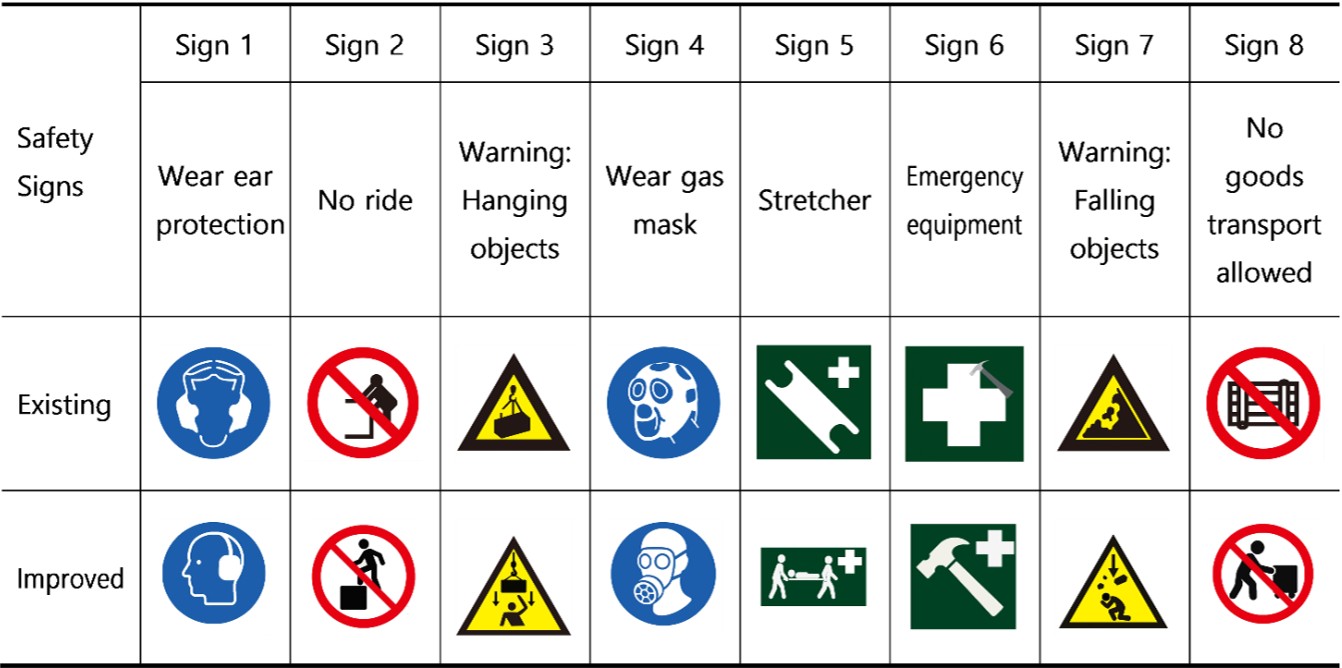
사전 설문 결과를 바탕으로 정답률이 낮거나 의미 이해가 어렵다고 판단된 총 8종의 표지를 선정하였다. 최종 선정된 표지는 귀마개 착용(Wear ear protection), 탑승 금지(No ride), 매달린 물체 경고(Warning: Hanging objects), 방독마스크 착용(Wear gas mask), 들것(Stretcher), 비상용 기구(Emergency equipment), 낙하물 경고(Warning: Falling objects), 물체 이동 금지(No goods transport allowed) 이다(Figure 1). 선정된 8종의 표지에 대해서는 사전 설문에서 수집된 참여자 피드백을 반영하여 개선하였다. 모든 표지는 산업안전보건법 제40조(안전보건표지의 제작 기준)에 명시된 색상 및 형태 규정을 준수하였으며(Occupational Safety and Health Act, 2022), 기존 표지(Existing)와 개선 표지(Improved)는 Figure 1에 제시하였다.
3.2 Main effects of type in two-way ANOVA
최종 선정된 8개의 기존 표지(Existing)와 개선 표지(Improved)의 시인성(Visibility), 확신도(Confidence), 의도부합성(Meaning congruence)에 대해 표지 유형(Type)의 주효과를 분석하였다.
3.2.1 Visibility
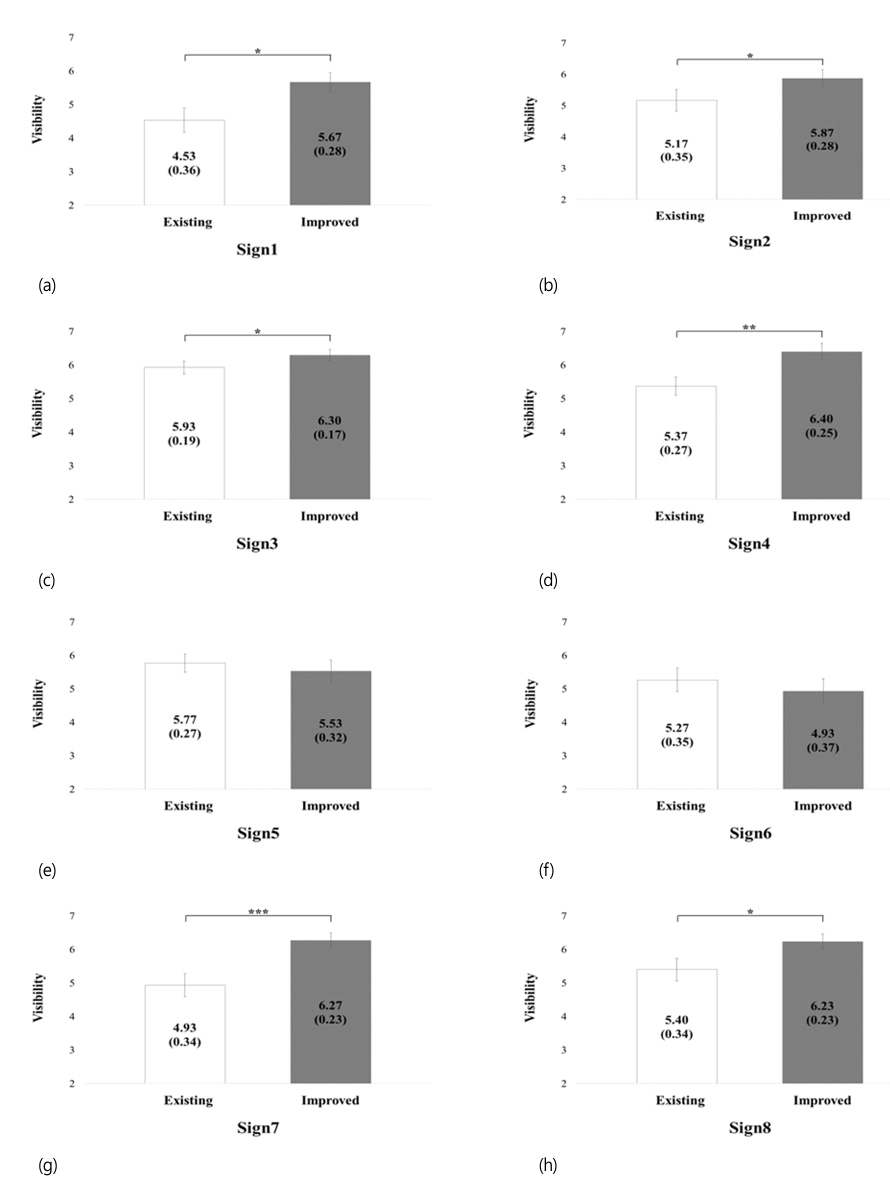
시인성(Visibility)에서 Type (Existing, Improved)에 따른 주효과 분석 결과, Sign 5(들것, Stretcher)와 6(비상용 기구, Emergency equipment)을 제외한 모든 표지에서 통계적으로 유의한 차이가 나타났으며(p<0.05), 개선 표지(Improved)가 기존 표지(Existing)에 비해 유의하게 더 높은 시인성 점수를 보였다. 구체적으로 Sign 1은 F(1, 28)=6.474, p=0.017, ηp2=0.188, Sign 2는 F(1, 28)=4.276, p=0.048, ηp2=0.132, Sign 3은 F(1, 28)=4.924, p =0.035, ηp2=0.150, Sign 4는 F(1, 28)=9.721, p=0.004, ηp2=0.258, Sign 7은 F(1, 28)=21.497, p<.001, ηp2=0.434, Sign 8은 F(1, 28)=7.068, p=0.013, ηp2=0.202으로 나타났다. 통계적으로 유의하지 않은 Sign 5와 6의 평균값 비교를 살펴보면, 개선 표지가 기존 표지에 비해 더 낮은 시인성 점수를 보였다(Figure 2).
3.2.2 Confidence
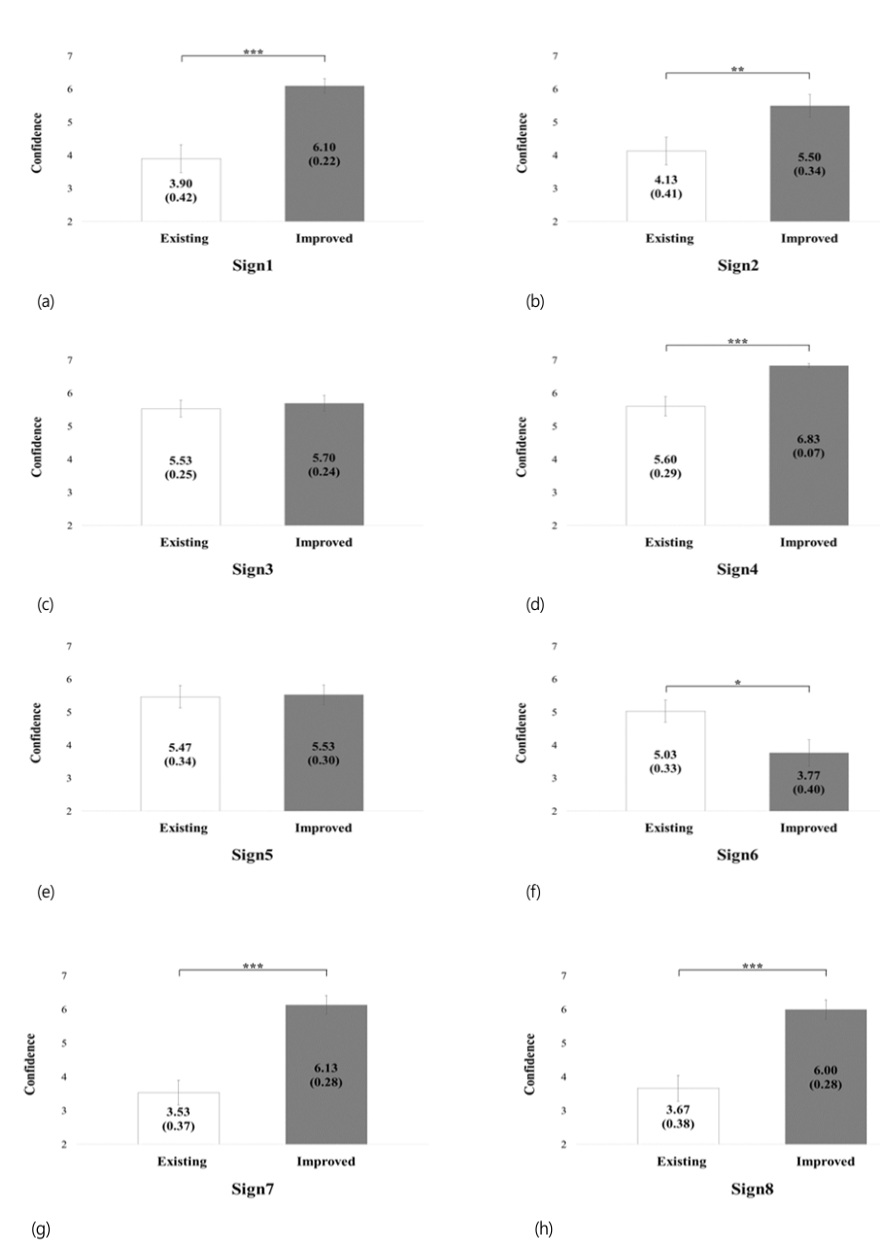
확신도(Confidence)에서 Type (Existing, Improved)에 따른 주효과 분석 결과, Sign 3(매달린 물체 경고, Warning: Hanging objects)과 5(들것, Stretcher)를 제외한 모든 표지에서 통계적으로 유의한 차이가 나타났으며(p<0.05), 개선 표지(Improved)가 기존 표지(Existing)에 비해 유의하게 더 높은 확신도 점수를 보였다(Figure 3). 구체적으로 Sign 1은 F(1, 28)=28.497, p<0.001, ηp2=0.504, Sign 2는 F(1, 28) =8.166, p=0.008, ηp2=0.226, Sign 4는 F(1, 28)=19.204, p<0.001, ηp2=0.407, Sign 6은 F(1, 28)=5.928, p=0.022, ηp2=0.175, Sign 7은 F(1, 28)=35.052, p<0.001, ηp2=0.556, Sign 8은 F(1,28)=31.182, p<0.001, ηp2=0.527으로 나타났다. Sign 3과 5의 경우 개선 표지가 기존 표지보다 약간 더 높은 평균값을 보였으나, 통계적으로 유의하지는 않았다(Figure 3).
3.2.3 Meaning congruence
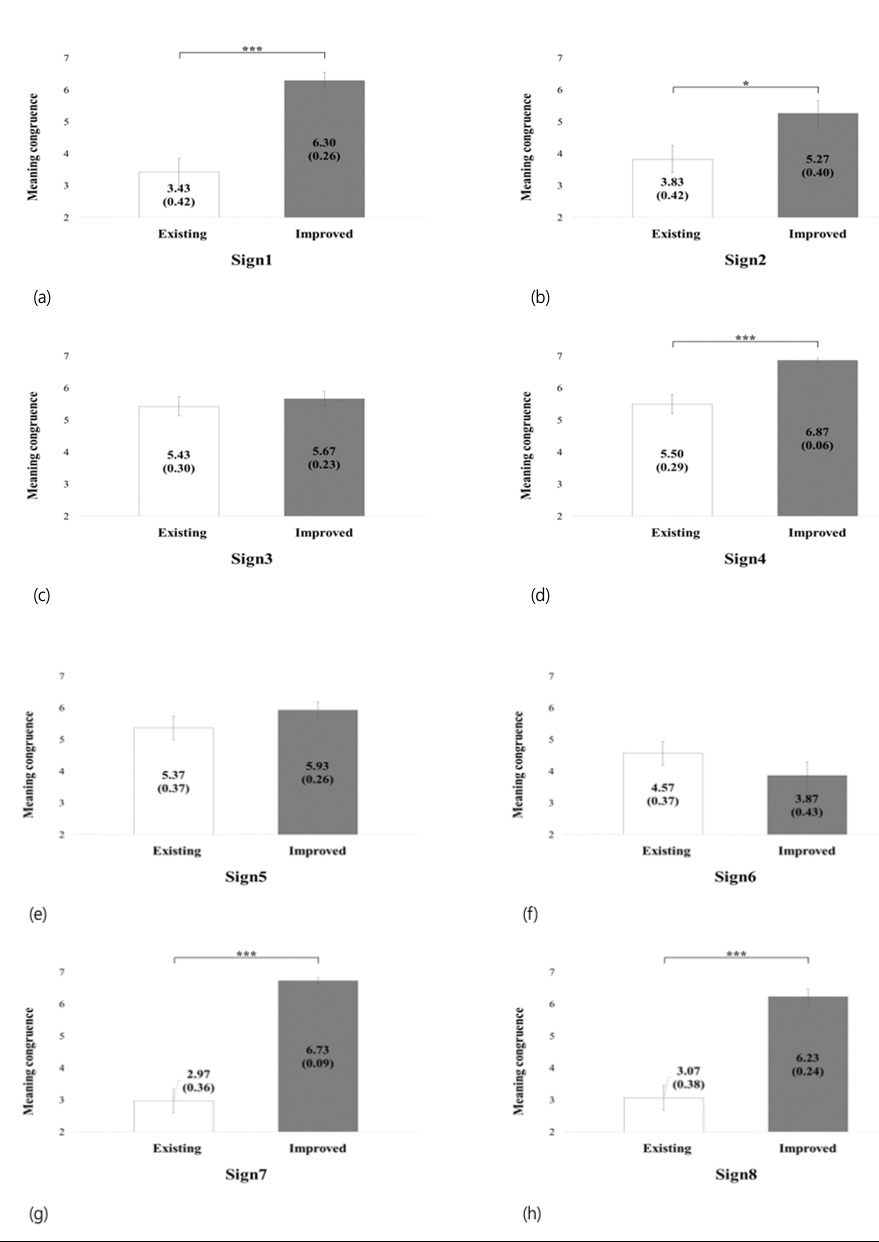
의도부합성(Meaning congruence)에서 Type (Existing, Improved)에 따른 주효과 분석 결과, Sign 3(매달린 물체 경고, Warning: Hanging objects), 5(들것, Stretcher), 6(비상용 기구, Emergency equipment)을 제외한 모든 표지에서 통계적으로 유의한 차이가 나타났으며(p<0.05), 개선 표지(Improved)가 기존 표지(Existing)에 비해 유의하게 더 높은 의도부합성 점수를 보였다(Figure 4). 구체적으로 Sign 1은 F(1, 28)=42.893, p<0.001, ηp2=0.605, Sign 2는 F(1, 28)=7.199, p=0.012, ηp2=0.205, Sign 4는 F(1, 28)=22.796, p<0.001, ηp2=0.449, Sign 7은 F(1, 28)=96.318, p<0.001, ηp2=0.775, Sign 8은 F(1,28)=63.556, p<0.001, ηp2=0.694으로 나타났다. 통계적으로 유의하지 않은(p>0.05) 표지 중 Sign 3과 5의 경우 개선 표지가 기존 표지에 비해 더 높은 점수를 보였으나, Sign 6에서는 개선 표지가 기존 표지에 비해 더 낮은 의도부합성 점수를 보였다(Figure 4).
3.3 Main effects of Nationality in two-way ANOVA
최종 선정된 8개의 기존 표지(Existing)와 개선 표지(Improved)의 시인성(Visibility), 확신도(Confidence), 의도부합성(Meaning congruence)에 대해 국적(Nationality)의 주효과를 분석하였다.
3.3.1 Visibility
시인성(Visibility)에 대한 국적(Nationality)의 주효과 분석 결과, 모든 표지에서 국적 간 차이는 통계적으로 유의하지 않았다(p>0.05, Table 2).
|
Sign No. |
Korean (n=15) |
Foreigner (n=15) |
F |
p-value |
ηp2 |
|
Sign 1 |
5.1±1.15 |
5.1±1.4 |
0.000 |
1.00 |
0.000 |
|
Sign 2 |
5.97±0.92 |
5.07±1.89 |
2.758 |
0.108 |
0.090 |
|
Sign 3 |
6.23±0.65 |
6.00±1.04 |
0.546 |
0.466 |
0.019 |
|
Sign 4 |
5.13±1.21 |
5.07±0.93 |
0.579 |
0.453 |
0.020 |
|
Sign 5 |
5.37±1.34 |
5.93±1.59 |
1.112 |
0.301 |
0.038 |
|
Sign 6 |
5.13±1.25 |
5.07±1.75 |
0.014 |
0.905 |
0.000 |
|
Sign 7 |
5.83±0.86 |
5.37±1.74 |
0.870 |
0.359 |
0.030 |
|
Sign 8 |
6.10±0.76 |
5.53±1.71 |
1.381 |
0.250 |
0.047 |
3.3.2 Confidence
확신도(Confidence)에 대한 국적(Nationality)의 주효과 분석 결과, 모든 표지에서 국적 간 차이는 통계적으로 유의하지 않았다(p>0.05, Table 3).
|
Sign No. |
Korean (n=15) |
Foreigner (n=15) |
F |
p-value |
ηp2 |
|
Sign 1 |
4.80±1.42 |
5.20±1.50 |
0.562 |
0.460 |
0.020 |
|
Sign 2 |
4.97±1.36 |
4.67±1.81 |
0.264 |
0.611 |
0.009 |
|
Sign 3 |
5.33±1.05 |
5.90±0.97 |
2.372 |
0.135 |
0.078 |
|
Sign 4 |
6.10±0.85 |
6.33±0.82 |
0.588 |
0.449 |
0.021 |
|
Sign 5 |
5.47±1.16 |
5.53±1.64 |
0.017 |
0.889 |
0.001 |
|
Sign 6 |
4.00±1.02 |
4.80±1.72 |
2.404 |
0.132 |
0.079 |
|
Sign 7 |
4.87±1.08 |
4.80±1.52 |
0.019 |
0.891 |
0.001 |
|
Sign 8 |
4.83±1.3 |
4.83±1.51 |
0.000 |
1.000 |
0.000 |
3.3.3 Meaning congruence
의도부합성(Meaning congruence)에 대한 국적의 주효과 분석 결과, 모든 표지에서 국적 간 차이는 통계적으로 유의하지 않았다(p>0.05, Table 4).
|
Sign No. |
Korean (n=15) |
Foreigner (n=15) |
F |
p-value |
ηp2 |
|
Sign 1 |
5.07±1.07 |
4.67±1.79 |
0.553 |
0.463 |
0.019 |
|
Sign 2 |
4.83±1.47 |
4.27±1.87 |
0.851 |
0.364 |
0.029 |
|
Sign 3 |
5.43±0.92 |
5.67±1.41 |
0.288 |
0.596 |
0.010 |
|
Sign 4 |
6.00±0.82 |
6.37±0.83 |
1.468 |
0.236 |
0.050 |
|
Sign 5 |
5.73±1.10 |
5.57±1.61 |
0.109 |
0.743 |
0.004 |
|
Sign 6 |
4.10±1.50 |
4.33±1.98 |
0.132 |
0.719 |
0.005 |
|
Sign 7 |
5.10±1.06 |
4.60±0.87 |
2.004 |
0.168 |
0.067 |
|
Sign 8 |
4.47±1.29 |
4.83±1.44 |
0.542 |
0.468 |
0.019 |
3.4 Interaction effects (Type × Nationality)
최종 선정된 8개의 기존 표지(Existing)와 개선 표지(Improved)의 시인성(Visibility), 확신도(Confidence), 의도부합성(Meaning congruence)에 대해 표지 유형(Type)과 국적(Nationality)의 교호작용을 분석하였으며, 각 표지 별 개선 효과와 국적 별 차이를 보다 구체적으로 확인하기 위해 LSD (Least Significant Difference) 기준 단순 주효과(Simple main effects)를 분석하였다.
3.4.1 Visibility
시인성(Visibility)에서 표지 유형(Type)과 국적(Nationality)의 교호작용(Type × Nationality)을 표지별로 분석한 결과, Sign 1은 F(1, 28)= 0.806, p=.377, ηp2=0.028, Sign 2는 F(1, 28)=3.500, p=0.072, ηp2=0.111, Sign 3은 F(1, 28)=0.017, p=0.842, ηp2=0.001, Sign 4는 F(1, 28)= 0.819, p=0.373, ηp2=0.028, Sign 5는 F(1, 28)=0.147, p=0.704, ηp2=0.005, Sign 6은 F(1, 28)=0.014, p=0.905, ηp2=0.000, Sign 7은 F(1, 28)= 0.484, p=0.492, ηp2=0.017, Sign 8은 F(1, 28)=0.554, p=0.463, ηp2=0.019로 나타나 모두 통계적으로 유의하지 않았다.
Simple main effects on Type
표지 유형(Type)과 국적(Nationality)의 교호작용에서 표지 유형에 대한 단순 주효과(Simple main effects) 결과는 아래와 같다(Figure 5).
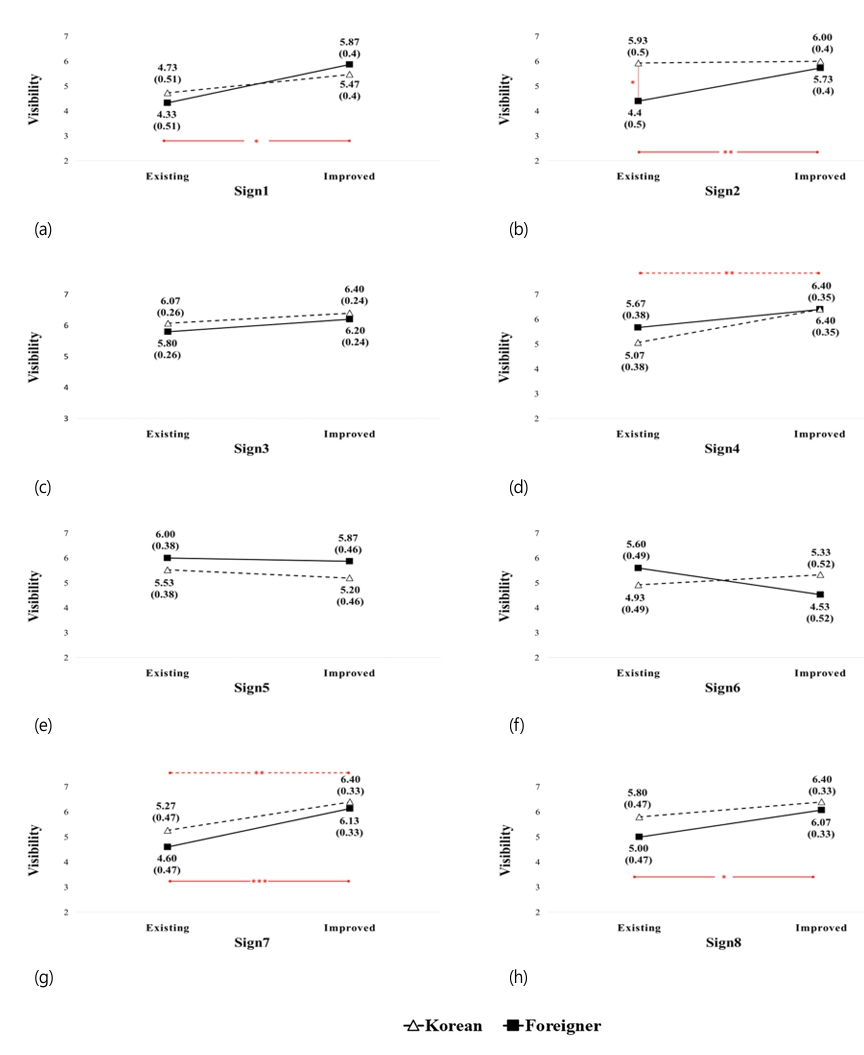
한국인의 경우 Sign 5(들것, Stretcher)를 제외하고 개선 표지가 기존 표지보다 시인성에서 더 높은 값을 기록하였다. 특히 Sign 4 (방독마스크 착용, Wear gas mask)와 7(낙하물 경고, Warning: Falling objects)에서 유의한 증가가 나타났다.
외국인의 경우 Sign 5(들것, Stretcher)와 6(비상용 기구, Emergency equipment)을 제외하고 개선 표지가 기존 표지보다 시인성에서 더 높은 값을 기록하였다. 특히 Sign 1(귀마개 착용, Wear ear protection), 2(탑승 금지, No ride), 7(낙하물 경고, Warning: Falling objects)과 8(물체 이동 금지, No goods transport allowed)에서 유의한 증가가 나타났다.
Simple main effects on Nationality
표지 유형(Type)과 국적(Nationality)의 교호작용에서 국적에 대한 단순 주효과(Simple main effects) 결과는 아래와 같다(Figure 5).
기존 표지의 경우 Sign 2(탑승 금지, No ride)를 제외하고 시인성에 대해 국적에 따른 유의한 차이가 없었다.
개선 표지의 경우 모든 표지에서 시인성에 대해 국적에 따른 유의한 차이가 없었다.
3.4.2 Confidence
확신도(Confidence)에서 표지 유형(Type)과 국적(Nationality)의 교호작용(Type × Nationality)을 표지별로 분석한 결과, Sign 1은 F(1, 28) =0.067, p=0.873, ηp2=0.002, Sign 2는 F(1, 28)=0.417, p=0.730, ηp2=0.015, Sign 3은 F(1, 28)=0.017, p=0.921, ηp2=0.001, Sign 4는 F(1, 28)=0.351, p=0.558, ηp2=0.012, Sign 5는 F(1, 28)=0.749, p=0.394, ηp2=0.026, Sign 6은 F(1, 28)=0.805, p=0.377, ηp2=0.028, Sign 7은 F(1, 28)=0.207, p=0.652, ηp2=0.007, Sign 8은 F(1, 28)=0.000, p=1.000, ηp2=0.000로 나타나 모두 통계적으로 유의하지 않았다.
Simple main effects on Type
표지 유형(Type)과 국적(Nationality)의 교호작용에서 표지 유형에 대한 단순 주효과(Simple main effects) 결과는 아래와 같다(Figure 6).
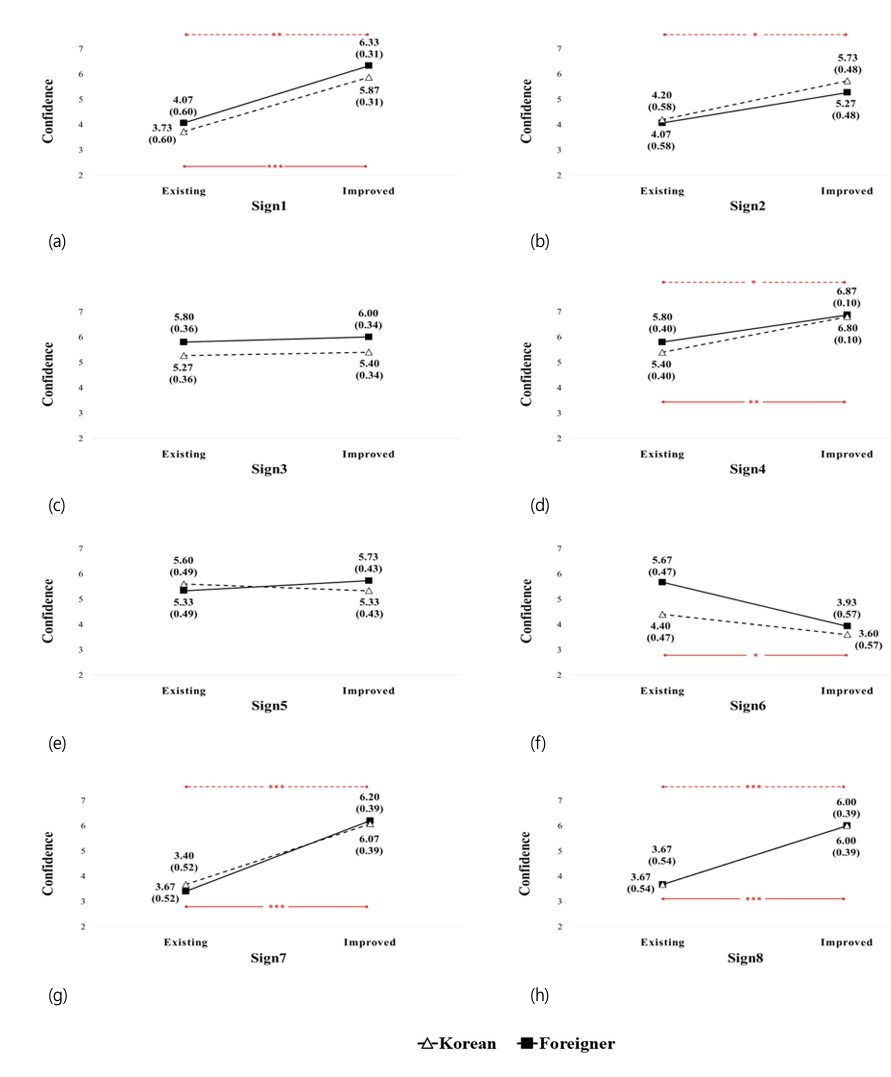
한국인의 경우 Sign 5(들것, Stretcher)와 6(비상용 기구, Emergency equipment)을 제외하고 개선 표지가 기존 표지보다 확신도에서 더 높은 값을 기록하였다. 특히 Sign 1(귀마개 착용, Wear ear protection), 2(탑승 금지, No ride), 4(방독마스크 착용, Wear gas mask), 7(낙하물 경고, Warning: Falling objects)과 8(물체 이동 금지, No goods transport allowed)에서 유의한 증가가 나타났다.
외국인의 경우 Sign 6을 제외하고 개선 표지가 기존 표지보다 확신도에서 더 높은 값을 기록하였다. 특히 Sign 1(귀마개 착용, Wear ear protection), 4(방독마스크 착용, Wear gas mask), 7(낙하물 경고, Warning: Falling objects)과 8(물체 이동 금지, No goods transport allowed)에서 유의한 증가가 나타났다.
Simple main effects on Nationality
표지 유형(Type)과 국적(Nationality)의 교호작용에서 국적에 대한 단순 주효과(Simple main effects) 결과는 아래와 같다(Figure 6).
기존 표지의 경우 모든 표지에서 확신도에 대해 국적에 따른 유의한 차이가 없었다.
개선 표지의 경우 모든 표지에서 확신도에 대해 국적에 따른 유의한 차이가 없었다.
3.4.3 Meaning congruence
의도부합성(Meaning congruence)에서 표지 유형(Type)과 국적(Nationality)의 교호작용(Type × Nationality)을 표지별로 분석한 결과, Sign 3에서만 F(1, 28)=8.988, p=0.006, ηp2=0.243으로 나타나 통계적으로 유의한 차이를 보였다. 반면 Sign 1은 F(1, 28)=1.137, p=0.295, ηp2=0.039, Sign 2는 F(1, 28)=1.191, p=0.666, ηp2=0.041, Sign 4는 F(1, 28)=1.638, p=0.211, ηp2=0.055, Sign 5는 F(1, 28)=0.007, p=0.933, ηp2=0.000, Sign 6은 F(1, 28)=1.078, p=0.308, ηp2=0.037, Sign 7은 F(1, 28)=0.370, p=0.548, ηp2=0.013, Sign 8은 F(1, 28)=1.190, p=0.285, ηp2=0.041으로 나타나 통계적으로 유의하지 않았다.
Simple main effects on Type
표지 유형(Type)과 국적(Nationality)의 교호작용에서 표지 유형에 대한 단순 주효과(Simple main effects) 결과는 아래와 같다(Figure 7).
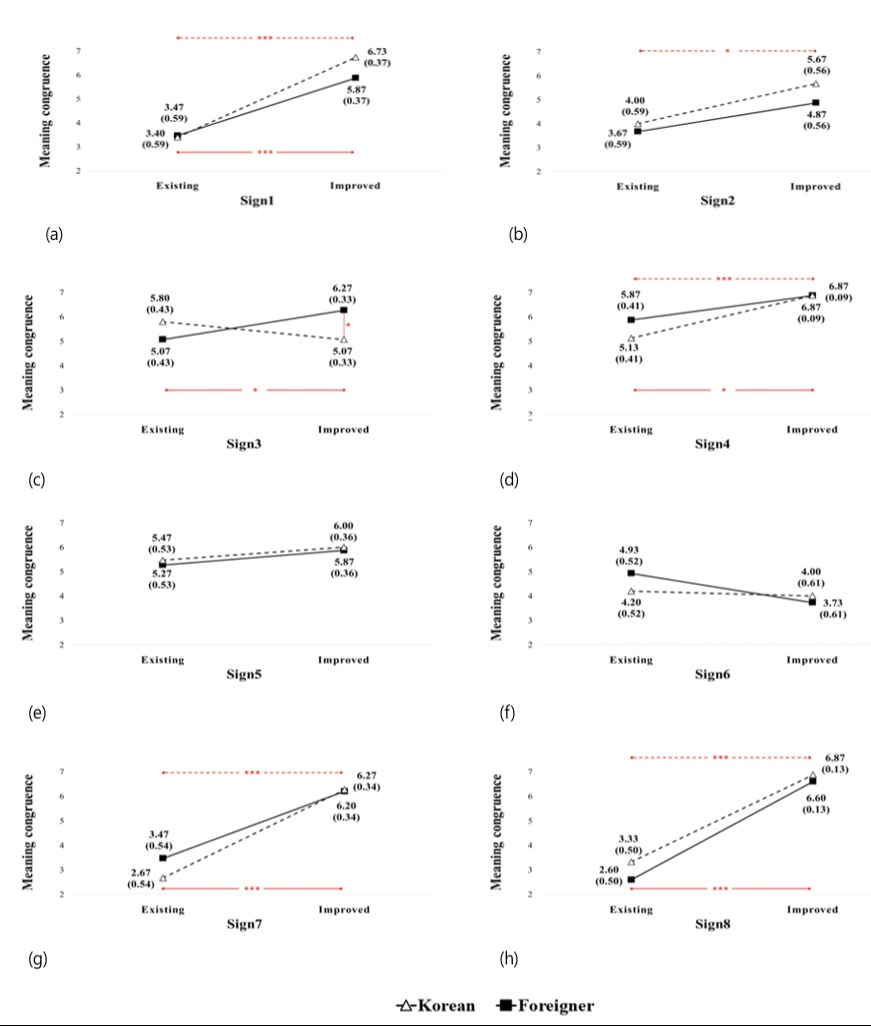
한국인의 경우 Sign 3(매달린 물체 경고, Warning: Hanging objects)과 6(비상용 기구, Emergency equipment)을 제외하고 개선 표지가 기존 표지보다 의도부합성에서 더 높은 값을 기록하였다. 특히 Sign 1(귀마개 착용, Wear ear protection), 2(탑승 금지, No ride), 4(방독마스크 착용, Wear gas mask), 7(낙하물 경고, Warning: Falling objects)과 8(물체 이동 금지, No goods transport allowed)에서 유의한 증가가 나타났다.
외국인의 경우 Sign 6(비상용 기구, Emergency equipment)을 제외하고 개선 표지가 기존 표지보다 의도부합성에서 더 높은 값을 기록하였다. 특히 Sign 1(귀마개 착용, Wear ear protection), 3(매달린 물체 경고, Warning: Hanging objects), 4(방독마스크 착용, Wear gas mask), 7(낙하물 경고, Warning: Falling objects)과 8(물체 이동 금지, No goods transport allowed)에서 유의한 증가가 나타났다.
Simple main effects on Nationality
표지 유형(Type)과 국적(Nationality)의 교호작용에서 국적에 대한 단순 주효과(Simple main effects) 결과는 아래와 같다(Figure 7).
기존 표지의 경우 모든 표지에서 의도부합성에 대해 국적에 따른 유의한 차이가 없었다.
개선 표지의 경우 Sign 3(매달린 물체 경고, Warning: Hanging objects)에서만 의도부합성에 대해 국적에 따른 유의한 차이가 있었다.
3.5 Comprehension
의미이해도(Comprehension)의 경우 주관식 응답에 대해 의미 기반 정답 판별 절차를 적용하여 0점과 1점으로 이분화하여 측정하였다. 그 결과 대부분의 표지에서 개선 표지의 정답률이 기존 표지보다 증가하였다. 한국인은 Sign 1, 2, 4, 6, 7, 8에서 개선 표지의 정답률이 개선되었다. 그러나 Sign 5는 기존 표지 86.7%에서 개선 표지 46.7%로 정답률이 감소하였다. 외국인은 Sign 1, 2, 4, 5, 7, 8에서 개선 표지의 정답률이 증가하였다. 그러나 Sign 3에서는 기존 표지 60%에서 개선 표지 33.3%로 정답률이 감소하였고, Sign 6은 기존 표지와 개선 표지의 정답률이 동일하였다(Table 5).
|
Korean |
|||
|
Sign No. |
Existing (n=15) |
Improved (n=15) |
Total (n=30) |
|
N (%) |
N (%) |
N (%) |
|
|
Sign 1. Wear ear protection |
3 (20.0%) |
11 (73.3%) |
14 (46.7%) |
|
Sign 2. No ride |
3 (20.0%) |
14 (93.3%) |
17 (56.7%) |
|
Sign 3. Warning: Hanging objects |
1 (6.7%) |
0 (0.0%) |
1 (3.3%) |
|
Sign 4. Wear gas mask |
12 (80.0%) |
13 (86.7%) |
25 (83.3%) |
|
Sign 5. Stretcher |
13 (86.7%) |
7 (46.7%) |
20 (66.7%) |
|
Sign 6. Emergency equipment |
4 (26.7%) |
5 (33.3%) |
9 (30.0%) |
|
Sign 7. Warning: Falling objects |
3 (20.0%) |
15 (100.0%) |
18 (60.0%) |
|
Sign 8. No goods transport allowed |
1 (6.7%) |
14 (93.3%) |
15 (50.0%) |
|
|
|||
|
Foreigner |
|||
|
Sign No. |
Existing (n=15) |
Improved (n=15) |
Total (n=30) |
|
N (%) |
N (%) |
N (%) |
|
|
Sign 1. Wear ear protection |
3 (20.0%) |
12 (80.0%) |
15 (50.0%) |
|
Sign 2. No ride |
8 (53.3%) |
10 (66.7%) |
18 (60.0%) |
|
Sign 3. Warning: Hanging objects |
9 (60.0%) |
5 (33.3%) |
14 (46.7%) |
|
Sign 4. Wear gas mask |
12 (80.0%) |
15 (100.0%) |
27 (90.0%) |
|
Sign 5. Stretcher |
11 (73.3%) |
13 (86.7%) |
24 (80.0%) |
|
Sign 6. Emergency equipment |
2 (13.3%) |
2 (13.3%) |
4 (13.3%) |
|
Sign 7. Warning: Falling objects |
5 (33.3%) |
14 (93.3%) |
19 (63.3%) |
|
Sign 8. No goods transport allowed |
5 (33.3%) |
13 (86.7%) |
18 (60.0%) |
4.1 Main findings
본 연구는 건설 현장에서 사용되는 기존 안전표지 8종과 시각 정보 중심 개선 표지 8종을 비교하여 한국인과 외국인의 표지 인지 차이 및 개선 표지의 효과를 평가하였다. 그 결과 표지 유형(Type)의 주효과는 대부분의 표지에서 유의하게 나타났으며, 개선 표지(Improved)가 기존 표지(Existing)보다 시인성(Visibility), 확신도(Confidence), 의도부합성(Meaning congruence)에서 높은 점수를 기록하였다(Figures 2-4). 반면 국적(Nationality)의 주효과는 모든 평가 항목에서 통계적으로 유의하지 않았다(Tables 2-4). 표지 유형(Type)과 국적(Nationality)의 교호작용은 다수 표지에서 관찰되었으며(Figures 5-7), 의미이해도(Comprehension)에서는 전반적인 점수 증가에도 불구하고 일부 표지(Sign 3, 5, 6)에서 시각적 개선이 실제 이해로 이어지지 않았다(Figures 2-7, Table 5).
표지 유형(Type)의 주효과는 시인성(Visibility), 확신도(Confidence), 의도부합성(Meaning congruence)에서 대부분의 개선 표지가 기존 표지보다 유의하게 높은 점수를 기록하였다(Figures 2-4). 시인성은 Sign 5(들것, Stretcher)와 6(비상용 기구, Emergency equipment)을 제외한 모든 표지에서(Figure 2), 확신도는 Sign 3(매달린 물체 경고, Warning: Hanging objects)과 5(들것, Stretcher)를 제외한 모든 표지에서(Figure 3), 의도부합성은 Sign 3(매달린 물체 경고, Warning: Hanging objects), 5(들것, Stretcher)와 6(비상용 기구, Emergency equipment)을 제외한 모든 표지에서 개선 표지가 기존 표지보다 유의하게 높은 점수를 보였다(Figure 4). 이러한 결과는 다수의 개선 표지에서 주변 환경 대비 형태 또는 색상이 더 두드러졌기 때문으로 해석되며, 이는 Wogalter (2018)의 C-HIP (Communication-Human Information Processing) 모형과도 부합한다. C-HIP 모형에 따르면 효과적인 경고는 주의(Attention) 단계에서 포착된 정보가 이해(Comprehension) 단계로 원활히 전이되어야 한다. 다수의 개선 표지에서 시인성과 함께 확신도 및 의도부합성의 점수도 함께 상승하였으며, 이는 시각적 단서의 강조가 의미 이해 단계로 원활히 연결되었음을 보여준다(Wogalter, 2018).
국적(Nationality)의 주효과는 시인성(Visibility), 확신도(Confidence), 의도부합성(Meaning congruence) 모두에서 유의하지 않았으나(Tables 2-4), 표지 유형(Type)과 국적(Nationality)의 교호작용은 다수 표지에서 관찰되었다(Figures 5-7). 표지 유형에 대한 단순 주효과 분석 결과, 한국인과 외국인 모두에서 대부분의 개선 표지가 기존 표지보다 시인성, 확신도 및 의도부합성에 대해 더 높은 점수를 보였다(Figures 5-7). 특히 Sign 1(귀마개 착용, Wear ear protection), 2(탑승 금지, No ride), 4(방독마스크 착용, Wear gas mask), 7(낙하물 경고, Warning: Falling objects)과 8(물체 이동 금지, No goods transport allowed)은 두 국적 모두에서 하나 이상의 평가 항목에 대해 유의한 향상을 보였다. 이는 시각적 요소의 강조가 국적과 관계없이 전반적인 인지 능력을 향상시킬 수 있음을 보여준다.
국적(Nationality)에 대한 단순 주효과 분석 결과, 대부분의 표지에서 국적 간 차이는 뚜렷하게 나타나지 않았다. 시인성(Visibility)의 경우 기존 표지 중 Sign 2(탑승 금지, No ride)에서만 한국인이 외국인보다 유의하게 높은 점수를 보였으며(Figure 5), 확신도(Confidence)에서는 모든 표지에서 유의한 차이가 없었다(Figure 6). 의도부합성(Meaning congruence)에서는 개선 표지 중 Sign 3(매달린 물체 경고, Warning: Hanging objects)에서만 외국인이 한국인보다 유의하게 높은 점수를 보였다(Figure 7).
이러한 경향은 의미이해도(Comprehension)의 응답에서도 확인된다(Table 5). 한국인은 Sign 1, 2, 4, 6, 7, 8에서 정답률이 증가하였으나 Sign 3과 5에서 정답률이 감소하였다(Table 5). 외국인은 Sign 1, 2, 4, 5, 7, 8에서 정답률이 증가하였으나 Sign 3에서는 정답률이 감소하였고 Sign 6은 변동이 없었다(Table 5). 이는 시인성(Visibility), 확신도(Confidence), 의도부합성(Meaning congruence)의 평가 항목과 실제 의미이해도가 항상 일치하지 않음을 보여준다. 즉 표지의 색상이나 형태와 같은 시각적 요소는 표지의 주목성을 높이고 의미 판단에 대한 확신을 증가시킬 수 있으나, 실제 의미를 정확하게 해석하는 과정에서는 기존 경험, 친숙성, 또는 문화적 해석 방식 등이 함께 영향을 미칠 가능성이 있다(Liu et al., 2021).
특히, Sign 3(매달린 물체 경고, Warning: Hanging objects), 5(들것, Stretcher)와 6(비상용 기구, Emergency equipment)은 다른 표지들과 상이한 패턴을 보였다. 세 표지는 시인성(Visibility), 의미이해도(Comprehension), 확신도(Confidence), 의도부합성(Meaning congruence)에서 일관된 향상이 나타나지 않았으며, 일부에서는 오히려 성능이 저하되었다(Figures 2-7, Table 5). Sign 3의 경우 개선 표지에서 시인성은 향상되었으나 확신도와 의도부합성에서는 개선 효과가 나타나지 않았으며, 의미이해도 분석에서는 '매달림' 외에도 낙하물, 후크, 크레인 작업 등 다양한 해석이 나타났다. 이는 Wogalter (2018)의 C-HIP (Communication-Human Information Processing) 모형과 같이, 시각적 대비가 주의(Attention) 단계에서는 효과적으로 작동했지만 이해(Comprehension) 단계에서 목표 의미로의 정보 전달이 충분히 이루어지지 않았음을 의미한다. 즉 형태적 단서가 인접 개념을 동반할 경우 이해 단계에서 인지적 혼선이 발생할 수 있다.
Sign 5(들것, Stretcher)와 6(비상용 기구, Emergency equipment)에서도 유사한 경향이 관찰되었다. Sign 5는 기존 표지에서 높은 의미이해도를 보였으나 개선 표지에서는 한국인의 의미이해도가 감소하였는데(Table 5), 이는 기존 표지에 대한 친숙성이 의미 판단에 영향을 미쳤을 가능성을 보여준다. 선행 연구에서도 오랜 기간 사용된 관습형 픽토그램은 높은 친숙성으로 인해 의미 판단에 유리하게 작용할 수 있으며(Yoo et al., 2023), 사용자 학습 효과 역시 표지 해석에 중요한 변수로 작용할 수 있음이 보고된 바 있다(Min, 2024). 또한 픽토그램의 부분적 형태 변형이 오히려 의미 해석을 제한하거나 목표 개념과의 연결을 약화시킬 수 있다는 연구도 존재한다(Kim et al., 2020). Sign 6의 경우에도 특정 공구의 시각적 단서가 강조되면서 '비상용 기구'라는 상위 개념보다 특정 도구로 해석되는 경향이 나타났는데, 이러한 결과는 구체적인 범주 수준이 추상적인 상위 범주보다 시각 탐색에서 더 강한 주의 유도를 제공한다는 선행 연구 결과와도 일치한다(Maxfield and Zelinsky, 2012).
이러한 결과는 시각적 요소를 강조한 안전표지가 전반적으로 효과적이지만, 모든 표지에서 그 결과가 동일하지 않음을 보여준다. 따라서 건설 현장과 같이 다양한 언어와 국적이 혼재하는 환경에서는 단순한 시각적 강조를 넘어 핵심 의미와의 명확한 연결을 유지하는 설계 전략이 필요하다. 이는 외국인 건설 근로자의 안전 커뮤니케이션에서 언어 및 문화적 차이가 중요하게 작용하며, 다국어 작업 환경에서 시각적 안전 정보 전달의 필요성이 강조된 선행 연구의 내용과도 부합한다(Afzal and Shafiq, 2021; Chan et al., 2009; Kim et al., 2024).
4.2 Proposed design improvements for signs 3, 5, and 6
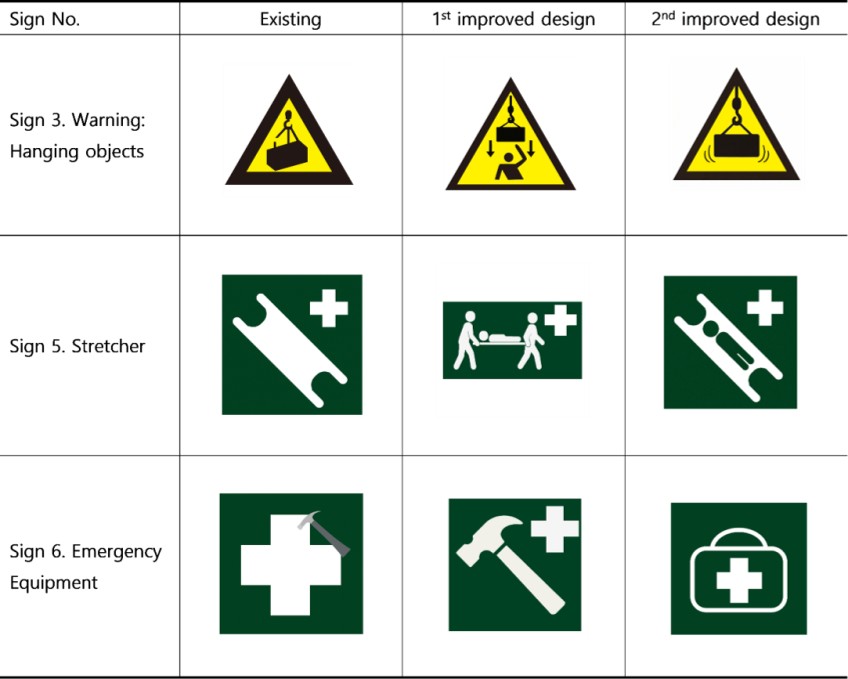
1차 개선 표지 중 대부분은 시인성(Visibility), 의미이해도(Comprehension), 확신도(Confidence), 의도부합성(Meaning congruence)을 유의하게 향상시켰으나, Sign 3(매달린 물체 경고, Warning: Hanging objects), 5(들것, Stretcher)와 6(비상용 기구, Emergency equipment)에서는 평가 항목에 따라 개선 효과가 미비하거나 반대 방향의 결과가 나타났다. 이에 따라 해당 표지들에 대해 의미이해도 응답을 분석하여 사용자가 위험을 인지하고 의미를 해석하는 과정에서 어떤 단서가 혼동을 유발하였는지 확인하였다. Sign 3은 낙하물 경고와의 구분이 어려웠으며, Sign 5는 기존 핵심 형태가 약화되면서 응급실이나 응급환자와 같은 다른 맥락으로 해석될 가능성이 있었다. 또한 Sign 6은 비상용 기구라는 상위 범주보다 특정 공구를 나타내는 표지로 인식되는 경향이 확인되었다. 따라서 2차 개선에서는 각 표지에서 의미 전달을 방해한 시각 요소를 최소화하고 핵심 개념을 직접적으로 강조할 수 있도록 재설계를 진행하였다. 이러한 설계 전략은 C-HIP (Communication-Human Information Processing) 모형의 정보 흐름 구조에 근거하여, 주의 단계에서 의미 이해 단계로의 전이를 원활하게 하는 것을 목표로 하였다.
이러한 설계 전략에 따라 2차 개선 표지를 제작하였다. Sign 3(매달린 물체 경고, Warning: Hanging objects)은 사람의 형태와 낙하 화살표를 제거하여 시각적 분산을 줄였으며, 매달린 물체의 크기를 확대하고 흔들림 효과를 추가하여 매달린 상태를 더욱 직접적으로 표현하였다. Sign 5(들것, Stretcher)는 기존 표지의 형태를 유지하면서 들것의 의미를 강조하기 위해 사람의 형태를 추가하고 불필요한 요소는 제거하였다. Sign 6(비상용 기구, Emergency equipment)은 특정 공구로 해석될 가능성을 줄이기 위해 망치 형태를 제거하였으며, 비상 표시와 구급함 표시를 중앙에 배치하여 비상용 기구라는 상위 개념이 먼저 인식될 수 있도록 개선하였다(Figure 8).
4.3 Implications
본 연구의 시사점(Implications)은 다음과 같다. 첫째, 본 연구는 건설 현장의 외국인 근로자를 대상으로 시각 정보 중심 안전표지의 효과를 확인함으로써 기존의 언어 의존적 안전 정보 전달 방식의 한계를 보완할 수 있는 설계 방향을 제시하였다. 특히 개선 표지가 국적과 관계없이 시인성(Visibility), 의미이해도(Comprehension), 확신도(Confidence), 의도부합성(Meaning congruence)을 전반적으로 향상시킨 결과는 다국적 작업 환경에서 시각 중심 안전표지의 필요성을 뒷받침한다. 둘째, 본 연구는 단순히 국적 간 차이를 확인하는 데 그치지 않고, 실제 적용 가능한 개선 표지를 제안하고 그 효과를 함께 검증하였다. 다만 일부 표지에서는 시각적 강조가 반드시 정확한 의미 해석으로 이어지지 않았으므로, 향후에는 사용자 친숙도와 문화적 맥락을 함께 고려한 정교한 설계가 필요하다. 마지막으로, 본 연구는 근로자의 안전표지 인식을 정량적으로 분석함으로써, 현장에서 사용되는 안전표지의 개선과 안전교육 방향을 살펴보는 데 참고할 수 있는 결과를 제시하였다. 이는 안전표지가 단순한 안내 수단에 그치지 않고 작업자의 위험 인지와 안전 행동을 지원하는 수단으로 고려될 필요가 있음을 보여준다.
4.4 Limitation and future research ideas
본 연구는 다음과 같은 한계점을 지닌다. 첫째, 외국인의 국적 분포가 제한적이므로 문화권 차이를 일반화하기 어렵다. 후속 연구에서는 국적과 언어권을 다양화하고, 체류 기간, 한국어 능력에 대해 함께 분석할 필요가 있다. 둘째, 본 실험은 통제된 실험실 환경에서 수행되었으므로 실제 건설 현장에서 발생하는 시야각 변화, 조도 변동, 동시 과업 수행 등 핵심 맥락을 충분히 반영하지 못하였다. 따라서 다양한 현장 조건을 고려한 환경에서 안전표지가 실제로 어떻게 해석되는지를 측정할 필요가 있다. 셋째, 본 연구에서는 각 표지(sign)별 개선 효과를 독립적으로 평가하기 위해 개별적인 two-way ANOVA를 수행하였다. 이러한 접근은 각 표지별 특성을 구체적으로 확인할 수 있다는 장점이 있으나, 반복적인 통계 검정에 따른 한계가 있을 수 있다. 따라서 향후 연구에서는 보다 통합적인 분석 방법을 함께 고려할 필요가 있다. 넷째, Sign 3, 5, 6에 대해 2차 개선 표지를 도출했으나, 이에 대한 개선 전후 비교 실험이 수행되지 않았다. 후속 연구에서는 2차 개선 표지를 포함하여 이해도 기준을 충족하는지 확인해야 한다. 마지막으로, 분석 대상 표지 수가 제한적이므로 향후 연구에서는 더 다양한 표지로 확장하여 개선 표지 제작 및 효과 확인이 필요하다.
본 연구는 건설 현장에서 사용되는 기존 안전표지와 시각 정보 중심으로 개선된 안전표지를 비교하여 한국인과 외국인 근로자의 표지 인지 차이를 분석하고 개선 표지의 효과를 확인하고자 하였다. 한국인 15명과 외국인 15명을 대상으로 시인성(Visibility), 의미이해도(Comprehension), 확신도(Confidence), 의도부합성(Meaning congruence)을 평가하였으며, 분석 결과 대부분의 표지에서 개선 표지가 기존 표지보다 높은 점수를 보였다. 반면 일부 표지(Sign 3, 5, 6)에서는 시각적 개선이 의미이해도 향상으로 이어지지 않아 의미 전달의 한계가 확인되었다.
본 연구 결과는 시각 정보 중심의 안전표지 설계가 국적과 관계없이 건설 현장에서 효과적인 위험 정보 전달 수단이 될 수 있음을 보여준다. 동시에 일부 표지에서 나타난 결과는 단순한 시각적 강조만으로는 정확한 의미 전달이 보장되지 않으며, 핵심 개념과의 명확한 의미 연결과 사용자 친숙성을 고려한 설계가 필요함을 시사한다. 이러한 결과는 다국적 인력이 함께 작업하는 건설 현장에서 안전표지 설계 가이드라인을 마련하는 데 기초 자료로 활용될 수 있으며, 향후 연구에서는 본 연구에서 제안한 2차 개선 표지의 효과와 실제 건설 현장 환경에서의 적용 가능성을 검증할 필요가 있다.
References
1. Afzal, M. and Shafiq, M.T., Evaluating 4D-BIM and VR for Effective Safety Communication and Training: A Case Study of Multilingual Construction Job-Site Crew, Buildings, 11(8), 319, 2021. doi:10.3390/buildings11080319
Google Scholar
2. Chan, A.H.S., Han, S.H., Ng, A.W.Y. and Park, W., Hong Kong Chinese and Korean comprehension of American security safety symbols, International Journal of Industrial Ergonomics, 39(5), 835-850, 2009. doi:10.1016/j.ergon.2009.02.009
Google Scholar
3. Construction Workers Mutual Aid Association, Construction Site Report: Foreign Workers (Focused on Retirement Mutual Aid Contributions), Construction Workers Mutual Aid Association, 2025.
4. Enforcement Rule of the Occupational Safety and Health Act, Attached Table 6, The Korean Law Information Center, 2025.
5. Fang, Y., Ni, G., Gao, F., Zhang, Q., Niu, M. and Ding, Z., Influencing Mechanism of Safety Sign Features on Visual Attention of Construction Workers: A Study Based on Eye-Tracking Technology, Buildings, 12(11), 1883, 2022. doi:10.3390/buildings12111883
Google Scholar
6. Hasanzadeh, S., Dao, B., Esmaeili, B. and Dodd, M.D., Measuring the Impact of Working Memory Load on the Safety Performance of Construction Workers, Computing in Civil Engineering, 158-166, 2017. doi:10.1061/9780784480847.020
Google Scholar
7. Kim, J., Ishdorj, S., Jeon, J. and Kim, J., Identifying Vital Factors for Enhancing Safety Communication among Foreign Construction Field Workers, Buildings, 14(6), 1714, 2024. doi:10.3390/buildings14061714
Google Scholar
8. Kim, S., Jin, S. and Nam, Y., An Evaluation and Improvement of the Safety Signs for Increasing Recognition Rate, Journal of the Ergonomics Society of Korea, 39(2), 109-117, 2020. doi:10.5143/JESK.2020.39.2.109
Google Scholar
9. Korea Occupational Safety and Health Agency (KOSHA), Safety rules at a glance for foreign workers, KOSHA, 2024, https:// kosha.or.kr/notification/release/press-release?bbsId=B2025021400010&pstNo=202406241024229GQZLP (retrieved December 19, 2025).
10. Kwon, Y.H., Kwon, Y.B., Nwagbala, D.C. and Park, J.Y., The Cognitive Load Limits of Multiple Safety Signs, Buildings, 14(8), 2391, 2024. doi:10.3390/buildings14082391
Google Scholar
11. Lee, J.H. and Son, T.H., In-depth Analysis of Fatal Accidents in the Construction Industry based on CSI Data, Construction & Economy Research Institute of Korea, 2023.
12. Lee, J.S., Jeong, K., Jo, M., Park, J. and Lee, D., A Study on the Safety Management of Foreign Workers in Construction Site, Architecture Image Studies, 6(4), 95-100, 2025. doi:10.62754/ais.v6i4.402
Google Scholar
13. Lee, S.B., Yu, S.W. and Shin, D.I., A Study on the Improvement of Safety Education of Foreign Workers at Construction Sites, Journal of Standards, Certification and Safety, 11(2), 103-113, 2021. doi:10.34139/JSCS.2021.11.2.103
Google Scholar
14. Lee, Y.W., Analysis of work-related accident status among foreign workers, Statistics Brief, Migration Research and Training Centre, 2025.
15. Liu, M., Liao, P.C., Wang, X.Y., Li, S. and Rau, P.L.P., Influence of semantic cues on hazard-inspection performance: A case in construction safety, International Journal of Occupational Safety and Ergonomics, 27(1), 14-28, 2021. doi:10.1080/ 10803548.2018.1541648
Google Scholar
16. Maxfield, J.T. and Zelinsky, G.J., Searching Through the Hierarchy: How Level of Target Categorization Affects Visual Search, Visual Cognition, 20(10), 1153-1163, 2012. doi:10.1080/13506285.2012.735718
Google Scholar
17. Min, S.N., Research on the Application of Safety Signs using Optical Illusions in Industrial Sites - Focusing on Fall and Collision Prevention, Journal of the Ergonomics Society of Korea, 43(1), 27-40, 2024. doi:10.5143/JESK.2024.43.1.27
Google Scholar
18. Min, S.N., Kim, S.H., Kang, C.K., Im, J.N., Kim, D.Y. and Kim, D.J., Comprehensibility of Occupational Safety Pictograms for Foreign Workers: An ISO 9186-1-Based, Journal of the Ergonomics Society of Korea, 45(1), 13-26, 2026.
19. Ministry of Employment and Labor, (Explanation) Regarding the News1 article, "Foreign workers neglected in construction safety education... ‘Even without knowing Korean, just endure 4 hours and it is OK’", Ministry of Employment and Labor, 2024, https://www.moel.go.kr/news/enews/explain/enewsView.do?news_seq=16678 (retrieved December 19, 2025).
20. Occupational Safety and Health Act, Article 37(1), The Korean Law Information Center, 2024.
21. Occupational Safety and Health Act, Article 40, The Korean Law Information Center, 2022.
22. Rules on Occupational Safety and Health Standards, Article 8 (Illuminance), The Korean Law Information Center, 2025.
23. Weng, Y. and Ren, Q., Visual communication design in laboratory safety: effectiveness and optimization of warning signs, Scientific Reports, 15, 43040, 2025. doi:10.1038/s41598-025-26061-6
Google Scholar
24. Wogalter, M.S., Communication-human information processing (C-HIP) model. In M.S. Wogalter (Ed), Forensic Human Factors and Ergonomics: Case Studies and Analyses, CRC Press, Boca Raton, 34-46, 2018.
Google Scholar
25. Yoo, H.Y., Oh, B.K. and Hwang, S.H., Analysis of Application of Pictograms to Public Buildings and Design Improvement, Archives of Design Research, 36(4), 311-331, 2023.
PIDS App ServiceClick here!
